Flushed Object Disappeared But Your Toilet Drains Slowly — Here’s Why and What to Do Next
If a foreign object went down the toilet and vanished but the bowl now drains slower than normal, the object is almost certainly still inside your plumbing. It did not dissolve or wash away. In most cases, it is stuck in the curved internal passage of the toilet itself, creating a partial blockage that allows some water to squeeze past but not enough to drain at full speed.
This is one of the most common drain problems homeowners deal with, and it makes sense that it causes confusion. The object is gone from sight, the toilet technically still flushes, and everything looks fine on the surface. But that slow drain is telling you something important: the problem is not resolved, and it is very likely to get worse if nothing changes. This article explains exactly what is happening, what you can safely try on your own, and how to tell when it is time to call a licensed drain cleaning professional.
What Is Actually Happening Inside Your Toilet Right Now
The Trapway — Where Foreign Objects Get Stuck
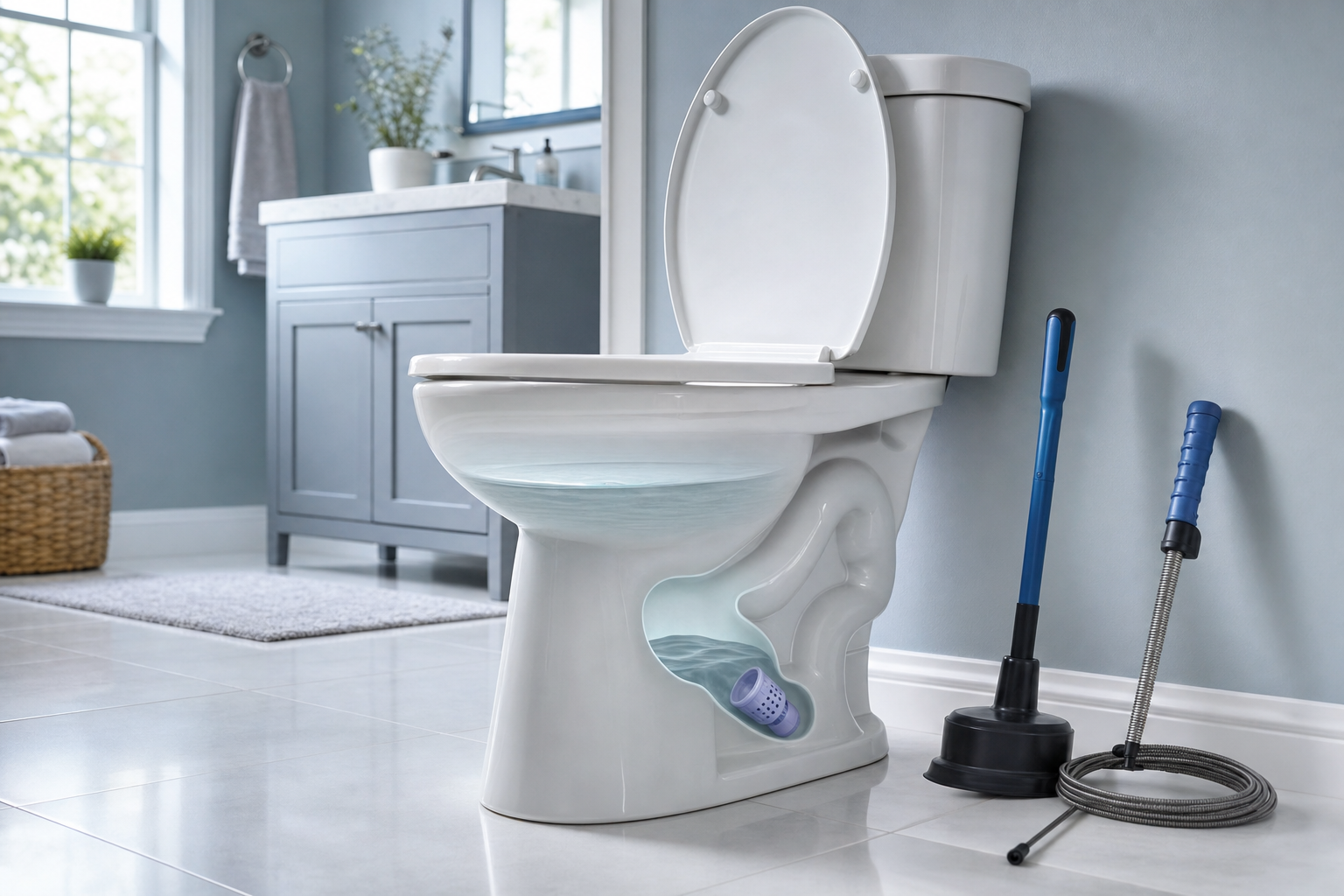
Every toilet has an internal curved passage built into the porcelain called the trapway. This is the S-shaped or P-shaped channel that connects the bowl to the drainpipe in your floor. Its job is to hold a small amount of standing water that seals out sewer gases while letting waste and water pass through when you flush.
When a solid object gets flushed — a small toy, a bottle cap, a washcloth, a hygiene product — it often gets pulled out of the visible bowl but wedges itself somewhere inside this curved passage. The trapway narrows significantly as it bends, and objects that are rigid, oddly shaped, or slightly too large to pass through smoothly end up lodged in that curve.
From your perspective, the object disappeared. From the toilet’s perspective, it is stuck about six to twelve inches past the drain opening, jammed in a spot you cannot see or reach with your hand.
Why Water Still Drains, But Barely
A foreign object lodged in the trapway usually does not seal off the passage completely. Water can still seep around it, especially if the object is irregularly shaped or small enough to leave gaps. That is why the toilet still flushes — it just does so slowly, with the bowl filling higher than usual before eventually draining down.
This is what is called a partial blockage. It is different from a full blockage, where nothing moves at all and the bowl fills up and may overflow. A partial blockage can feel manageable because the toilet still works, but it is not a stable situation.
Why This Gets Worse Over Time, Not Better
Here is the part many homeowners do not realize: that lodged object becomes a trap for everything else that passes through. Toilet paper, waste, and other debris start catching on the stuck object and building up around it. What starts as a slow drain gradually becomes a slower drain, and eventually can become a full blockage.
The longer the object sits there, the more material accumulates around it, and the harder it becomes to clear — even for a professional. Addressing the problem while it is still a partial blockage is almost always simpler and less disruptive than waiting until the toilet stops draining entirely.
How to Tell Where the Object Is
Knowing approximately where the object ended up helps you decide what to do next. There are three possibilities, and each one has different signs.
Signs the Object Is Still in the Toilet Trap
This is the most common scenario and the one you should assume unless you see evidence otherwise.
- Only the one toilet is draining slowly — all other fixtures in the house work fine.
- The bowl fills higher than normal during a flush, then drains down gradually.
- You may hear a faint gurgling sound from the toilet itself as water works its way past the obstruction.
- The slow drain started immediately or shortly after the object was flushed.
Signs the Object May Have Moved Into the Drain Line
If the object was small enough or smooth enough to clear the trapway but got stuck farther downstream, the signs are different.
- More than one fixture is affected — for example, the toilet is slow and a nearby shower or sink is backing up.
- You notice water gurgling in another drain when you flush the toilet.
- There is a foul smell coming from drains that normally do not have one.
- Water backs up into a bathtub or shower on the same floor when the toilet is flushed.
If you see any of these signs, the situation has likely moved beyond the toilet itself and into the branch drain or possibly the main sewer line. This is a more involved problem that typically requires professional drain cleaning equipment to resolve.
Could It Have Passed Through Completely?
It is possible but less likely, especially with rigid objects like toys or plastic items. If the toilet is draining at full normal speed and there are no symptoms anywhere in the house, the object may have made it all the way through. However, if you are reading this article because the toilet is still draining slowly, the object is almost certainly still in the system somewhere.
What Not to Do — Read This Before Trying Anything
Before you attempt any fix, there are a few actions that can make this situation significantly worse.
Do not keep flushing repeatedly. Each flush pushes more water and pressure against the lodged object. This can force it deeper into the drain line, where it becomes much harder to retrieve. It also pushes more debris onto the obstruction, building up the clog. If the partial blockage becomes a full blockage during one of these flushes, the bowl can overflow.
Do not pour chemical drain cleaners into the toilet. Chemical cleaners are designed to dissolve organic buildup like hair and soap residue. They cannot dissolve a plastic toy, a bottle cap, a washcloth, or most other solid foreign objects. Pouring chemicals into a toilet with a foreign object lodged in the trap accomplishes nothing useful and can make the situation more unpleasant to deal with when the toilet eventually needs to be worked on.
Do not ignore the slow drain and keep using the toilet normally. This is tempting because it still works, technically. But every use adds material to the partial blockage. What could be a straightforward clearing today may become a much more involved problem in a few days or weeks.
DIY Steps to Try, in Order
If the object appears to be stuck in the toilet trap — meaning only one toilet is affected and no other fixtures are involved — there are a few things worth trying before calling for professional help. Work through these in order, and if one does not work after a reasonable attempt, move to the next rather than forcing it.
Step 1: Turn Off the Water Supply and Check for Visibility
Before you do anything else, turn off the water supply valve behind the toilet. This is the small oval-shaped valve near the floor where the supply line connects to the tank. Turning it clockwise shuts off the water flow and prevents the tank from refilling, which reduces the risk of overflow if something goes wrong during your attempt.
Next, look into the drain opening at the bottom of the bowl. Use a flashlight. In some cases, especially with larger objects, you may be able to see part of the item just inside the opening. If you can see it and reach it, put on rubber gloves and try pulling it out by hand. This is the simplest resolution and works more often than people expect.
Step 2: Use a Flange Plunger the Right Way
If the object is not visible, the next step is plunging — but the type of plunger matters.
A flange plunger is the kind with a soft rubber extension that folds out from the bottom of the cup. That extension is designed to fit into the toilet’s drain opening and create a proper seal. A standard flat-cup plunger, the kind most people keep under the sink, will not seal well against a toilet bowl and will not generate enough pressure to be effective.
Place the flange plunger into the bowl so the rubber extension seats into the drain opening. Push down gently to form a seal, then pull up sharply. The goal is to create suction that pulls the object back toward the bowl rather than pushing it deeper. Repeat this motion several times. If the object dislodges, you may see it appear in the bowl or feel the drain suddenly clear as water rushes through.
If plunging does not produce a result after two or three solid attempts, stop. Continuing to force it is unlikely to help and may push the object further into the trapway or beyond.
Step 3: Try a Toilet Auger
A toilet auger, sometimes called a closet auger, is a specialized tool built exclusively for use in toilets. Its design includes a flexible cable enclosed within a curved metal sleeve, which shields the porcelain bowl from contact damage during use. This makes it a very different tool from a standard drain snake, which is not designed for toilet bowls and can leave marks on the surface.
Feed the auger into the drain opening and turn the handle gradually to work the cable through the trapway. When the cable contacts the blockage, you will typically notice increased resistance. Depending on the nature of the obstruction, the auger may be able to snag the object and draw it back into the bowl, or it may break apart softer material enough to allow normal drainage to resume.
A few honest notes about using a toilet auger:
- Take your time, especially if you have not used one before. Applying too much force can drive the object further in or cause bowl damage if the tool is not properly positioned.
- Rigid objects like hard plastic toys or metal items may not budge with an auger. The cable may just push past them without grabbing hold.
- If you feel solid resistance that does not move after careful attempts, that is a reasonable point to stop.
Does the Type of Object Matter?
Yes, significantly. Different objects create different kinds of blockages, and they respond differently to DIY efforts.
| Object Type | Examples | How It Behaves in the Trap | DIY Likelihood |
|---|---|---|---|
| Rigid and solid | Small toys, plastic caps, toothbrushes, action figures | Wedges firmly in the trapway curve; does not compress or break apart | Lower — often requires professional drain clearing |
| Soft and flexible | Washcloths, small towels, socks, fabric items | Compresses partially but absorbs water and expands, blocking more of the passage over time | Moderate — a toilet auger can sometimes hook and pull fabric back out |
| Hygiene products | Wipes, sanitary products, cotton swabs, dental floss | May pass the trap initially but accumulate in the drain line; dental floss and wipes catch and tangle | Moderate for the trap itself, but may indicate a downstream issue |
If a rigid object like a hard plastic toy caused the slow drain, plunging and augering are less likely to resolve it. These objects often need to be physically retrieved, and a professional drain cleaning technician will have the equipment to address the blockage properly.
When It Is Time to Call a Professional
There is a clear line between a situation you can handle yourself and one that needs professional drain cleaning equipment. Here is how to recognize it.
Call a licensed drain cleaning professional if:
- Plunging and augering did not clear the drain after reasonable attempts.
- You can feel the object with the auger but cannot dislodge it or pull it back.
- The slow drain is getting worse or has become a full blockage.
- More than one fixture is draining slowly or backing up.
- Water is backing up into a shower, tub, or sink when the toilet is flushed.
- You notice a sewage smell coming from drains.
- You are not comfortable using a toilet auger or attempting any DIY steps.
None of these situations means you did something wrong. Foreign objects in toilets are one of the most common drain problems in homes, especially homes with young children. Calling for help at this point is the practical next step, not a last resort.
What a Drain Cleaning Visit Looks Like for This Problem
Many homeowners hesitate to call because they are not sure what the visit involves. Here is what typically happens when a drain cleaning professional handles a foreign-object clog:
The technician assesses the toilet and the drain system to determine where the blockage is. If the object is lodged in the trapway, professional-grade drain cleaning equipment can often reach and address the obstruction. Depending on where the object is located and how it is wedged, the scope of the work will vary. In some cases, accessing the object may require work beyond drain cleaning — a drain technician can assess what is needed and advise you on next steps.
The goal is to clear the blockage completely, confirm the drain is flowing at normal speed, and make sure the object has not caused secondary buildup further down the line.
Why Waiting Usually Costs More Than Acting Now
A partial blockage that gets addressed promptly is typically a straightforward drain cleaning job. A partial blockage that is left alone for days or weeks can turn into a full blockage, which may involve more buildup, more time to clear, and in some cases, the object being pushed deep enough into the drain line that the scope of work increases.
If the object moves past the toilet and into the branch drain or main sewer line, what started as a single-toilet issue can affect multiple fixtures in the house. Addressing the problem while it is still isolated to one toilet is almost always the simpler, faster resolution.
Just Drains Helps Central New Jersey Homeowners With Exactly This Kind of Problem
If you have tried plunging and augering and the toilet is still draining slowly — or if the problem has spread to other fixtures — Just Drains can help. We are a licensed drain cleaning and sewer cleaning company serving homeowners across Central New Jersey, the Jersey Shore, and surrounding areas, including Monmouth, Mercer, Union, Morris, and Ocean Counties.
Drain cleaning starts at $63, and we offer service within 60 minutes. We handle clogged toilets, slow drains, backed-up sewer lines, and mainline blockages — the kinds of problems that a plunger cannot fix and that should not wait. Pricing depends on the specifics of your situation, and our team can discuss the details when you call.
There is no judgment about what got flushed or how it happened. This is one of the most common calls we get, and getting the right equipment to the problem quickly is what makes the difference.
Call Now: (732) 279-2427
Frequently Asked Questions
Can a flushed object cause problems later even if the toilet seems fine now?
Yes. If the object made it past the toilet trap but is lodged somewhere in the drain line, it may not cause symptoms immediately. Over time, waste and debris can accumulate around the object and create a blockage that affects multiple fixtures. If you know a solid object was flushed, monitoring for slow drainage, gurgling, or unusual smells in the days afterward is a practical precaution.
Will a plunger push the object deeper and make things worse?
It can, depending on the technique. A forceful downward push can drive the object further into the trapway or into the drain line. That is why the recommended approach is to focus on the pull stroke — seat the plunger, then pull up sharply to create suction that draws the object back toward the bowl. If plunging does not produce a result after a few attempts, stop rather than continuing to force it.
Can chemical drain cleaners dissolve a toy or plastic object?
No. Chemical drain cleaners are formulated to break down organic material like hair, grease, and soap buildup. They have no meaningful effect on plastic, metal, fabric, or most other solid objects that get accidentally flushed. Using them in this situation does not help and can make the clog more unpleasant to deal with when it is eventually cleared.
How do I know if the object is still in the toilet or has moved into the sewer line?
The main indicator is whether other fixtures are affected. If only the one toilet is draining slowly and every other drain in the house works normally, the object is most likely still in the toilet’s trapway. If you notice slow drainage, gurgling, or backup in nearby sinks, showers, or tubs — especially when the toilet is flushed — the object may have moved into the shared drain line or main sewer line.
Is it safe to keep using the toilet while it drains slowly?
Limited use may be tolerable in the short term if the drain is only slightly slow, but every flush adds material around the lodged object and increases the risk of a full blockage. If the bowl fills noticeably high before draining, or if drainage is getting slower with each use, stop using that toilet and call for help. Using a different bathroom in the house while the affected toilet is out of service is the safest approach.
Do I need to replace the toilet if something is stuck inside it?
In most cases, no. A foreign object stuck in the trapway can often be addressed with professional drain cleaning equipment. Whether additional work is needed depends on where the object is lodged and how it is positioned. A drain cleaning professional can assess the situation and let you know what is involved.
How much does it typically cost to have a professional clear a foreign object from a toilet?
Costs vary depending on where the object is lodged and how much buildup has accumulated around it. At Just Drains, drain cleaning starts at $63. The exact scope and pricing depend on the specific situation — call (732) 279-2427 to discuss what you are dealing with and get a clearer picture of what is involved.
The Bottom Line
A foreign object that disappears after flushing did not go away. It is almost certainly stuck in the toilet’s internal trapway, and the slow drain you are noticing is the result of water squeezing past a partial blockage. This situation does not fix itself, and it gradually worsens as more material accumulates around the stuck object.
Try a flange plunger with an upward pull technique first. If that does not work, a toilet auger is the next reasonable step. If neither clears the drain — or if you notice the problem spreading to other fixtures — it is time to call a professional.
Just Drains provides licensed drain cleaning and sewer line clearing for homeowners across Central New Jersey, including Monmouth, Ocean, Mercer, Union, and Morris Counties. Drain cleaning starts at $63, and we offer service within 60 minutes.
Ready to get the drain cleared? Call Just Drains now: (732) 279-2427