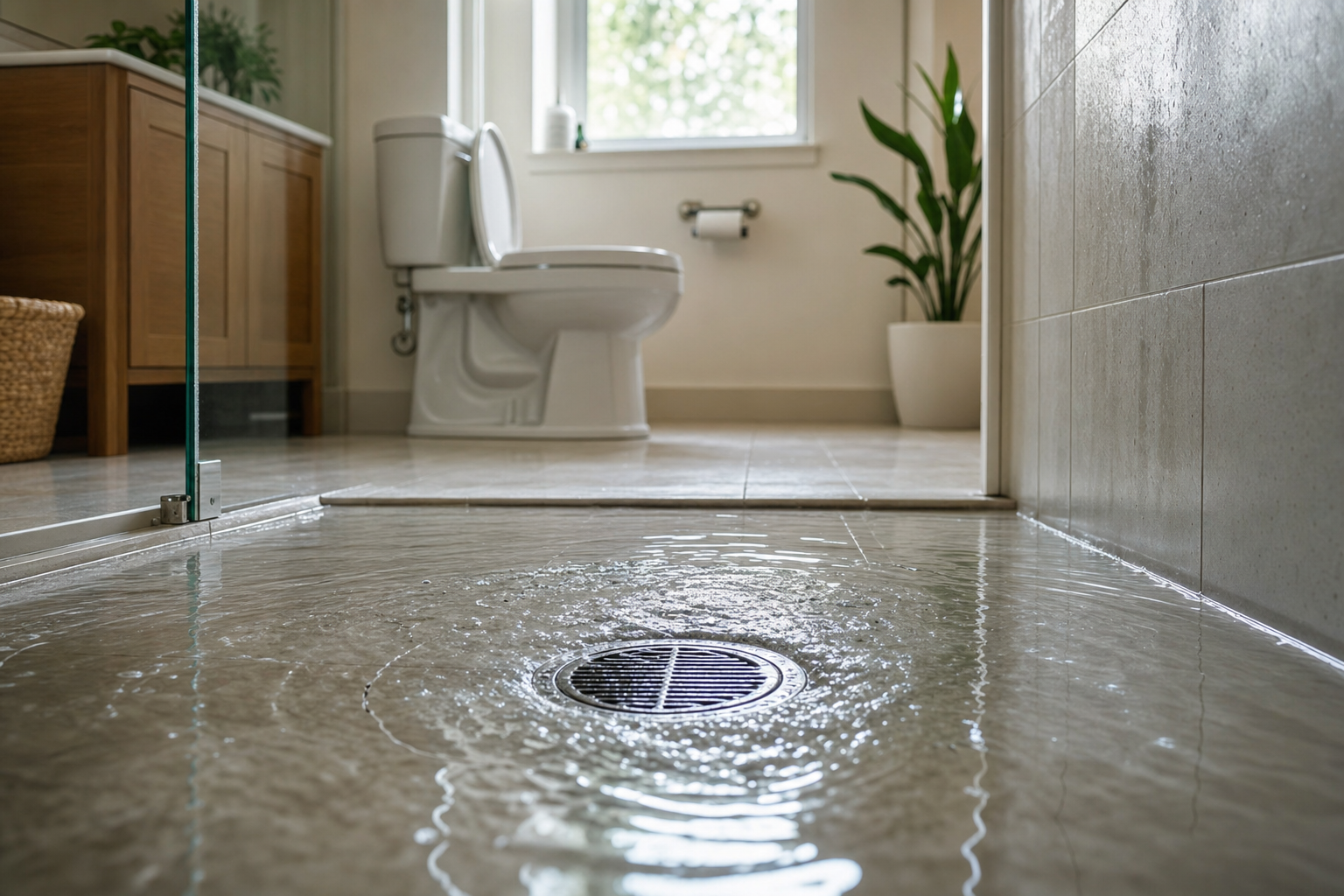
Why Does the Shower Drain Back Up When You Flush the Toilet?
When your toilet flushes and water rises up through the shower drain, it means there is a blockage somewhere downstream in a drain line that both fixtures share. The toilet sends a large volume of water into the pipe all at once, and when that water hits a clog it cannot pass through, it gets pushed back up through the nearest open, low-sitting drain — your shower.
This is not a shower problem. It is a sign that something is partially or fully blocking a shared drain line or your home’s main sewer line. It affects homeowners across Central New Jersey regularly, especially in older homes with mature landscaping and aging pipe systems. The good news: this is exactly the kind of problem a licensed drain and sewer cleaning company can clear.
How Your Bathroom Drains Are Connected
Your toilet, shower, and bathroom sink do not each have their own separate pipe running out to the street. Instead, they all connect to a shared branch line inside your walls or beneath your floor. That branch line feeds into your home’s main sewer line, which is the single pipe that carries all wastewater from your house out to the municipal sewer or your septic system.
When everything is clear, water flows through this system by gravity without any issue. But when a blockage forms anywhere downstream of where the toilet and shower connect, the water from a toilet flush has nowhere to go forward. It reverses direction and comes up through the lowest available opening.
Your shower drain sits lower than your toilet bowl rim. It also has no water trap tall enough to resist the pressure of a full toilet flush pushing backward. That is why the shower becomes the relief point — not the sink, not the toilet itself. The shower drain is simply the easiest exit for water that cannot move forward through the pipe.
What Causes the Blockage
Several things can create the kind of restriction that causes this cross-fixture backup. What they all have in common is that the clog is not at an individual fixture. It is further down the line, in a section of pipe that serves more than one drain.
Tree Root Intrusion
Tree roots naturally seek out moisture. In older neighborhoods throughout Monmouth, Ocean, and Morris Counties, mature trees send roots toward sewer pipes, entering through small cracks or joints. Once inside, roots grow and expand, catching debris and gradually narrowing the pipe. A toilet flush creates a sudden surge of water that the narrowed pipe cannot handle, and the overflow pushes back up through the shower.
Non-Flushable Items
Products labeled “flushable” — including wipes, feminine hygiene products, and thick paper towels — do not break down the way toilet paper does. They snag on rough spots inside the pipe, accumulate over time, and create a mass that partially blocks the shared line. Each toilet flush forces water against that mass, and some of it redirects upward.
Grease, Soap Scum, and Mineral Buildup
Grease from kitchen drains, soap residue from showers, and mineral scale from hard water all coat the inside of pipes gradually. Over months and years, that coating thickens and reduces the pipe’s internal diameter. The pipe may still handle normal flow from a single fixture, but the high-volume surge from a toilet flush can overwhelm the narrowed section.
Hair and Organic Debris
Hair that washes into the shower drain can travel further down the branch line than most homeowners expect. When hair combines with soap scum or grease deeper in the pipe, it forms a dense mat that resists water flow. This kind of buildup tends to worsen slowly, which is why many homeowners first notice the shower backing up only occasionally before it becomes a regular problem.
Aging or Deteriorating Pipes
Many homes in Central New Jersey, particularly near the Jersey Shore and in older suburban developments, still have original cast iron or clay tile drain pipes. These materials corrode, crack, and develop rough interior surfaces over decades. That roughness catches debris more easily, and cracks allow soil or roots to enter. The pipe’s capacity decreases over time until a toilet flush is enough to trigger a backup.
Full or Overloaded Septic Tank
If your home uses a septic system rather than a municipal sewer connection, a tank that has not been pumped in several years can cause wastewater to back up into the house. The symptoms often appear first at the lowest drain — your shower — when higher-volume fixtures like the toilet are used.
How to Tell If It Is a Branch Line Clog or a Main Sewer Line Problem
This distinction matters because it affects how urgent the situation is and what kind of service you need. Here is a practical way to assess what you are seeing:
- If only the shower backs up when you flush the toilet, and all other drains in the house work normally, the blockage is most likely in the shared branch line that connects your bathroom fixtures. The clog is downstream of where the toilet and shower pipes meet, but upstream of the main sewer line.
- If multiple drains are slow, gurgling, or backing up — for example, the kitchen sink gurgles when you flush, or the basement floor drain has standing water — the blockage is likely in the main sewer line. This is a more serious situation because it affects the entire house.
- If you can locate your sewer cleanout (a capped pipe, usually white or black PVC, often found in the basement, crawl space, or outside near the foundation), do not attempt to open it yourself. Standing water or pressure inside a cleanout indicates a potential main sewer line blockage and should be assessed by a professional to avoid exposure to sewage or sewer gas.
Both situations require professional drain or sewer line clearing. A main sewer line problem is more urgent because continued use of any water in the house can cause sewage to back up into your lowest drains or fixtures.
What to Do Right Now
- Stop using water in the house. Every flush, every faucet, and every appliance that sends water down a drain adds to the pressure behind the blockage. The less water you run, the less likely you are to cause a full sewage backup.
- Check other drains. Walk through the house and look for slow drainage, gurgling sounds, or water pooling around floor drains. This helps you assess whether the problem is isolated to one bathroom or affecting the whole house.
- Do not pour chemical drain cleaners into the drain. Store-bought drain cleaners cannot reach a blockage that is deep in a shared branch line or main sewer pipe. They are designed for surface-level clogs at individual fixtures. Using them on a deeper blockage wastes money and can damage pipes, especially older cast iron or clay lines.
- Do not keep flushing the toilet to see if the problem clears. Each flush pushes more water into a system that cannot move it forward. This can escalate a partial backup into a full sewage overflow.
- If sewage or dark, foul-smelling water is visibly rising into your shower or tub, keep everyone away from the area. Backed-up sewer water may contain harmful bacteria. Keep children and pets out of the affected space and call a drain and sewer cleaning professional promptly.
Why DIY Methods Usually Do Not Work for This Problem
When the shower backs up only during a toilet flush, the blockage is not at the shower drain opening. It is deeper in the pipe system. That changes what tools can reach it.
- A plunger can sometimes create enough pressure to push a minor, partial clog past the connection point. But if the blockage is firm or located further down the shared line, plunging the toilet provides temporary relief at best. The backup returns with the next flush.
- A homeowner-grade drain snake is typically 15 to 25 feet long. Many shared branch lines and main sewer lines extend 50 feet or more to the street. A short snake may not reach the blockage.
- Chemical drain cleaners flow with gravity and pool at the nearest trap or low point. They rarely reach a clog that sits 20, 40, or 60 feet down a sewer line. Meanwhile, the chemicals can sit in your pipes and corrode joints and pipe walls over time.
If you have tried a plunger and the backup keeps happening, or if multiple drains are affected, it is time to call a licensed drain and sewer cleaning professional. This is not a problem that improves on its own — partial blockages tend to worsen with continued use.
When to Call a Drain Cleaning Professional
Call for professional help if any of the following apply:
- The shower backs up every time you flush, not just once
- More than one drain in the house is slow, gurgling, or backing up
- You see or smell sewage near any drain or fixture
- A plunger gives only temporary relief and the backup returns
- Water is pooling around a basement floor drain
A drain and sewer cleaning professional uses commercial-grade equipment that reaches deep into the shared branch line or main sewer pipe to break apart and clear the blockage. Once the line is clear, flow is restored to the fixtures in the house.
How Just Drains Can Help
Just Drains is a licensed drain and sewer cleaning company serving homeowners across Central New Jersey, the Jersey Shore, and surrounding areas, including Monmouth, Mercer, Union, Morris, and Ocean Counties. We specialize in exactly this kind of problem: backed-up drains, clogged sewer lines, and cross-fixture backups that plungers cannot fix.
We offer drain cleaning starting at $63. If your shower is backing up when you flush, or if you are dealing with slow drains, recurring clogs, or a backed-up sewer line, give us a call and we will work to get to you as quickly as possible.
Call Now: (732) 279-2427
What to Do After the Blockage Is Cleared
Once a professional has cleared the line, the affected area where the backup occurred should be cleaned and disinfected. If any sewage-contaminated water reached surfaces in your shower or tub, use protective gloves and avoid skin contact with the water or residue. A household disinfectant can be used on hard surfaces for minor exposure, but if a significant amount of sewage entered your home, consider consulting a professional remediation service rather than attempting cleanup on your own. Run fresh water through all drains in the house to confirm everything is flowing normally.
To reduce the chance of a future blockage:
- Flush only toilet paper — avoid flushing wipes, paper towels, or feminine hygiene products
- Use a drain screen in the shower to catch hair before it enters the pipe
- Avoid pouring grease or cooking oil down kitchen drains
- If your home has older pipes or large trees near the sewer line, consider periodic professional drain cleaning to keep the line clear before a clog develops
Frequently Asked Questions
Is the water coming up in my shower dangerous?
It can be. If the blockage is in the main sewer line, the water backing up through the shower may contain raw sewage and bacteria. Avoid direct contact, keep children and pets away from the area, and have the surface properly disinfected after the blockage is cleared. If sewage exposure is significant, professional remediation may be appropriate.
Is this an emergency?
If sewage is actively rising into your home, treat it as urgent and call a drain and sewer cleaning professional right away. If you noticed the backup once and it drained slowly on its own, it is less immediately critical — but it should still be addressed promptly before the partial blockage becomes a full one.
Can a plunger fix this?
A plunger may temporarily relieve a minor partial clog near the connection point. But if the blockage is further down the shared branch line or in the main sewer pipe, plunging will not reach it. If the backup returns after plunging, the clog needs professional clearing.
Does this mean my sewer line is broken?
Not necessarily. In many cases, this symptom is caused by a blockage — tree roots, buildup, or debris — that can be cleared with professional drain or sewer line cleaning. A blockage does not automatically mean the pipe itself is damaged or needs replacement.
Will this problem come back?
It depends on the cause. If the blockage was from flushed items or buildup, changing habits and occasional preventive cleaning can help keep the line clear. If tree roots are involved, roots can regrow into the pipe over time, and periodic professional cleaning may be needed to reduce the chance of recurrence.
What does the gurgling sound in my drains mean?
Gurgling happens when air gets displaced in the drain system. When a blockage prevents water from flowing freely, air trapped behind the clog gets pushed through the water sitting in nearby drain traps. If you hear gurgling from the shower, sink, or toilet — especially when another fixture is in use — it is a strong signal that a shared line or main sewer line has a restriction.
How much does it cost to clear a clogged drain line?
Costs vary depending on the location and severity of the blockage. Just Drains offers drain cleaning starting at $63 for homeowners in Central New Jersey and the surrounding area. For a specific assessment, the fastest step is to call and describe what you are experiencing.
Get Your Drain Cleared Fast
A shower that backs up when you flush is your plumbing system telling you where the blockage is. The longer the clog stays in the line, the more likely it is to worsen and cause a larger backup.
Just Drains helps homeowners across Central New Jersey clear clogged drains and backed-up sewer lines quickly and affordably. Drain cleaning starts at $63. Call us to find out how soon we can get to you.
Call Now: (732) 279-2427