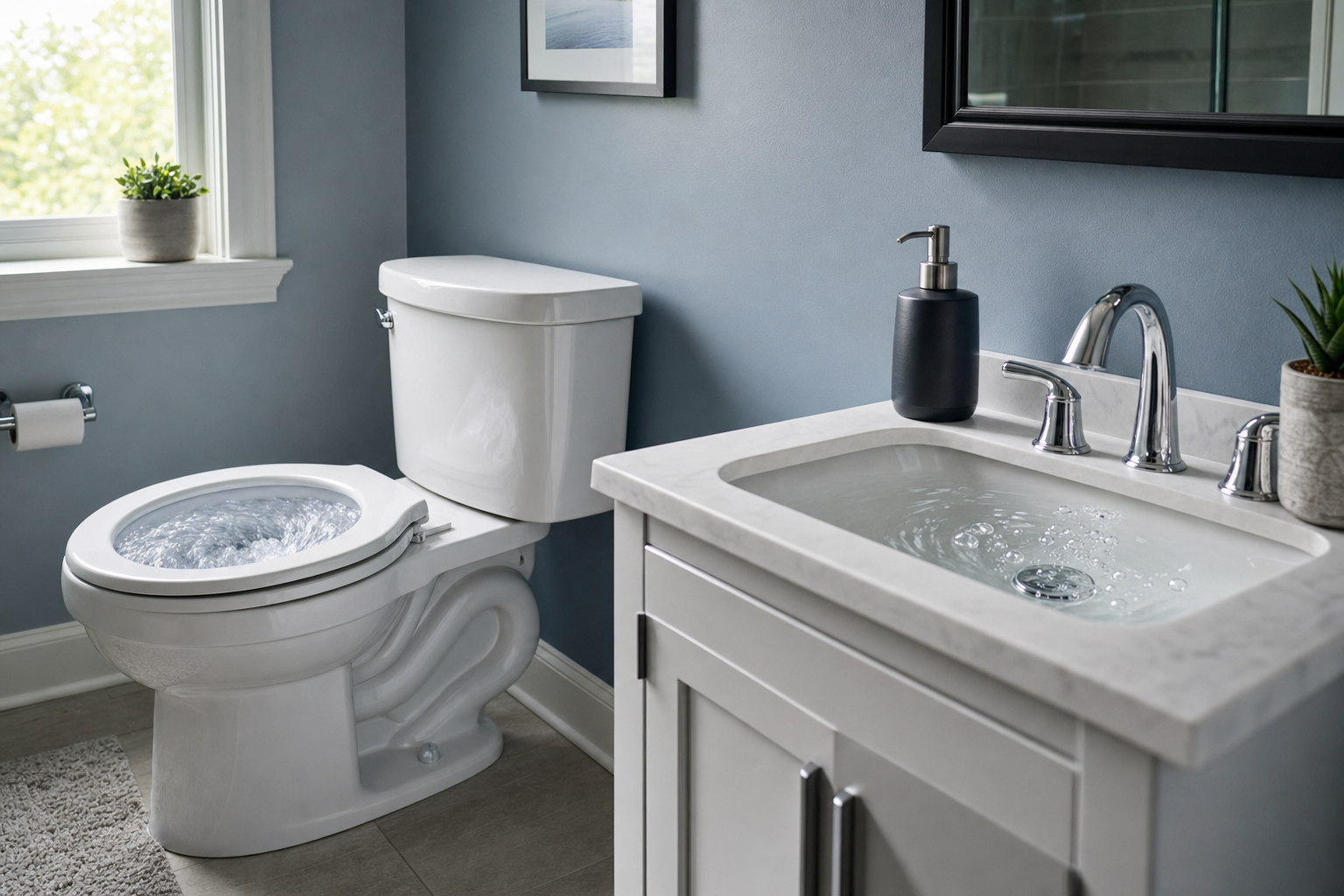
Why Do My Drains Gurgle When I Flush the Toilet?
Gurgling drains after you flush the toilet means air is being forced through the water sitting in your drain traps — usually because something is blocking the normal airflow inside your plumbing system. The sound you hear is air bubbling up through the small pool of water that sits in the curved pipe beneath your sink, tub, or shower floor drain.
The three most common reasons this happens are a blocked vent pipe on your roof, a partial clog building up in one of your drain lines, or a developing blockage in your main sewer line. Some of these you can troubleshoot yourself. Others need professional drain cleaning or sewer line clearing to resolve before the problem gets worse.
This guide will help you understand what is actually happening inside your pipes, figure out which type of problem you are most likely dealing with, and know when it is time to call for help.
Why Flushing Creates That Gurgling Sound
Your home’s plumbing is not just drain pipes and water supply lines. There is a third system most homeowners never think about: the vent system.
Every drain in your house connects to a pipe that runs up through the roof called a vent stack. This pipe does not carry water. Its purpose is to keep air moving freely through your drain system so wastewater can flow through the pipes without disruption. Think of it like the small hole in the lid of a travel coffee mug — without that air hole, the liquid inside cannot pour out evenly.
When you flush a toilet, a large volume of water rushes through the drain pipes all at once. That moving water pushes air ahead of it and creates a brief drop in air pressure behind it. Under normal conditions, the vent stack lets fresh air flow in from the roof to balance that pressure change, and everything drains quietly.
But when something blocks that airflow — whether it is a clogged vent, a partial blockage in a drain line, or a developing problem in your main sewer line — the air has nowhere to go. Instead, it gets pulled through the water sitting in the nearest P-trap. That is the U-shaped pipe under your sink or built into your tub drain. When air forces its way through that standing water, you hear the gurgling.
The gurgling itself is not dangerous. But it is your plumbing telling you that airflow is restricted somewhere in the system — and that usually means something needs attention before it becomes a bigger problem.
The Three Most Common Causes of Gurgling Drains
A Blocked or Restricted Vent Pipe
The vent stack exits through your roof, which means it is exposed to everything the weather and the outdoors can throw at it. Leaves, bird nests, small animal debris, and general buildup can partially or fully block the opening over time.
This is especially relevant for homeowners in Central New Jersey and the Jersey Shore area during colder months. When temperatures drop, moisture inside the vent pipe can freeze near the top and create an ice cap that restricts airflow. You may notice your drains gurgle more during winter and less during warmer seasons — that pattern often points to a vent issue.
What you would typically notice: Multiple fixtures gurgle when you flush, not just one. You might also notice slow draining in sinks or tubs that are not themselves clogged, or a faint sewer smell near drains, especially in bathrooms that do not get used often.
A vent blockage is not something drain cleaning addresses directly, since the vent pipe carries air rather than water. If your symptoms point to a vent issue, it is worth calling a professional to assess it — roof vents are not safe or practical for most homeowners to inspect or clear on their own. That said, many homeowners who assume they have a vent problem actually have a partial drain clog or a developing sewer line issue that professional drain cleaning can clear.
A Partial Clog in a Branch Drain Line
A branch drain line is the pipe that connects an individual fixture — like a bathroom sink, a tub, or a toilet — to the larger drain system in your house. Over time, these lines can develop partial blockages from hair, soap residue, grease, mineral buildup, or objects that were accidentally flushed or washed down the drain.
A partial clog does not stop water flow entirely. Instead, it narrows the pipe enough to disrupt the normal air balance when a large volume of water moves through the system. Flushing a toilet sends the biggest single rush of water through the pipes, which is why the gurgling often shows up in a nearby sink or tub right after you flush.
What you would typically notice: Only one fixture gurgles, and it is usually close to the toilet you just flushed — like the bathroom sink or the tub in the same room. That fixture may also drain a little slower than it used to, even if it has not fully backed up yet.
This type of problem is one of the most common situations that drain cleaning resolves. A licensed drain cleaning professional can clear the partial blockage and restore normal airflow through that section of pipe.
A Developing Blockage in the Main Sewer Line
Your main sewer line is the single large pipe that carries all the wastewater from every drain in your house out to the municipal sewer or your septic system. When this line starts to develop a blockage — from tree root intrusion, accumulated buildup, or shifting soil compressing the pipe — it affects every fixture in the house because all of them share that one exit path.
A main line blockage is the most serious of the three common causes, and it is also the one most likely to escalate into a full sewer backup if it is not addressed.
What you would typically notice: Multiple drains throughout the house gurgle when you flush, not just one. You may see water rising in the bathtub or shower when you flush a toilet. Drains in the lowest level of the house — a basement floor drain or a first-floor bathroom — may be the first to back up. You might notice a persistent sewage smell that was not there before.
Main line blockages require professional sewer line clearing. This is not a situation where a plunger or a store-bought drain snake can reach the problem. A licensed drain and sewer cleaning company can access the main line through a cleanout and work to clear the obstruction.
How to Figure Out What Is Causing Your Gurgling
The single most useful thing you can do before calling anyone — or before trying any DIY fix — is pay attention to which drains gurgle and when they do it. The pattern tells you a lot about where the problem is.
Use This Quick Diagnostic Checklist
- Only one drain gurgles, and it is near the toilet you flushed: Most likely a partial clog in the branch drain line connecting those fixtures. This is the most common and usually the simplest to address with professional drain cleaning.
- Multiple drains gurgle in different rooms when you flush any toilet: The problem is likely in the main sewer line or the main vent stack. The more fixtures affected, the further downstream the blockage probably is.
- Water rises in the tub or shower when you flush a toilet: This is a strong signal of a main sewer line blockage. Water has nowhere to go, so it backs up into the lowest available drain. Do not ignore this — it often gets worse quickly.
- Gurgling happens mainly in cold weather or winter: Ice may be partially blocking your roof vent. If the problem goes away when temperatures rise, the vent is the likely culprit.
- Gurgling happens after heavy rain: Stormwater can temporarily overwhelm municipal sewer systems or infiltrate older sewer lines through cracks and joints. This is not uncommon in parts of Monmouth County and Ocean County, where older infrastructure and coastal weather patterns can put extra pressure on sewer systems during storms. If it only happens during or right after heavy rain and resolves on its own, the issue may be temporary — but repeated occurrences could indicate a vulnerability in your sewer line that is worth having checked.
- Drains gurgle and you smell sewage: The air forcing through your P-traps may be pulling sewer gas into the house. This means the pressure imbalance is significant enough to partially empty the water seal in your traps. Call a professional soon — this will not improve on its own.
The Key Distinction: One Fixture vs. Many
If you take away one thing from this section, it is this: a single gurgling drain usually means a localized clog that drain cleaning can handle. Multiple gurgling drains usually mean a main line problem that needs sewer line clearing.
This distinction matters because it determines both the urgency and the type of service you need. A single slow drain with occasional gurgling is worth addressing soon, but it is unlikely to flood your bathroom tonight. Multiple drains gurgling, backing up, or producing sewage smells is a situation that can escalate into a full sewer backup — and that creates the kind of mess, smell, and stress that no homeowner wants to deal with.
What You Can Try Yourself
Before calling for help, there are a few things you can safely check or try at home. Be honest with yourself about whether these steps resolve the problem or just temporarily mask it.
Plunge the Affected Drain
If only one drain is gurgling, try plunging it. Use a flange plunger (the kind with a rubber extension that fits into the drain opening) rather than the flat cup-style plunger most people keep by the toilet. A flange plunger creates a better seal and moves more water pressure through the line.
If plunging clears the gurgling and the drain flows normally again, you likely had a minor partial clog that shifted. If the gurgling comes back within a few days, the clog is still there — it just moved temporarily — and you will probably need professional drain cleaning to fully clear it.
Run Water Through Infrequently Used Drains
If you have a guest bathroom, a basement floor drain, or a laundry tub that does not get used regularly, the water in the P-trap can evaporate over time. When that water seal is gone, air can pass freely through the drain, which can sound like gurgling and also allow sewer odor into the house.
The fix is simple: run water for 15 to 20 seconds in any drain that has not been used in a few weeks to refill the trap. If the gurgling stops, that was your issue.
What You Should Not Do
Do not pour chemical drain cleaners down the drain to fix gurgling. Gurgling is an air pressure problem, not a standing-water-in-the-pipe problem. Chemical cleaners are designed to dissolve organic matter sitting in the pipe, but they do nothing to address vent issues, main line blockages, or the kind of partial clogs that cause pressure imbalances. In many cases, they can damage older pipes and create a bigger problem than the one you started with.
Do not attempt to inspect or clear a roof vent yourself. Roof work carries real fall risk, particularly in wet or cold conditions. If you suspect a vent blockage, call a professional — it is not a safe or practical task for most homeowners.
When It Is Time to Call a Professional
If any of the following are true, DIY troubleshooting is no longer the right move:
- Multiple drains in different rooms are gurgling or draining slowly
- Water backs up in the tub, shower, or floor drain when you flush a toilet
- You notice a persistent sewage smell near one or more drains
- Plunging resolves the issue temporarily but the gurgling returns within a few days
- The gurgling is getting worse or more frequent over time
- You see any sign of sewage or dark water backing up out of a drain
These symptoms typically indicate either a stubborn partial clog that needs professional drain cleaning equipment to clear, or a main sewer line blockage that requires sewer line clearing.
What Happens During Professional Drain Cleaning
If you have never called a drain cleaning company before, here is what to expect: a technician accesses the affected drain line and uses a professional-grade cable or auger to break through and clear the obstruction. For main line blockages, the technician accesses the line through a cleanout — a capped access point usually located in the basement, crawl space, or outside the house near the foundation — and works to clear the line from there.
The process is usually straightforward for most standard drain clogs. The goal is to restore full water flow and normal air pressure in the system so the gurgling stops and your drains work the way they should.
Just Drains Can Help
If you are a homeowner in Central New Jersey or the Jersey Shore area dealing with gurgling drains, slow drains, a backed-up sewer line, or any of the warning signs described above, Just Drains provides licensed drain cleaning and sewer line clearing to get your plumbing back to normal.
Just Drains offers drain cleaning starting at $63 on qualifying jobs and a 60-minute service offer — because when your drains are backing up and the house smells like sewage, waiting hours or days for someone to show up is not an option.
Just Drains serves homeowners across Monmouth, Mercer, Union, Morris, and Ocean Counties.
Call Now: (732) 279-2427
Can a Gurgling Drain Fix Itself?
Sometimes, yes — but usually only in very specific circumstances. If the gurgling was caused by a temporary air pocket or a nearly empty P-trap in an unused drain, running water may resolve it. If cold weather caused ice to form on a vent pipe, warmer temperatures may melt the obstruction naturally.
But if the cause is a partial clog or a developing main sewer line blockage, the problem will not resolve on its own. Clogs do not shrink over time — they grow. What starts as occasional gurgling often progresses to noticeably slow drains, then to water backing up in the lowest fixtures, and eventually to a full sewer backup with sewage coming up through floor drains, tubs, or toilets.
The gurgling is your early warning. It is easier and less expensive to deal with the problem at the gurgling stage than it is to deal with it after sewage has backed up into your home.
Frequently Asked Questions
Is a gurgling drain dangerous?
The gurgling sound itself is not dangerous. However, it indicates that normal airflow in your drain system is disrupted, which can allow sewer gas to enter your home through partially emptied P-traps. Sewer gas has an unpleasant smell and, in sustained concentrations, is not something you want to breathe regularly. More importantly, gurgling often signals a clog or blockage that will worsen over time. It is not an emergency in most cases, but it is worth investigating and addressing before it becomes one.
Why does my bathroom sink gurgle when I flush the toilet but no other drains are affected?
Your bathroom sink and toilet likely share a branch drain line or a vent connection inside the wall. When you flush, the rush of water creates a pressure change in that shared section of pipe. If there is a partial clog or restricted airflow in that branch, the air gets pulled through the sink’s P-trap instead of flowing through the vent — and you hear the gurgle. Because only one fixture is affected, the problem is almost certainly localized and is a good candidate for standard drain cleaning.
Should I use a chemical drain cleaner for gurgling drains?
No. Chemical drain cleaners target organic buildup sitting in the pipe, but gurgling is caused by an air pressure imbalance — not by standing debris at the drain opening. Chemical cleaners will not reach a main line blockage, will not clear a vent pipe, and will not address the actual cause of the gurgling in most cases. They can also damage older pipes, especially if used repeatedly. If plunging does not solve the problem, professional drain cleaning is a safer and more effective next step.
What does it mean if multiple drains gurgle at the same time?
When more than one drain gurgles — especially drains in different rooms or on different floors — the blockage is most likely in your main sewer line rather than in an individual branch line. This is the scenario that requires the most prompt attention because a main line blockage affects every drain in the house and can lead to sewage backing up into the lowest fixtures. This is a situation for professional sewer line clearing, not a DIY fix.
Why do my drains gurgle more during heavy rain?
Heavy rain can temporarily increase pressure in the municipal sewer system, which pushes air back through your home’s drain lines. In homes with older sewer laterals — the pipe connecting your house to the public sewer — stormwater can also infiltrate through cracks or deteriorated joints, adding volume to a line that may already have partial buildup. If this only happens during major storms and resolves on its own, it may be a temporary issue. If it happens during moderate rain or is getting worse, there could be a developing problem in your sewer line that drain and sewer cleaning can help address.
When should I call a professional instead of trying to fix gurgling drains myself?
Call a professional when more than one drain is affected, when you see water backing up in a tub or shower after flushing, when you smell sewage, when the problem keeps coming back after plunging, or when the gurgling is getting worse over time. These patterns indicate a clog or blockage that is beyond what household tools can reach. Just Drains offers drain cleaning starting at $63 on qualifying jobs and a 60-minute service offer for homeowners across Central New Jersey and the Jersey Shore. Call Now: (732) 279-2427