Can Flushable Wipes Clog Your Sewer Line Even If the Package Says Flushable?
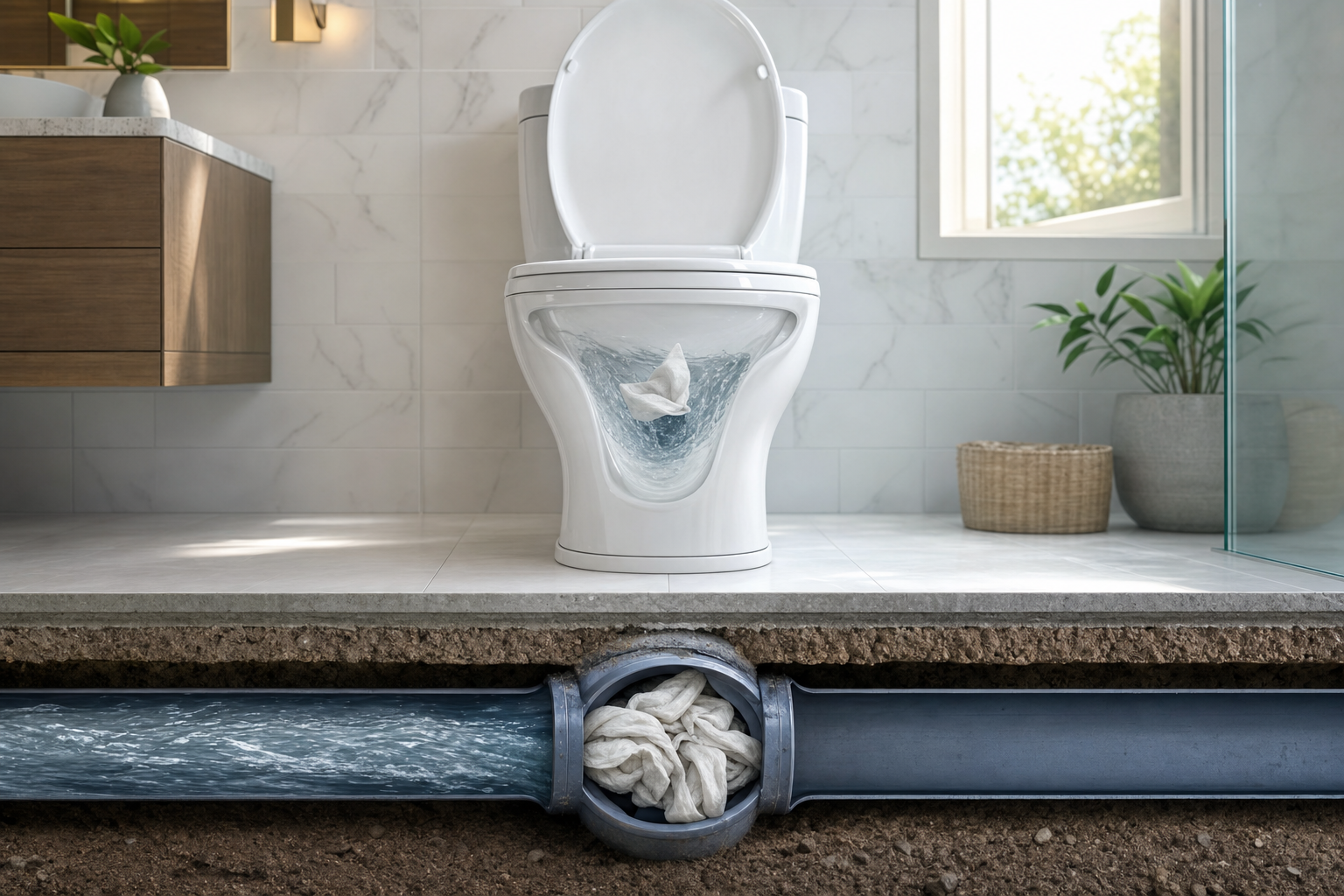
Yes — flushable wipes are one of the most common causes of sewer line clogs in residential homes. The word “flushable” on the package means the wipe will go down the toilet bowl. It does not mean the wipe will safely break down as it travels through your home’s drain pipes and sewer line. That difference matters, and it is the reason so many homeowners end up dealing with slow drains, backed-up toilets, and full sewer line blockages that a plunger cannot fix.
If you have been flushing wipes and your drains are starting to act differently — draining slower, gurgling, or backing up — this article will help you understand what is happening inside your pipes, what the warning signs look like, and what to do next.
What “Flushable” Actually Means on a Wipe Package
When a wipe manufacturer labels a product “flushable,” they are telling you the wipe is small enough and flexible enough to pass through your toilet’s internal trap when you flush. That is the beginning and end of what the label promises.
There is no government-regulated standard that defines “flushable” as safe for your entire sewer system. The term is not tested or certified by any plumbing authority. It is a product marketing claim, not a plumbing safety guarantee.
Here is the key distinction most homeowners miss: clearing the toilet bowl is only the first few inches of a much longer journey. Your sewer line may run 50 to 100 feet or more from your house to the municipal connection or septic tank. Everything you flush has to travel that entire distance. Just because something disappears from the bowl does not mean it will make that trip without causing problems.
Why Wipes Do Not Break Down the Way Toilet Paper Does
Toilet paper and wipes look similar, but they are designed to do opposite things in water.
Toilet paper is built to fall apart. It is made from loosely bonded wood pulp fibers that begin separating within seconds of hitting water. You can see this yourself — drop a sheet of toilet paper into a glass of water, swirl it gently, and within a minute or two the paper starts dissolving into a soft pulp. That is exactly what it is supposed to do inside your drain pipes.
Wipes are built to hold together. They are made from nonwoven synthetic or blended fabric — material that is specifically engineered to stay strong and intact when wet. That is what makes them useful for cleaning. It is also what makes them a problem inside your plumbing.
Drop a flushable wipe into the same glass of water. Swirl it around. Come back in ten minutes, thirty minutes, or even an hour. The wipe will still be fully intact. It might look a little softer, but it will not dissolve or break apart.
That simple glass-of-water test shows you the core problem. What holds together in a glass of water also holds together inside a sewer line.
How Wipe Clogs Actually Form Inside a Sewer Line
A single flushed wipe does not usually cause an immediate full blockage. Wipe-related clogs are cumulative — they build over time through a predictable sequence that happens inside the pipe where you cannot see it.
The Wipe Stays Intact After Flushing
Unlike toilet paper, which breaks apart before it travels far, a flushed wipe remains whole. It moves through the pipe as a solid sheet of fabric. In a best-case scenario, it passes all the way through. But most residential sewer lines are not a best-case scenario.
The Wipe Catches on a Rough Spot in the Pipe
Every sewer line has imperfections. Pipe joints where two sections meet. Slight offsets where the ground has shifted over time. Spots where tree roots have started pushing into the line. Rough edges from older pipe materials like clay or cast iron. These small irregularities are normal and usually harmless — until something catches on them. A wipe, because it stays intact and has a fabric texture, is far more likely to snag on these spots than dissolved toilet paper.
More Material Piles Up Behind It
Once one wipe catches, it acts like a net. The next wipe that comes through may catch on the first. Grease from kitchen drains, hair from shower drains, soap residue, and other debris all start collecting in the same spot. Over weeks or months, what started as one snagged wipe becomes a growing mass that slowly chokes the flow inside the pipe.
This is why the problem can seem to appear suddenly even if you have been flushing wipes for a long time. The clog has been building gradually, but you only notice it when flow is restricted enough to cause visible symptoms in your home.
Low-Flow Toilets Can Make It Worse
Most toilets installed in the last 15 to 20 years use 1.28 gallons per flush or less. These low-flow models are great for conserving water, but they push less volume through the pipe with each flush. That means there is less water available to carry heavy, non-dissolving material like wipes all the way through a long sewer line. In homes with longer pipe runs or any existing partial restriction, the lower flush volume increases the chance that wipes settle and accumulate rather than clearing fully.
Warning Signs That Wipes May Already Be Causing a Problem
Wipe-related clogs do not usually announce themselves with a dramatic backup on the first day. They tend to develop gradually, and the early signs are easy to dismiss or blame on something else.
Watch for these symptoms:
- Toilets draining slower than they used to. The flush works, but the bowl takes a few extra seconds to empty. You may not notice it every time, but the pattern is there.
- Gurgling sounds after flushing. Air trapped behind a partial blockage gets pushed back through the pipe. If you hear bubbling or gurgling from a drain — especially a drain you did not just use — something is restricting flow downstream.
- A sewage smell coming from a drain. When flow slows down, waste material sits in the pipe longer. That standing material can produce odor that travels back up through the drain.
- Multiple fixtures draining slowly at the same time. If your toilet, shower, and kitchen sink all seem sluggish at once, the restriction is probably not in any one fixture’s drain — it is further down the line, in the main sewer line where all your drains connect. This is one of the clearest signs of a mainline sewer clog.
- Needing the plunger more often than you used to. A plunger can clear a simple toilet clog, but if you are reaching for it every week, the real problem may be a partial blockage further down the line that keeps catching new material.
If any of these symptoms sound familiar, especially if you have been flushing wipes regularly, there is a good chance wipes are contributing to the problem.
Why “I Have Been Flushing Them for Years With No Problem” Does Not Mean You Are in the Clear
This is the most common thing homeowners say when they first learn about wipe-related clogs. It is understandable — if something has not caused a visible problem yet, it is natural to assume it is fine.
But wipe clogs are not an on-or-off situation. They are a slow buildup. The wipes you flushed last month may be sitting in your sewer line right now, partially snagged, gradually collecting more material with each flush. The fact that your drains are still working today does not mean the line is clear — it may mean the restriction has not yet reached the point where flow is noticeably affected.
Certain conditions make your home more vulnerable to wipe buildup:
- Older pipes. Clay, cast iron, and Orangeburg pipes — common in homes built before the 1970s and 1980s across many parts of New Jersey — have rougher interior surfaces and more joint imperfections where wipes can catch.
- Tree roots near the sewer line. Even small root intrusions create snag points inside the pipe. In established neighborhoods with mature trees, this is one of the most common compounding factors.
- Long pipe runs. The farther the wipe has to travel from your toilet to the main connection, the more chances it has to get caught along the way.
- Septic systems. Homeowners in parts of Ocean County, Morris County, and other areas where homes rely on septic tanks face an additional concern. Wipes that reach the septic tank do not break down there either and can interfere with normal tank function over time.
The absence of symptoms today is not proof that the line is clear. It just means the buildup has not reached a tipping point yet.
What to Do If You Have Been Flushing Wipes and Your Drains Are Acting Up
If you recognize any of the warning signs described above, here is a straightforward approach:
- Stop flushing wipes immediately. This is the single most important step. Every additional wipe you flush adds to whatever may already be building up in the line. Switch to throwing used wipes in a small lidded trash can next to the toilet.
- Try a plunger if only one fixture is affected. A slow-draining toilet or a single backed-up sink may just need basic plunging. If the plunger clears it and the drain stays clear afterward, you may have caught the problem early.
- Pay attention to whether the problem comes back or spreads. If the same fixture clogs again within a few days, or if other fixtures in the house start draining slowly too, the issue is likely deeper in the line — not just at one fixture.
- Call a licensed drain and sewer cleaning professional if multiple drains are affected, the plunger is not working, or you notice sewage backing up. When the problem is in the main sewer line, household tools will not reach it. Professional drain cleaning equipment is designed to reach deep into the line and clear the kind of stubborn buildup that wipes create.
If you are in Central New Jersey, the Jersey Shore area, or surrounding communities in Monmouth, Mercer, Union, Morris, or Ocean County, Just Drains handles exactly this kind of situation. We are a licensed drain and sewer cleaning company that focuses specifically on clearing clogged drains and sewer lines — including the stubborn wipe-related blockages that plungers cannot fix. We offer drain cleaning for $63, and our goal is to get your line cleared fast.
Call Now: (732) 279-2427
The Simple Rule That Prevents Most Sewer Line Clogs
The easiest way to protect your sewer line is to follow a two-item rule:
Only flush human waste and toilet paper. Everything else goes in the trash.
This applies to all wipes — not just baby wipes, but also flushable wipes, makeup-removal wipes, cleaning wipes, and personal hygiene wipes. If it is not toilet paper, it does not belong in the toilet.
A small lidded trash can next to the toilet makes this habit easy. It does not need to be complicated — just a simple switch that keeps non-dissolving material out of your pipes.
This one change can prevent the kind of slow-building sewer line clogs that lead to expensive, stressful backups down the road.
Frequently Asked Questions
Are flushable wipes really flushable?
They are flushable in the sense that they will go down the toilet when you flush. But they do not break down in water the way toilet paper does. Independent testing has consistently found that wipes marketed as flushable fail to disintegrate under conditions that reflect real residential sewer pipes. The label tells you the wipe fits through the toilet trap — it does not tell you it is safe for your sewer line.
Can just one or two wipes cause a clog?
A single wipe flushed once is unlikely to cause an immediate full blockage on its own. The real risk is cumulative. Over weeks and months of regular flushing, wipes accumulate inside the pipe, catching on joints, offsets, and rough spots. By the time you notice a slow drain or backup, dozens or hundreds of wipes may be partially blocking the line. One wipe is rarely the whole problem — but every wipe adds to it.
What is the difference between flushable wipes and baby wipes?
In practical terms, less than most people assume. Both are made from nonwoven fabric designed to stay strong when wet. Some flushable wipes use slightly thinner material or different fiber blends, but independent studies have found that the actual breakdown behavior of flushable wipes in water is not meaningfully different from standard baby wipes. Neither type dissolves the way toilet paper does, and neither should be flushed.
How long does it take for flushed wipes to cause a problem?
It depends on your pipes, how often you flush wipes, and whether your sewer line has existing imperfections like root intrusion or joint offsets. Some homeowners notice symptoms within a few months of regular wipe flushing. Others flush wipes for years before a clog becomes obvious. The buildup is gradual, and the timeline varies — but the direction is always the same. The longer you flush wipes, the more likely a blockage becomes.
When should I call a professional drain cleaner instead of trying to fix it myself?
A plunger is a reasonable first step for a single clogged toilet or a slow sink drain. But if the plunger does not solve it, the clog keeps coming back, multiple drains in the house are slow or backed up at the same time, or you notice sewage smell or standing water near a floor drain, the problem is likely in the main sewer line. That is when a licensed drain and sewer cleaning company can help. In Central New Jersey, Just Drains provides fast drain cleaning and sewer line clearing — call (732) 279-2427 to get your drains flowing again.
Can flushable wipes cause problems for a septic system?
Yes. Wipes that reach a septic tank do not break down inside the tank the way toilet paper and organic waste do. Over time, they can accumulate and interfere with normal septic function. Homeowners in areas that rely on septic systems — which includes parts of Ocean County, Morris County, and other areas throughout New Jersey — should be especially careful about keeping all wipes, including those labeled flushable, out of the toilet.