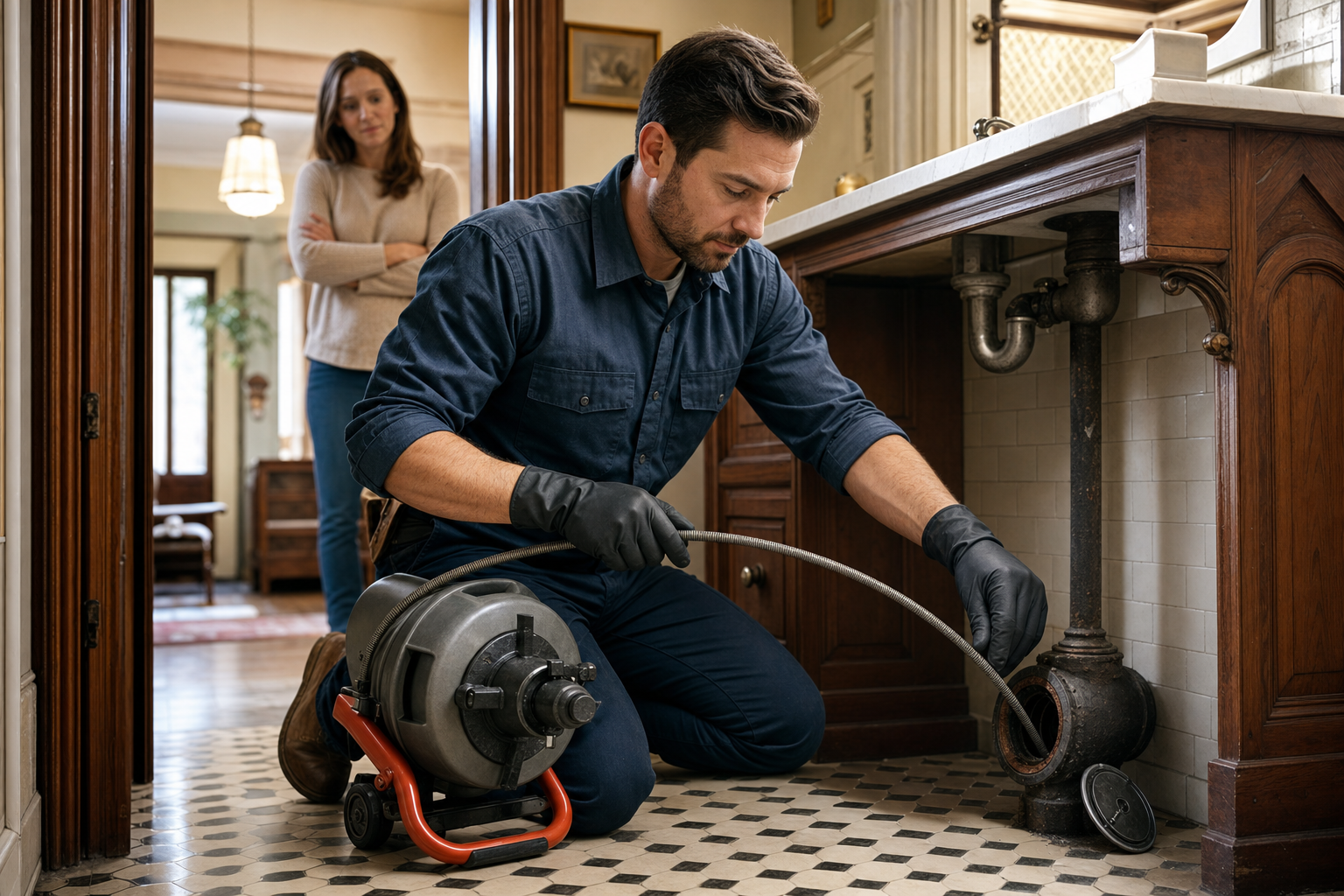
Drain Cleaning for Older Victorian Homes in Morris Plains, NJ
Victorian-era homes in Morris Plains often have drain pipes made from cast iron, clay, or galvanized steel — materials that behave very differently from the PVC piping found in newer construction. These older pipes can still function well after many decades, but they need a drain cleaning approach that accounts for their age, condition, and material. The wrong method applied too aggressively can turn a straightforward clog into a much more serious problem.
If you own an older home in Morris Plains and you are dealing with a slow drain, a clogged sink, a backed-up toilet, or a sewer line that will not clear, this guide explains what makes your situation different and what to look for when choosing a drain cleaning company that understands older plumbing systems.
Why Victorian-Era Homes in Morris Plains Have Different Drain Problems
Morris Plains and surrounding areas of Morris County have a significant number of homes built in the late 1800s and early-to-mid 1900s. These homes were built with the materials and plumbing methods available at the time, which means the drain lines running under and away from the house are often made from materials that modern plumbers rarely encounter in new construction.
That matters because the way a drain cleaner approaches a clog should depend on what the pipe is made of, how old it is, and what condition it is likely in. A method that works perfectly on a ten-year-old PVC line can damage or even collapse a pipe that has been in the ground for a century.
The Pipe Materials You Likely Have
Most Victorian and early-20th-century homes in this part of New Jersey were built with one or more of these pipe materials:
- Cast iron — Heavy, durable metal pipes commonly installed from the 1860s through the 1970s. Cast iron holds up well structurally for decades, but over time the interior walls corrode and develop rough, scaly buildup. That buildup narrows the pipe diameter and catches debris, grease, and waste that would flow through a smooth modern pipe without issue. A cast iron drain that used to work fine may start clogging repeatedly as internal corrosion worsens.
- Clay or terracotta — Reddish-brown pipes made from fired clay, commonly used for sewer laterals (the pipe running from the house to the municipal sewer line). Clay pipes are rigid and brittle, and the joints between pipe sections are especially vulnerable. Over decades, these joints can shift, separate, or crack, creating entry points for tree roots and soil.
- Galvanized steel — Steel pipes coated with zinc to resist corrosion. The zinc layer eventually wears away, and the steel underneath corrodes from the inside out. Galvanized pipes build up layers of mineral deposits and rust that progressively reduce water flow. A galvanized drain line that drains slowly may not be clogged in the traditional sense — the pipe itself may be partially closed off by corrosion buildup.
Many older Morris Plains homes have a combination of these materials, especially if plumbing was updated or extended at different points over the years. It is not unusual for a home to have cast iron drains inside, clay sewer laterals outside, and a section of galvanized steel somewhere in between from a mid-century renovation.
Decades of Modifications Create Unpredictable Layouts
A Victorian home that has been lived in for over a hundred years has likely had bathrooms added, kitchens moved, and drain lines rerouted more than once. Each generation of work was done with whatever materials and methods were standard at the time. The result is often a drain system with unexpected turns, mixed materials, and connections that do not follow the clean logic of a modern plumbing layout.
This matters during drain cleaning because the person running the snake or clearing the line needs to navigate a path that may not be straightforward. A technician who assumes every home drains the same way can get stuck, apply too much force at a turn, or miss the actual location of the blockage entirely.
Mature Trees and Root Infiltration
Older homes in Morris Plains tend to sit on lots with large, mature trees — oaks, maples, and other species with extensive root systems. Tree roots naturally seek out moisture, and the joints in clay and cast iron sewer lines are a common entry point. Once a root finds its way into a joint, it grows inside the pipe, catching waste and creating blockages that come back again and again.
If you have an older home with large trees and you notice recurring sewer backups, root infiltration into the sewer lateral is one of the most common causes. Drain cleaning can clear the blockage and restore flow, but understanding that roots may be part of the picture helps you plan for the possibility that the problem could return over time.
What Can Go Wrong When Old Pipes Are Cleaned the Wrong Way
This is the concern that keeps many older-home owners up at night: calling someone to fix a clog and having them make things worse. That concern is not unreasonable. Older pipes are more fragile than modern materials, and the wrong approach can cause real damage.
Here is what to be aware of:
- Aggressive mechanical force on corroded cast iron — Cast iron that has been corroding internally for decades can be thin in spots. A drain snake or auger applied with too much force or at the wrong angle can punch through a weakened section of pipe. A careful, experienced approach involves working the line with appropriate pressure and paying attention to how the pipe responds.
- Chemical drain cleaners on old pipes — Store-bought chemical drain cleaners are one of the worst things you can put into an older drain system. These products generate heat as they work, and that heat accelerates corrosion in cast iron and can weaken the joints in clay pipes. A single use probably will not destroy a pipe, but repeated use over months and years can cause real deterioration. If you have old pipes, avoid chemical drain cleaners entirely.
- Too much pressure on fragile clay joints — Clay sewer pipes are strong under compression but brittle under impact. The joints between sections are the weakest points. Cleaning methods that apply too much force at a joint can crack the pipe or push sections apart, turning a blockage into a break.
None of this means old pipes cannot be cleaned. They can, and they are cleaned successfully every day. The key is that the person doing the work should understand what kind of pipe they are likely dealing with and adjust their approach accordingly.
How Drain Cleaning Should Work in an Older Home
A drain cleaning visit to a newer home is usually simple: access the cleanout or the affected fixture, run a mechanical snake or auger, clear the clog, and confirm the line is flowing. The whole process may take thirty minutes.
In an older home, a few additional considerations come into play:
- Understanding the home’s age and pipe material before starting — A good drain cleaner will ask about the age of the home, whether you know what your pipes are made of, and whether you have had previous drain work done. This information helps them choose the right approach before they begin.
- Working the line with appropriate care — Mechanical snaking is the standard method for clearing most drain clogs, and it works well on older pipes when done with the right touch. The technician should be responsive to how the cable moves through the line — resistance at an unexpected point can indicate a turn, a joint, or a section of pipe that requires more careful navigation.
- Recognizing when the problem may be bigger than the clog — Sometimes what feels like a clogged drain is actually a symptom of a deeper issue in the sewer line. A technician who has worked in older homes before will know when a blockage clears normally and when the way the line responds suggests something else may be going on — like root infiltration, a partially collapsed section, or severe internal corrosion.
The core idea is simple: assess before you act. A drain cleaner who takes a moment to understand the home before running equipment is far less likely to cause damage than one who treats every call the same way regardless of the home’s age.
Signs Your Older Home’s Drains Need Professional Attention
Not every slow drain requires a service call, and not every homeowner needs to worry about their old pipes all the time. But there are specific signs that suggest it is time to stop trying DIY solutions and call a licensed drain and sewer cleaning professional.
| What You Are Noticing | What It Often Means | What to Do |
|---|---|---|
| A single drain is slow but a plunger clears it temporarily | A localized partial blockage in one drain line, likely grease, soap, or hair buildup | If a plunger resolves it, monitor briefly. In older homes, a clog that returns within days or weeks is a reason to call for professional drain cleaning rather than continuing to plunge — recurring blockages in old pipes often point to a deeper cause. |
| The same drain clogs repeatedly, even after clearing | Possible internal corrosion narrowing the pipe, or a partial obstruction like a root that is not fully removed by plunging | Call for professional drain cleaning. Mention the pattern of recurring clogs so the technician knows it is not a one-time blockage. |
| Multiple drains in the home are slow or backing up at the same time | Often a sign of a mainline sewer clog rather than individual drain problems. When the main sewer line is partially blocked, it affects every drain connected to it. | Call for sewer cleaning or sewer line clearing. This is not something a plunger or store-bought product can fix. |
| Sewage smell in the home without a visible backup | Could indicate a partial sewer line blockage, a dry trap, or a crack in a drain or sewer pipe allowing sewer gas to escape | Call a licensed drain and sewer cleaning company. The smell itself can be a health concern, and the cause needs to be identified. |
| Gurgling sounds from drains or toilets when water is running elsewhere | Usually means air is being displaced in the drain system because water cannot flow freely, often pointing to a partial blockage downstream | Call for professional assessment. Gurgling in an older home often indicates a sewer line issue rather than a simple drain clog. |
| Water backing up in a basement floor drain or lowest fixture | A strong indicator of a mainline sewer backup. Water backs up at the lowest point because it has nowhere else to go. | Stop using water in the home and call for emergency sewer line clearing immediately. Avoid contact with any backed-up water. |
If you are experiencing any of the more serious signs — multiple drains backing up, sewage smell, or water coming up through a basement drain — do not wait or try chemical products. These situations typically involve the main sewer line, and the longer you wait, the worse the mess and the damage can become.
What to Tell Your Drain Cleaner Before They Start
If you have an older home, you can help your drain cleaning technician do a better job by sharing a few pieces of information upfront. This is especially useful in Victorian-era homes where the plumbing history may not be obvious from the outside.
Before your appointment, have answers ready for these questions:
- How old is the home? Even a rough estimate — something like “constructed around the turn of the century” or “predating the Second World War” — gives the technician useful context for anticipating what pipe materials are likely present in the system.
- Do you know what your pipes are made of? If you have ever had plumbing work done and the plumber mentioned cast iron, clay, or galvanized pipes, share that. If you do not know, that is fine — just say so.
- Has this drain been cleaned before? If you have had the same drain or sewer line professionally cleaned in the past, mention when and how often. A line that needs cleaning every six months tells a different story than one that has not been touched in ten years.
- Which drains are affected? Be specific. Describing exactly which fixture is running slow is more useful than a general statement that things are not draining. If multiple fixtures are affected, say so — that changes the likely cause and the approach.
- Is this sudden or gradual? A toilet that was working fine yesterday and is now completely blocked is different from a shower that has been draining slowly for three months. Sudden complete blockages and gradual slowdowns often have different causes.
- Have you used chemical drain cleaners recently? If you have poured chemical products down the drain, tell the technician. This affects what they might encounter inside the pipe and how they approach the job.
You do not need to be a plumbing expert to provide this information. Even basic details about your home’s history help a good drain cleaner make better decisions about how to handle your pipes safely and effectively.
Preventive Habits That Help Older Drains Last Longer
You cannot stop cast iron from aging or tree roots from growing, but you can reduce the frequency of drain problems with a few practical habits:
- Use drain screens on every fixture — A simple mesh screen over your kitchen sink, bathroom sink, and shower drain catches hair, food particles, and small debris before they enter the pipe. In an older home where the interior pipe walls are rough from corrosion, even small debris can catch and start building a blockage.
- Keep grease and oil out of the kitchen drain — Pour cooking grease into a container and throw it in the trash. In older pipes with internal scaling, grease sticks to the rough interior walls and hardens, creating stubborn blockages that are difficult to clear.
- Run hot water through your drains regularly — After washing dishes or using the kitchen sink, letting hot water run for a short time can help move grease and soap residue through the line. This is a simple habit, not a substitute for professional cleaning when a real clog develops.
- Never use chemical drain cleaners — This bears repeating. The heat these products generate accelerates corrosion inside cast iron pipes and can weaken clay pipe joints. If a plunger does not clear the clog, call a professional rather than reaching for a bottle.
- Pay attention to seasonal patterns — In Morris County, tree roots are most active during spring and summer when they are growing. If you notice your drains slowing down during warmer months and improving slightly in winter, root infiltration may be part of the problem. Scheduling preventive drain cleaning before the active growing season can help you stay ahead of it.
How Just Drains Approaches Older Homes in Morris Plains
At Just Drains, a large portion of the calls we receive in Morris County come from homeowners with older properties. We understand that when you call about a clogged drain or a backed-up sewer line in a Victorian-era home, you are not just worried about the clog — you are worried about whether the person you call will make things worse.
We are a licensed drain cleaning and sewer cleaning company, and drain and sewer line clearing is all we do. We are not a general plumber trying to fit drain cleaning in between other jobs. When we show up, our focus is on clearing your line safely and paying attention to how the pipe responds throughout the job.
When a homeowner in Morris Plains calls us about a slow drain or a sewer backup in an older home, we want to know what you know about the home’s plumbing. That conversation takes a minute, and it helps us approach the job the right way from the start.
We offer drain cleaning for $63, and we offer service within 60 minutes. For a homeowner who is dealing with a backed-up kitchen sink before a holiday dinner or a toilet that will not flush, getting prompt help from someone who understands older pipes matters.
Frequently Asked Questions
Is drain cleaning safe for cast iron pipes?
Yes, when done correctly. Mechanical drain cleaning with a snake or auger is the standard method for clearing clogs in cast iron lines, and it is safe when the technician uses appropriate pressure and responds to how the cable moves through the pipe. The risk comes from overly aggressive force or from using chemical drain cleaners, which accelerate corrosion. A drain cleaning professional experienced with older homes will work the line carefully and adjust their approach based on what the pipe tells them.
Why does my old house keep getting drain clogs?
Recurring clogs in older homes usually have one of three causes. First, internal corrosion in cast iron or galvanized pipes roughens the interior walls, which catches debris that would pass through a smooth modern pipe. Second, tree roots can infiltrate clay sewer pipe joints and create blockages that return after each clearing as the roots regrow. Third, decades of grease, soap, and mineral buildup can narrow the effective diameter of the pipe over time. Understanding which cause applies to your situation helps determine whether routine drain cleaning is sufficient or whether further evaluation is warranted.
Can chemical drain cleaners damage old pipes?
Yes. Store-bought drain cleaning products produce heat in the process of breaking down clogs, and that thermal reaction speeds up deterioration within cast iron pipe walls. In clay pipes, the heat and chemical reaction can weaken the mortar or joint material between pipe sections. Repeated use of chemical drain products in an older home can cause real long-term damage to the drain system. If a plunger does not clear the blockage, calling a drain cleaning professional is a safer choice than using chemicals.
How do I know if my Victorian home has cast iron or clay pipes?
If your home was built before the 1970s in this part of New Jersey, there is a good chance that some or all of your drain pipes are cast iron, clay, or galvanized steel. Cast iron pipes are dark gray or black, heavy, and often visible in basements or crawl spaces. Clay pipes are typically found underground on the sewer lateral running from the house to the street — you may not see them unless they have been exposed during previous work. If you are unsure, mention your home’s approximate age when you call for drain cleaning service, and the technician can factor that into their approach.
How is drain cleaning different for older homes compared to newer homes?
The core process is similar — a mechanical snake or auger is used to break up and clear the blockage. The difference is in how the job is approached. Older pipes made from cast iron, clay, or galvanized steel are more fragile than modern PVC. They may have internal corrosion, weakened joints, or sections where decades of settling have changed the pipe’s slope. A technician clearing a drain in an older home should work with more care, pay attention to unusual resistance in the line, and factor in the likelihood that the pipe material and condition may require a gentler approach. The work itself can be done successfully — it simply has to be carried out with the pipe’s history and condition taken into account.
What should I do if multiple drains in my old home are backing up at once?
When more than one drain in your home is slow or backing up at the same time, the source of the trouble is almost always the main sewer line rather than any individual fixture drain. This is a common situation in older homes where the sewer lateral may have root infiltration, a partial collapse, or heavy buildup. Stop using water in the home if possible, avoid contact with any backed-up water, and call for sewer line clearing right away. This is not something a plunger or a store-bought product can address — it requires professional equipment to reach and clear the main line.
Your Older Home Deserves Drain Cleaning Done Right
A Victorian-era home in Morris Plains is something worth taking care of — including the plumbing that keeps everything running behind the walls and under the floors. When a drain problem comes up, having it handled by someone who understands older pipe materials and adjusts their approach accordingly can make the difference between a simple service call and a much bigger headache.
If you are dealing with a clogged drain, a slow sink, a backed-up toilet, or a sewer line problem in an older Morris Plains home, Just Drains can help. We are a licensed drain cleaning and sewer cleaning company serving Morris County and surrounding areas of Central and North New Jersey. We offer drain cleaning for $63 and provide service within 60 minutes.
Call Now: (732) 279-2427