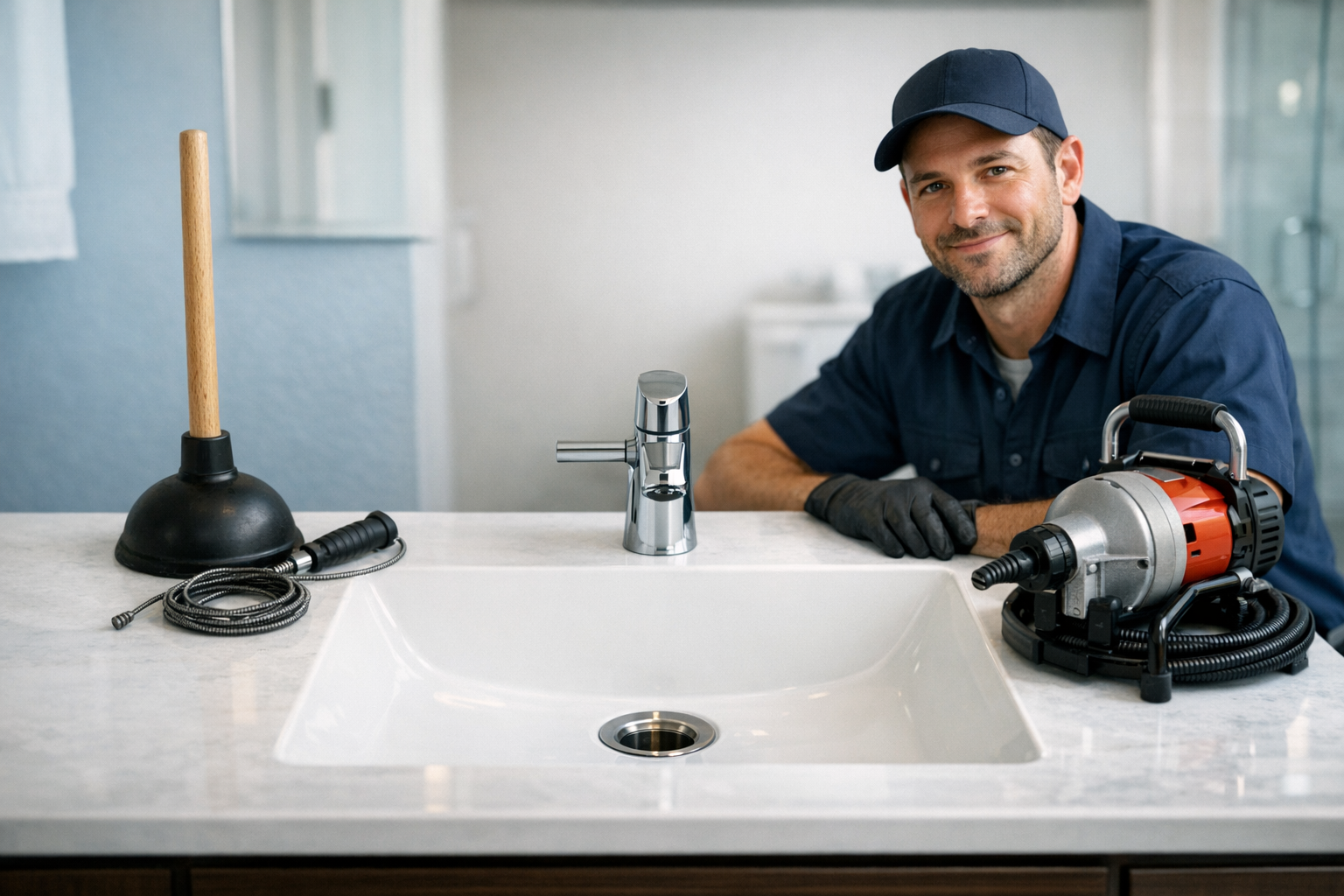
DIY vs. Professional Drain Cleaning: How to Know Which You Actually Need
The main difference between DIY and professional drain cleaning comes down to three things: where the clog is, how deep it goes, and whether basic household tools can actually reach it. A plunger or a hand snake can often clear a simple, surface-level blockage in one fixture. But if the clog is deeper in the line, keeps coming back, or affects more than one drain, you need professional equipment and a trained eye to fix it properly.
If you’re reading this right now, there’s a good chance something in your home isn’t draining the way it should. Maybe the kitchen sink is pooling water again, or you’re dealing with a toilet that won’t flush no matter what you try. That situation is stressful, and you want to make the right call without wasting time or money. This guide will help you figure out when a DIY fix is genuinely worth trying, when it’s time to stop and call a licensed drain-cleaning professional like Just Drains, and what makes the professional approach fundamentally different from what you can do on your own.
What DIY Drain Cleaning Can Actually Handle
DIY drain cleaning has a real place. Not every clog requires a service call, and being honest about that is important. Here’s what works at home, what it’s good for, and where it runs out of usefulness.
Tools That Work for Simple Clogs
- Cup plunger or flange plunger: Your first and best option for a single clogged toilet or a slow sink. A proper seal and steady vertical pressure can dislodge a soft blockage sitting close to the drain opening. If it works on the first few attempts, you’ve probably solved the problem.
- Hand-crank drain snake (manual auger): A small, inexpensive cable tool you can feed into a drain to physically break through or pull out a clog. Works well for hair clumps in a bathroom sink or tub drain. Most homeowner models reach about 15 to 25 feet into a line.
- Baking soda and hot water flush: Useful as a mild maintenance step for slow drains, not a real solution for a true blockage. It can help dissolve minor grease buildup over time, but it will not clear a solid clog.
- Drain screens and strainers: Not a cleaning tool, but one of the most effective things you can do to prevent clogs in the first place. Catching hair and food particles before they enter the drain saves a lot of trouble.
When DIY Is Genuinely the Right Move
If you’re dealing with a single fixture that’s draining slowly and there’s an obvious cause — a visible hair clump near the drain opening, a minor food buildup in the kitchen sink trap — a plunger or hand snake is a reasonable first step. If the clog clears on the first attempt and the drain flows normally afterward, you handled it well.
The key phrase there is first attempt. A clog that responds to a plunger once and doesn’t come back was probably a simple surface blockage. That’s a win.
Why Chemical Drain Cleaners Are a Problem
The bottle of liquid drain cleaner under the sink might seem like the easiest fix, but most licensed plumbers and drain-cleaning professionals advise against it, and for practical reasons.
Chemical drain cleaners work by creating a chemical reaction that generates intense heat inside your pipe. That heat can soften or warp PVC pipes and accelerate corrosion in older cast iron or galvanized steel pipes. With repeated use, you’re gradually weakening the pipe walls while only partially dissolving the clog.
The other problem is that chemical cleaners typically burn a narrow hole through the blockage rather than clearing it fully. The pipe walls stay coated with buildup, which means the clog reforms — often within days or weeks. That leads to a cycle of pouring more chemicals into an already stressed pipe, which can eventually cause leaks or pipe failure that costs far more to repair than the original clog.
If you have a septic system, chemical cleaners carry an additional risk: they can disrupt the bacterial balance your septic tank needs to function properly.
A practical rule: If you’ve used a chemical cleaner on the same drain more than once in the past few months, that drain has a problem the chemicals aren’t solving. It may be time to call a licensed professional.
Where DIY Stops Working
There’s a real boundary between what household tools can reach and what requires professional-grade equipment. Understanding that boundary saves you time, frustration, and potentially expensive damage.
You Can’t Reach What You Can’t See
A hand snake can extend 15 to 25 feet into a drain line. That’s enough to reach through a sink trap or a short branch line. But your home’s plumbing system extends much farther than that. The main sewer line connecting your house to the municipal sewer or septic system can be 50, 75, or even 100 feet long, and it runs underground beneath your yard.
If a clog sits deep in a branch line or in the main sewer line itself, no amount of plunging or hand-snaking from inside the house will reach it. You might feel temporary improvement because you’ve pushed some debris around, but the core blockage hasn’t moved.
Poking a Hole vs. Actually Cleaning the Pipe
This is one of the most important differences between DIY and professional drain cleaning, and it’s rarely explained clearly.
When you use a hand snake or chemical cleaner, the best-case result is that you’ve punched a narrow channel through the clog. Water starts flowing again, and it feels like the problem is fixed. But the walls of the pipe are still coated with grease, soap residue, mineral scale, or organic buildup. That coating is what caused the clog in the first place, and with a narrow channel instead of a fully open pipe, it doesn’t take long for the blockage to reform.
Professional drain-cleaning equipment doesn’t just poke through — it works to restore proper flow through the pipe. That’s a fundamentally different result, and it’s why professional cleaning tends to last much longer.
Some Clogs Are Beyond Any DIY Tool
Certain types of blockages simply cannot be handled at home:
- Tree root intrusion: Roots can grow into pipe joints and cracks, forming dense masses inside the line. No hand snake or chemical will clear them.
- Mineral scale buildup: Calcium and mineral deposits that harden inside older pipes require mechanical force to remove.
- Collapsed or damaged pipe sections: If a pipe has shifted, cracked, or collapsed underground, clearing the debris won’t fix the structural problem. You need a professional to diagnose what’s actually happening.
- Deep grease blockages in the main sewer line: Grease that has traveled far down the line and solidified into a hard mass won’t respond to hot water or baking soda.
What Professional Drain Cleaning Actually Involves
One reason homeowners hesitate to call is that they don’t know what happens during a professional drain-cleaning visit. It feels like a mystery, and mystery creates anxiety about cost, time, and whether it’s even necessary. Here’s what the process typically looks like.
The Professional Tools and What They Do
- Motorized drain auger (power snake): A heavy-duty cable machine that can extend much farther than a hand snake and cut through tough blockages. Different cable sizes and cutting heads are selected based on the pipe diameter and the type of clog. A professional uses a full-size machine with root-cutting capability when needed — something no homeowner tool can match.
- Professional-grade drain cleaning equipment: Beyond a basic snake, licensed drain-cleaning professionals have access to equipment that doesn’t just clear a blockage but works to restore proper flow capacity through the pipe. This is what separates a professional result from a temporary DIY fix.
What a Typical Visit Looks Like
When a licensed drain-cleaning technician arrives at your home, the general process is straightforward:
- Assessment: The technician asks what you’re experiencing — which fixtures are affected, how long the problem has been going on, and what you’ve already tried.
- Access: They locate the best access point to your drain system, often a cleanout or the affected fixture itself.
- Clearing: Using the appropriate tool — typically a motorized auger for most residential clogs — the technician works through the blockage and clears the line.
- Verification: They run water to confirm the drain is flowing properly and check for any signs of deeper problems.
The whole process usually takes less time than most homeowners expect. At Just Drains, the focus is on getting to your home fast and clearing the drain efficiently so your household can get back to normal.
How to Decide Right Now: DIY or Call a Pro?
This is the practical decision point. Rather than weighing abstract pros and cons, use these real-world signals to figure out your next step.
| What You’re Experiencing | What It Likely Means | What to Do |
|---|---|---|
| One drain is slow, first time it’s happened, visible debris near the opening | Surface-level blockage in one fixture | Try a plunger or hand snake. If it clears on the first try, you’re fine. |
| You plunged or snaked a drain and it cleared, but the clog came back within a few days | The blockage is deeper than your tools can reach, or buildup is coating the pipe walls | Call a licensed drain-cleaning professional |
| More than one drain in the house is slow or backing up | The clog may be in a shared branch line or the main sewer line | Call a professional — this is not a DIY situation |
| Foul sewage smell coming from drains or near your cleanout | Possible sewer line backup or venting issue | Call a professional promptly |
| Gurgling sounds from drains or the toilet when you run water elsewhere | Air is being displaced in the line, which usually signals a partial blockage in the main line | Call a professional |
| Water backing up into a tub, shower, or floor drain | Mainline sewer backup — water has nowhere to go | Stop using water in the house and call a professional immediately |
| You’ve used chemical drain cleaners multiple times on the same drain | The chemicals are not reaching or fully clearing the blockage, and repeated use risks pipe damage | Stop using chemicals and call a professional |
A simple way to think about it: If a plunger solved it on the first try and the drain stays clear, DIY worked. If you’re attempting a second or third fix on the same drain, or if more than one fixture is affected, the problem is telling you it needs professional equipment.
What You’re Actually Paying For: The Real Cost Comparison
Cost is one of the biggest reasons homeowners try to handle a clog themselves, and that makes sense. Here’s what the numbers actually look like.
DIY Costs
A plunger costs a few dollars. A basic hand snake runs $15 to $40. A bottle of chemical drain cleaner is $5 to $15. On the surface, those are cheap compared to a service call.
But consider what happens when DIY doesn’t work:
- A second and third bottle of drain cleaner: another $10 to $30, plus cumulative pipe damage risk.
- A hand snake that scratches a porcelain fixture or damages a pipe fitting: potentially hundreds of dollars in repair.
- Weeks of a recurring clog that you keep temporarily clearing: hours of your time and ongoing stress.
- A partial blockage that turns into a full sewage backup because it was never properly cleared: significant cleanup costs and potential water damage.
The cheapest single attempt is DIY. But the cheapest resolution is often the one that actually solves the problem on the first visit.
Professional Costs
Professional drain cleaning costs vary depending on the company, the severity of the clog, and what’s required to clear it. Many homeowners assume it’s expensive because they don’t have a clear price to compare against.
At Just Drains, drain cleaning starts at $63. That’s a specific, transparent starting point. For a clog that you’ve already spent $30 to $50 trying to fix yourself, plus the time and frustration involved, a single professional visit that actually clears the line can cost less than the accumulated DIY attempts.
What Happens When You Ignore a Persistent Drain Problem
This isn’t about scare tactics. It’s about understanding how drain problems can escalate when they’re not properly addressed.
A slow drain that you manage to keep partially open with periodic plunging may seem like a minor inconvenience. But a partial blockage means debris continues to accumulate. Over weeks or months, a slow drain can progress to a complete blockage. A complete blockage in a branch line backs water up into that fixture. A complete blockage in the main sewer line can back sewage up into the lowest drains in your house — typically a basement floor drain, a ground-floor tub, or a first-floor toilet.
A sewer backup involves contaminated water, and contact with it should be avoided. If you experience sewage backing up into your home, stop using water, keep family members and pets away from the affected area, and call a qualified professional right away.
Early intervention on a persistent drain problem is almost always simpler, faster, and less expensive than dealing with the situation it can become.
Simple Habits That Help Keep Drains Clear
Once a drain is properly cleared, a few basic habits can help keep it that way:
- Use drain screens in showers, tubs, and kitchen sinks to catch hair and food particles before they enter the line.
- Never pour cooking grease down the drain. Let it cool, put it in a container, and throw it in the trash.
- Run hot water through the kitchen sink for 30 seconds after doing dishes to help flush residual grease.
- Be mindful of what goes down the toilet. Only human waste and toilet paper. Wipes — even those labeled “flushable” — are a common cause of blockages.
- For older homes with mature trees nearby, consider scheduling periodic professional drain maintenance to catch root intrusion early.
Frequently Asked Questions
Why do plumbers and drain professionals say not to use chemical drain cleaners?
Chemical drain cleaners generate heat through a chemical reaction inside your pipe. That heat can warp PVC, corrode cast iron and galvanized steel, and weaken pipe joints over time. They also tend to burn a narrow hole through the clog rather than fully clearing it, which means the blockage often comes back. For older homes especially, repeated chemical use can cause more damage than the original clog.
How do I know if the problem is in my drain or my main sewer line?
If only one fixture is slow or clogged, the blockage is likely in that fixture’s individual drain line. If multiple fixtures are affected at the same time — especially on different floors of the house — or if water backs up into a tub or floor drain when you flush a toilet, the problem is likely in a shared branch line or the main sewer line. Multiple drains acting up simultaneously is a strong signal to call a licensed professional.
Is professional drain cleaning worth the cost?
For a simple, one-time surface clog that a plunger can handle, a service call isn’t necessary. But for recurring clogs, deep blockages, multiple affected fixtures, or any sign of a sewer line issue, professional cleaning tends to resolve the problem more thoroughly and often costs less than repeated DIY attempts that don’t work. At Just Drains, drain cleaning starts at $63, which makes professional help more accessible than many homeowners expect.
Can I damage my pipes with a store-bought drain snake?
It’s possible, especially if you’re not familiar with how your plumbing is configured. Forcing a hand snake too aggressively can scratch porcelain fixtures, damage pipe fittings, or puncture older corroded pipes. If you use a hand snake, apply steady moderate pressure and stop if you feel significant resistance that doesn’t give way. Significant resistance usually means you’ve reached something that requires professional equipment.
What’s the difference between drain snaking and other professional cleaning methods?
A drain snake (auger) is a cable that physically breaks through or pulls out a clog. It clears the immediate blockage but may not fully clean the pipe walls. Licensed professionals have access to additional equipment and methods that can do more than just punch through a blockage — they can work to restore proper flow capacity through the pipe, which provides a more thorough and longer-lasting result, especially for pipes with grease, scale, or root problems.
How often should drains be professionally cleaned?
There’s no universal schedule that applies to every home. If your drains are flowing well, there’s no need for routine service. However, if you live in an older home, have large trees near your sewer line, or have a history of recurring clogs, periodic professional cleaning — perhaps once a year — can help catch developing problems before they turn into emergencies.
When It’s Time to Make the Call
If you’ve tried a plunger, the clog didn’t clear, or the same drain keeps giving you problems — you’ve reached the point where DIY isn’t going to fix it. If multiple drains are slow, there’s a bad smell, or you’re seeing water back up where it shouldn’t be, the problem is beyond what household tools can handle.
That’s exactly the kind of situation Just Drains handles every day. As a licensed drain-cleaning company, Just Drains focuses specifically on getting clogs cleared fast so your home can get back to normal. With drain cleaning starting at $63 and a goal of reaching you quickly, the aim is to take the stress out of a stressful situation.
You don’t need to keep fighting a drain that won’t cooperate. Call Just Drains now and get it taken care of.