What Happens When Your Main Sewer Line Is Clogged (and What to Do Right Now)
When your main sewer line clogs, every drop of wastewater in your home has nowhere to go. Instead of flowing out to the municipal sewer or your septic system, sewage backs up through your pipes and starts rising into your home through the lowest drains first — your basement floor drain, your ground-floor bathtub, or your shower.
This is different from a single clogged sink or toilet. A mainline clog affects your entire house because every drain, every toilet, every sink, and every appliance that uses water all connect to one single underground pipe. When that pipe is blocked, your whole plumbing system stalls. If you are seeing water back up in multiple places right now, stop using all water in the house and keep reading. We will walk you through exactly what is happening, how to confirm it is the mainline, and what to do next.
What Is Your Main Sewer Line?
Your main sewer line is the single large pipe — usually four inches in diameter — that runs underground from your home to the city sewer system or your septic tank. Every drain in your house empties into smaller branch pipes that all feed into this one main line. Think of it as the exit door for all the water in your home. When that exit is blocked, everything behind it stops moving.
Most homes also have a sewer cleanout — a short white or black capped pipe sticking up from the ground in your yard, basement, or crawl space. This is the access point a drain-cleaning professional uses to reach the main line. Knowing where yours is located can save valuable time when you need fast help.
What Happens Inside Your Pipes When the Main Line Clogs
To understand the symptoms you are seeing, it helps to know what is actually going on underground. Your plumbing relies on gravity. Wastewater flows downhill through your branch pipes into the main line, and then out to the sewer or septic system. When a blockage forms in that main line, water hits the obstruction and has nowhere to go. Pressure builds behind the clog, and water starts looking for the easiest way back up. That is almost always the lowest drain in your house.
This is why a mainline clog does not behave like a clogged kitchen sink. It does not stay in one place. It spreads across your entire plumbing system, and it gets worse every time someone uses water anywhere in the home.
Sewage Backs Up Into Your Home
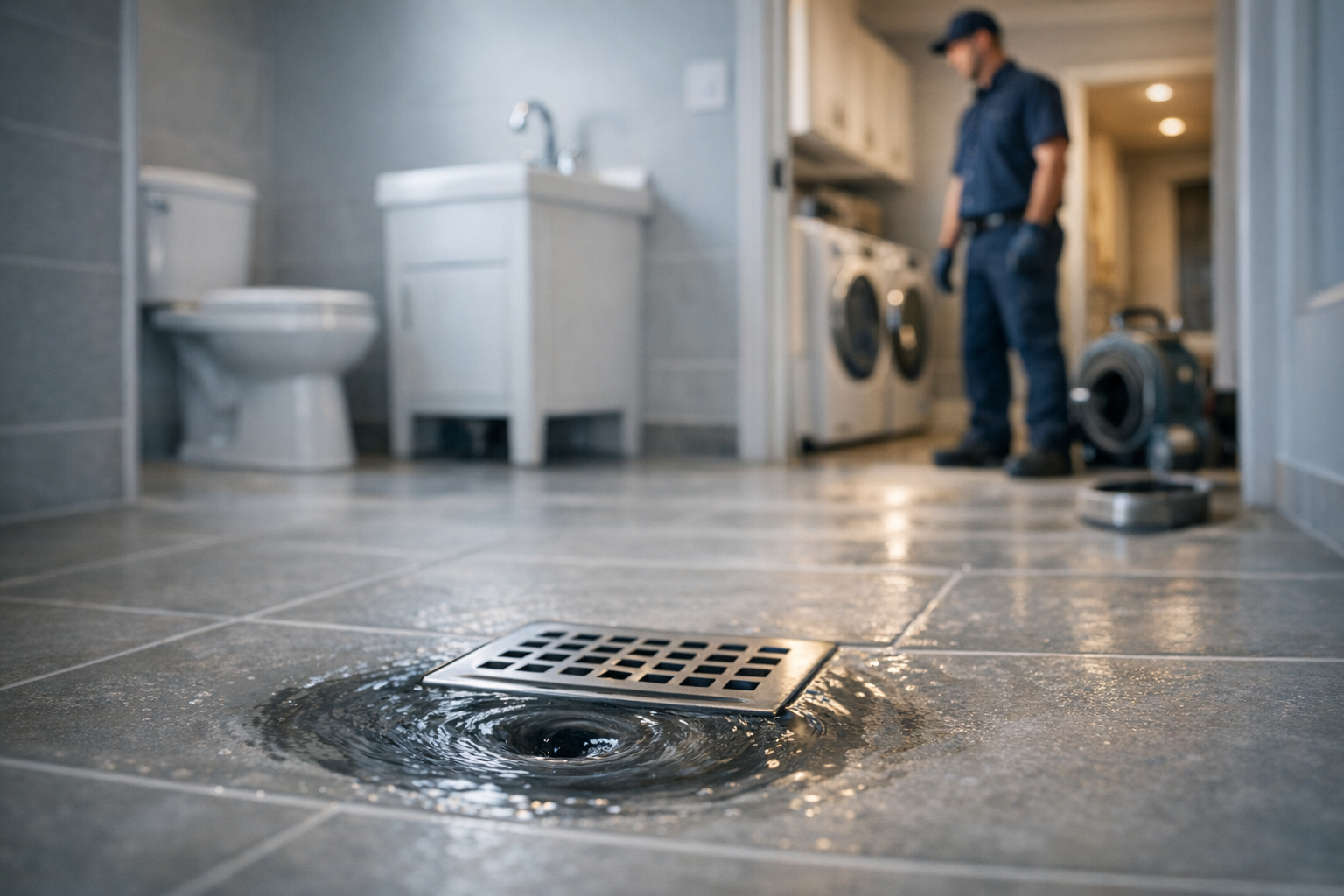
The most alarming sign is dirty water — or actual sewage — rising up through a basement floor drain, a first-floor shower, or a bathtub. This happens because those fixtures sit at the lowest point in your plumbing system. When the main line is blocked and pressure builds, sewage takes the path of least resistance back up through those low drains. The water is often dark, foul-smelling, and may contain solid waste.
If you see this happening, it is not a minor clog. This is raw sewage entering your living space, and it requires professional drain-cleaning help promptly.
Your Fixtures Start Affecting Each Other
One of the clearest signs of a mainline problem is what professionals sometimes call cross-talk between fixtures. Here is what that looks like in real life:
- You flush the upstairs toilet and hear water gurgling up in the basement shower.
- You run the washing machine and the kitchen sink starts backing up.
- Someone takes a shower and the toilet in the same bathroom starts bubbling.
This happens because all those fixtures share the same blocked exit. When you push water into one pipe, it cannot get past the clog, so it gets forced sideways or upward into another connected pipe. If two or more fixtures in different parts of your house are reacting to each other, the problem is almost certainly in the main line — not in any individual drain.
Every Drain in the House Slows Down
Before a complete blockage, you may notice that drains throughout your home are all running slower than normal at the same time. Not just the kitchen sink. Not just one bathroom. Multiple drains across the house, all sluggish. This is an early warning that something is building up in the main line and restricting flow before it shuts down completely.
You Smell Sewage
When waste gets trapped in your pipes with nowhere to go, it produces sewer gases. You may notice a strong, rotten smell coming from drains, from the area near your sewer cleanout in the yard, or from the basement. The odor is unmistakable — it smells like raw sewage, not just a dirty drain. If the smell is coming from multiple locations, the source is likely the main line, not a single trap or fixture.
Gurgling and Bubbling Sounds
When your main sewer line is partially or fully blocked, air gets trapped in the pipes. That trapped air pushes through the water sitting in your drain traps, creating a distinct gurgling or bubbling sound. You will often hear it in toilets, bathtub drains, or floor drains — especially right after you run water somewhere else in the house. Gurgling is one of the earliest warning signs that a mainline clog is developing, even before any visible backup appears.
How to Tell If It Is Your Main Line or Just One Drain
Not every slow drain means your main sewer line is clogged. Sometimes a single fixture gets backed up on its own. Here is how to tell the difference:
| Single-Drain Clog | Mainline Sewer Clog |
|---|---|
| Only one fixture is slow or backed up | Two or more fixtures in different rooms are slow or backed up at the same time |
| Other drains in the house work normally | Using one fixture causes a reaction in another (gurgling, bubbling, backing up) |
| A plunger or basic drain snake may help | A plunger does not help — the problem comes back or gets worse |
| No sewage odor from other drains | Sewage smell coming from multiple drains or from the yard near the cleanout |
| Problem stays contained to one area | Water backs up in the lowest drains (basement, first-floor tub or shower) |
A quick test: Flush a toilet and immediately watch a nearby bathtub or shower drain. If you see water rise, bubble, or hear gurgling in that drain, the blockage is downstream of both fixtures — which almost always means the main line.
If you are seeing the patterns in the right column, this is not something a plunger or a bottle of drain cleaner will fix. This is a mainline sewer clog, and it needs professional drain-cleaning equipment to clear.
What to Do Right Now
If you suspect a mainline sewer clog, here is what to do immediately — and what to avoid.
- Stop using all water in the house. Every toilet flush, every faucet, every dishwasher cycle, and every washing machine load adds more water to a system that cannot drain. Tell everyone in the household to stop running water until the line is cleared. This is the single most important thing you can do to prevent the backup from getting worse.
- Check your sewer cleanout if you can find it safely. Look for a short capped pipe in your yard, basement, or along the side of the house. If you can see standing water or sewage at the cleanout, that confirms the main line is blocked. Do not try to open or clear it yourself — just knowing the location helps a drain-cleaning professional get started faster when they arrive.
- Do not pour chemical drain cleaner down any drain. Store-bought drain cleaners are designed for small clogs near the drain opening. They cannot reach a blockage deep in your main sewer line, which may be 50 feet or more from the nearest drain. Worse, if sewage backs up with those chemicals in it, you now have contaminated, caustic water coming into your home. Chemical drain cleaners can also damage older pipes.
- Avoid contact with backed-up water. Water that has come up through your drains during a sewer backup may contain raw sewage. Avoid touching it without appropriate protective gear, keep children and pets away from affected areas, and do not attempt to clean it up until the line has been cleared and the backup has stopped.
- Call a licensed drain-cleaning professional. A mainline sewer clog requires specialized equipment — a motorized sewer auger that can reach deep into the pipe, not a handheld drain snake from the hardware store. The sooner you call, the sooner the backup stops and the less impact it can have on your home.
If you are dealing with this right now, Just Drains is a licensed drain-cleaning company that handles mainline sewer clogs for homeowners. Our goal is to reach your home as quickly as possible — often within 60 minutes — so we can get to work clearing the line. Call Just Drains now to get fast, local help before the problem gets worse.
What NOT to Do
When you are standing in front of a backed-up drain and the house smells like sewage, it is tempting to try anything. Here is what to avoid:
- Do not keep flushing or running water to “push through” the clog. This only adds more volume behind the blockage and makes the backup worse. Every gallon you add is a gallon that has to go somewhere — and right now, that somewhere is back into your home.
- Do not use chemical drain cleaners. They are not effective on mainline blockages and can create a chemical hazard if the water backs up.
- Do not ignore early warning signs. If you have noticed multiple slow drains, occasional gurgling, or faint sewage smells over the past few days or weeks, those are signs the clog has been building. Waiting until you have a full backup means a bigger mess and more urgency.
- Do not try to snake the main sewer line yourself. A mainline requires a motorized sewer auger, not a handheld drain snake. Using the wrong tool can push the blockage deeper, damage aging pipes, or create a situation that is harder and more expensive to fix.
What a Drain-Cleaning Professional Actually Does
If you have never called a drain-cleaning company for a mainline issue before, here is what the process typically looks like so you know what to expect:
- Arrival and assessment. The technician will ask what symptoms you are seeing, check which fixtures are affected, and locate the sewer cleanout. This helps them confirm whether the problem is in the main line or a branch line.
- Accessing the line. The technician opens the sewer cleanout (or, in some cases, removes a toilet to gain access) and feeds a motorized sewer auger — also called a sewer snake — into the main line. This is a heavy-duty machine with a flexible cable that can reach well over 100 feet into the pipe.
- Breaking up the clog. The auger works to break through the blockage — whether it is tree roots, grease buildup, or accumulated debris — and restore flow in the pipe. You will often hear water start draining again once the blockage clears.
- Confirming the line is clear. The technician may run water through the system to verify everything is flowing properly and check that the backup has stopped.
Many mainline clogs can be cleared in a single visit. The time required varies depending on the severity and location of the blockage — some jobs move quickly, others take longer.
At Just Drains, drain cleaning is what we do — it is our entire focus. We are a licensed drain-cleaning company built to handle exactly this kind of problem. Our drain cleaning starts at $63, and we work to get to your home fast so the backup stops and your household can get back to normal. Call Just Drains now to talk to someone who can help.
What Causes Mainline Sewer Clogs
Understanding what caused the blockage can help you recognize early warning signs in the future and take steps to reduce the risk of it happening again.
Tree Root Intrusion
Tree roots are one of the most common causes of mainline sewer clogs, especially in older homes. Roots are naturally drawn to the moisture around sewer pipes. They enter through small cracks or loose joints and grow inside the pipe over time, catching debris and gradually blocking the line. If your home has mature trees within 20 to 30 feet of the sewer line, or if your pipes are made of older materials like clay or cast iron, tree roots are a likely factor.
Grease and Fat Buildup
Grease, cooking oil, and fat may go down your kitchen sink as liquids, but they cool and solidify inside the pipe. Over months and years, grease coats the inside walls of the main line and narrows the opening until water can barely pass through. This is one of the most preventable causes of mainline clogs.
Items That Should Not Be Flushed
Products labeled “flushable” — including many wipes — do not break down the way toilet paper does. They can snag on rough spots inside the pipe, accumulate at joints, and create or worsen a blockage. Feminine hygiene products, cotton swabs, paper towels, and excessive amounts of toilet paper can all contribute to a mainline clog over time.
Aging or Damaged Pipes
In older homes, the main sewer line may be made of clay, cast iron, or a material called Orangeburg (a tar-paper-based pipe used in the mid-20th century). These materials deteriorate over decades. Clay pipes crack and separate at the joints. Cast iron corrodes from the inside. Orangeburg can collapse entirely. A pipe that has sagged, cracked, or partially collapsed creates a low spot where waste accumulates and clogs form.
What Happens If You Do Not Fix It
A mainline clog does not fix itself. Here is what typically happens when the problem is left unaddressed:
- In the first few hours: Slow drains turn into active backups. Water and sewage begin rising through the lowest fixtures in your home.
- Within a day: Sewage smell becomes persistent throughout the house. Backed-up water may begin spreading across floors. Continued water use by anyone in the household makes it worse.
- Within days to weeks: Standing sewage creates potential health concerns. Prolonged pressure on the pipe can worsen existing cracks or damage joints. Moisture in the walls or floors may lead to secondary problems over time.
- If left longer: The pipe itself may sustain damage from sustained pressure, root growth, or corrosion. In some cases, the area of your yard above the sewer line may show signs — soggy patches, unusually green grass, or even sunken ground — indicating that wastewater is leaking underground.
The bottom line is straightforward: the longer a mainline clog sits, the bigger the problem becomes and the more it may cost to resolve. Getting it cleared promptly is the most practical thing a homeowner can do.
Is It Your Responsibility or the City’s?
This is a question many homeowners have, and the answer depends on where the blockage is located. In most areas, you are responsible for the lateral sewer line — the pipe that runs from your house to the connection point at the city main. The city is responsible for the main sewer line that runs under the street.
If the clog is in your lateral line (which is the most common scenario for household backups), it is the homeowner’s responsibility to have it cleared. A licensed drain-cleaning professional can help you determine where the blockage is and get it resolved. If the issue turns out to be in the city main, they can let you know so you can contact your local utility.
Frequently Asked Questions
How do I know if my main sewer line is clogged?
The clearest indicator is multiple drains backing up or running slowly at the same time. If flushing a toilet causes gurgling or bubbling in a bathtub or shower drain, or if running the washing machine causes water to back up in a sink, the blockage is likely in the main sewer line where all your branch pipes connect.
Is a clogged main sewer line an emergency?
It should be treated urgently. A mainline clog can cause raw sewage to back up into your home, which creates health concerns and can cause damage to floors, walls, and belongings. The sooner it is cleared, the less impact it will have. Stop using water immediately and call a licensed drain-cleaning professional.
Can I unclog a main sewer line myself?
In most cases, no. Mainline clogs are located deep in the pipe — often 30 to 100 or more feet from the nearest drain. Clearing them requires a motorized sewer auger, not a handheld drain snake or plunger. Attempting to clear the line without the right equipment can push the blockage deeper or damage aging pipes.
Will a main sewer line clog fix itself?
No. Mainline clogs are caused by physical obstructions — tree roots, grease buildup, accumulated debris, or pipe damage. These do not dissolve or wash away on their own. Without clearing, the blockage will continue to build and the symptoms will get worse.
What causes main sewer lines to clog?
The most common causes are tree root intrusion through pipe joints, grease and fat buildup from kitchen drains, non-flushable items like wipes and hygiene products, and deterioration of older pipe materials such as clay, cast iron, or Orangeburg. In many cases, it is a combination of factors that have built up over time.
How long does it take to clear a main sewer line clog?
The time required varies depending on the severity and location of the blockage. Many mainline clogs can be addressed in a single visit, but the actual time on-site depends on what the technician finds. A professional with the right equipment will work to restore flow as efficiently as possible.
How much does mainline sewer cleaning cost?
Cost varies depending on the severity of the clog, the method required, and the condition of the pipe. At Just Drains, drain cleaning starts at $63, though your final cost will depend on the specifics of your situation. For an accurate estimate, the fastest step is to call Just Drains and describe what you are experiencing.
When to Call for Help
If you are seeing any combination of these signs — multiple slow drains, gurgling toilets, sewage smells, or water backing up through your bathtub or basement drain — you are likely dealing with a mainline sewer clog. This is not the kind of problem that responds to a plunger, a bottle of drain cleaner, or waiting it out.
The fastest way to stop a mainline backup from getting worse is to stop using water in the house and call a licensed drain-cleaning professional who has the equipment to reach and clear the blockage.
Just Drains is a licensed drain-cleaning company that specializes in exactly this — clearing clogged drains and backed-up sewer lines for homeowners who need help fast. Our goal is to arrive at your door as quickly as possible, and our drain cleaning starts at just $63.
If you are dealing with a backed-up sewer, a clogged mainline, or drains that have stopped working throughout your home, do not wait for it to get worse. Call Just Drains now and let us get your drains flowing again.