What to Expect from a Professional Drain Cleaning Service
A professional drain cleaning service typically starts with a quick assessment of your clogged drain, followed by clearing the blockage with specialized tools, and ends with a flow test to make sure everything drains properly again. Most appointments take somewhere between 30 minutes and two hours, depending on where the clog is and how stubborn it turns out to be.
If you have never called a drain-cleaning company before, not knowing what happens during the visit can feel almost as stressful as the clog itself. This walkthrough covers the full process from the moment you pick up the phone to after the technician leaves, so you know exactly what to expect and can feel confident about calling for help.
What Happens When You Call
The process actually starts before anyone shows up at your door. When you call a drain-cleaning company like Just Drains, expect to be asked a few straightforward questions:
- Which drain is giving you trouble? Kitchen sink, bathroom sink, toilet, shower, or multiple drains backing up at once.
- What are you seeing? Standing water, slow drainage, gurgling sounds, sewage smell, or water coming back up.
- How long has this been going on? A clog that started this morning is different from one that has been getting worse for weeks.
- Have you tried anything already? Plunging, store-bought products, or nothing at all.
These details help the technician understand what they are walking into so they can bring the right equipment and give you a realistic idea of what the visit will involve. At Just Drains, this call also sets up the service window. The goal is to have a licensed technician at your home in 60 minutes so you are not sitting around waiting while a backed-up drain gets worse.
How to Prepare Before the Technician Arrives
You do not need to do much, but a few small steps can make the visit faster and smoother for everyone.
- Clear the area around the problem drain. Move cleaning supplies from under the kitchen sink, pull the bathmat away from the tub, or shift anything stored near your basement floor drain. The technician needs room to work.
- Make a note of your symptoms. Which drains are slow? Is more than one fixture affected? Have you noticed odors or gurgling? Writing this down helps the technician diagnose the issue faster.
- Know where your main water shut-off is. You probably will not need it, but it is good to know just in case.
- Keep pets and small children out of the work area. There will be equipment and possibly some water on the floor.
That is it. You do not need to take apart any pipes or try one more round with the plunger. If what you have tried so far has not worked, it is time to let the tools and training do the job.
Step 1: The Technician Assesses Your Drain Problem
When the technician arrives, the first thing they do is ask you to describe the problem in your own words. Even though you covered this on the phone, the in-person conversation often surfaces details that help narrow things down. Maybe you mention that the toilet started backing up after you ran the washing machine, or that two sinks went slow on the same day. Those clues matter.
Next comes a visual inspection. The technician checks the affected fixture, looks at nearby drains, and may run water briefly to see how it behaves. They are looking for patterns. When only one drain is running slow, the issue is most likely confined to that particular line. When several fixtures are backing up together — particularly on the lowest floor of the home — the trouble is probably further down in the main sewer line.
Step 2: Clearing the Blockage
Once the technician understands what they are dealing with, they get to work clearing the clog. The most common professional method for residential drain cleaning is drain snaking.
Drain Snaking
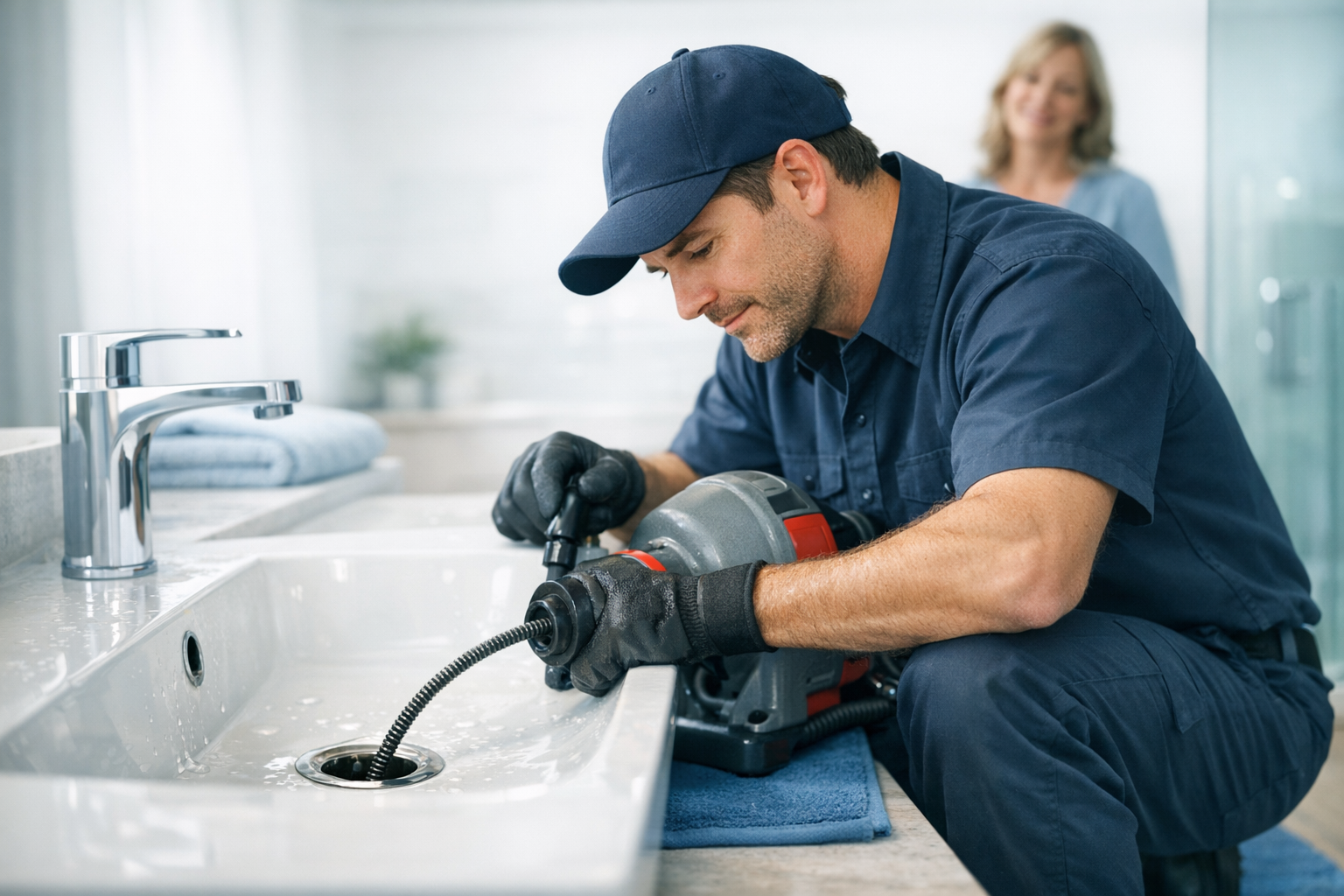
Drain snaking (sometimes called cabling or augering) uses a long, flexible metal cable with a cutting or corkscrew tip that is fed into the pipe. A motor spins the cable, and the tip breaks through the clog or hooks onto it so it can be pulled out. This is the standard approach for most household clogs: hair buildup in a bathroom drain, food and grease in a kitchen line, or a blockage in a toilet drain.
Snaking is fast, effective for the majority of residential clogs, and safe for most pipe types. It is what you will see used on a typical service call for a single clogged drain.
The technician selects their approach based on what the inspection reveals and explains why before any work begins. You should not have to guess what is happening or why.
Step 3: The Cleaning Itself
This is the part where the actual work happens. Here is what you can realistically expect as a homeowner while the technician is working.
You will hear some noise. A motorized snake makes a steady mechanical whirring sound. It is not alarmingly loud, but it is not silent work.
There may be some water. When a clog clears, the backed-up water has to go somewhere. A professional technician comes prepared with towels and takes precautions to protect your floors. Many technicians use shoe covers or booties to keep your home clean. This is a reasonable thing to expect from any licensed drain-cleaning company.
The technician works at the access point. Depending on the clog, that could be the drain opening itself, a cleanout access point in the basement or outside the house, or a nearby fixture. You do not need to be standing over them the whole time, but a good technician will keep you informed about what they are finding and doing.
Timing varies. A straightforward clogged sink or toilet can often be cleared relatively quickly once the equipment is set up. A main sewer line clog can take longer, especially if there is significant buildup or the cleanout point is harder to access. The technician should give you a realistic estimate before they start.
Step 4: Testing and Confirming the Drain Is Clear
Once the blockage has been removed, the technician does not just pack up and leave. The next step is running water through the system, sometimes from multiple fixtures, to verify that the drain is flowing freely. They are checking that the water moves quickly, drains completely, and does not back up again under normal flow.
This verification step matters. There is a real difference between assuming the repair worked and actually watching the drain perform the way it should. Before the technician leaves, you should feel confident that your drain is actually draining.
Step 5: What Happens After the Cleaning
A professional drain cleaning visit does not end the moment the water starts flowing again. The technician should walk you through what they found, what they did, and what you can do to keep your drains working well going forward.
Expect a plain-language summary. The technician should tell you what caused the clog — grease buildup, hair accumulation, root intrusion, a foreign object — and what method they used to clear it. If they noticed anything worth keeping an eye on, they should explain that too.
Expect basic prevention tips. These typically include:
- Using a drain screen or hair catcher in bathroom drains
- Avoiding pouring grease or cooking oil down the kitchen sink
- Running hot water through the kitchen drain after washing dishes
- Not flushing anything other than toilet paper
- Scheduling professional cleaning periodically — generally every 18 to 24 months for preventive maintenance, or more often if you have older pipes or a history of recurring issues
Expect cleanup. The technician should leave the work area clean. Debris pulled from the drain should be disposed of properly, floor protection should be removed, and the space should look the same as or better than when they arrived.
What If the Problem Is Bigger Than a Clog?
Sometimes what looks like a clogged drain turns out to be something more serious. During the inspection or cleaning, the technician may discover signs of:
- A collapsed or broken section of pipe
- Severe root intrusion that has damaged the pipe wall
- A sagging or “bellied” pipe that traps waste and water
- Corrosion or deterioration in older pipe materials
Drain cleaning cannot fix structural damage. If the pipe itself is compromised, cleaning will only provide a temporary improvement before the problem returns. In these situations, a good technician will be upfront about what they found, explain the limitation clearly, and suggest appropriate next steps.
This is actually one of the most valuable things a professional drain cleaning visit can reveal. Catching a pipe problem early — before it turns into a sewage backup in your basement — can save you from much bigger headaches later.
How Much Does Professional Drain Cleaning Cost?
Cost is one of the top concerns homeowners have when deciding whether to call a professional. At Just Drains, drain cleaning starts at $63, which is designed to make professional help accessible when you need it instead of putting it off and risking a worse problem. Pricing depends on the specific situation, and the goal is to be upfront about cost before any work begins so there are no surprises.
When calling any drain-cleaning company, it is fair to ask: What does the quoted price include? Will there be additional charges if the job takes longer than expected? Is the assessment included in the service cost? A trustworthy company answers these questions clearly before they start working.
Signs It Is Time to Call a Professional
Not every slow drain needs a professional visit. But there are clear signals that DIY is not going to cut it:
- The plunger is not working. If repeated plunging does not clear the clog, the blockage is likely too deep or too solid for a plunger to reach.
- Multiple drains are slow or backing up at the same time. This usually points to a mainline sewer issue, not a problem with a single fixture.
- You notice a sewage smell. Odors coming from drains, especially in the basement or near floor drains, often indicate a backup deeper in the system.
- Water is coming back up. If flushing a toilet causes water to rise in the shower drain, or running the washing machine backs up the kitchen sink, the main line is likely involved.
- The clog keeps coming back. A drain that clogs repeatedly even after you clear it may have a deeper issue like root intrusion, grease buildup, or a partial pipe problem.
- Gurgling sounds from drains. Air trapped by a blockage makes drains gurgle when water runs. This is a sign the clog may be growing.
If you are dealing with any of these situations — especially sewage backup or multiple drains affected at once — it is worth calling a licensed drain-cleaning company sooner rather than later. At Just Drains, the team is equipped to handle clogged drains, clogged sinks, clogged toilets, backed-up sewer lines, and mainline sewer clogs, and the goal is to get there fast so the problem does not get worse while you wait.
Why Professional Drain Cleaning Works Better Than Store-Bought Products
Chemical drain cleaners from the hardware store can sometimes move a minor clog, but they come with real trade-offs that are worth understanding.
They only address the surface of the clog. Chemical products typically dissolve a narrow channel through the blockage. The drain may flow temporarily, but the bulk of the buildup stays in place and the clog often returns within weeks.
They can damage pipes over time. Many chemical drain cleaners generate heat as they work. Repeated use can corrode or weaken pipe walls, especially in older homes with pipes that have already seen decades of service.
They cannot reach deep blockages. If the clog is further down the line — in a branch connection or the main sewer — liquid chemicals poured into a sink or toilet simply cannot travel far enough to make contact with the problem.
Professional drain cleaning uses mechanical force to physically remove the blockage and restore full flow. It addresses the actual cause of the clog rather than dissolving just enough to let water trickle through temporarily.
Frequently Asked Questions
How long does a professional drain cleaning take?
Timing varies depending on the location and severity of the clog. Many single-drain clogs can be cleared within an hour once the technician begins working. Main sewer line cleaning can take longer depending on the severity of the blockage and accessibility of the cleanout point. Your technician should give you an estimate before starting.
Do I need to be home during the service?
Yes, it is best to be home. The technician may need to access multiple areas of the house, run fixtures, and walk you through what they find. Being present also means you can ask questions and see the work firsthand.
Will the technician make a mess in my home?
A professional technician takes steps to protect your space, including shoe covers, floor protection, and proper debris disposal. Some water is normal during the process, but the area should be cleaned up before the technician leaves.
How often should I have my drains professionally cleaned?
For preventive maintenance, every 18 to 24 months is a common recommendation. Homes with aging pipes, mature trees growing near the sewer line, or a track record of repeat clogs may benefit from more frequent service.
What if the technician finds a bigger problem during the visit?
When the inspection turns up a cracked, collapsed, or severely deteriorated pipe, a straightforward explanation of the findings and available options is what you should expect from the technician. Drain cleaning alone cannot resolve structural pipe damage, and a reputable company will be transparent about that rather than proceeding with work that misses the root cause.
Will drain cleaning damage my pipes?
Standard drain snaking is safe for the vast majority of residential pipes. A qualified technician evaluates your plumbing before choosing a method and will let you know if any concerns arise.
When You Are Ready to Call
Dealing with a clogged drain, a backed-up sewer line, or a toilet that will not flush is stressful. The smell, the mess, the uncertainty about what is wrong and how much it will cost — it all adds up fast.
Now you know what the process looks like from start to finish. A professional drain cleaning visit is straightforward. A licensed technician shows up, figures out where the clog is and what is causing it, clears it with the right tools, tests the system, and walks you through what happened and how to prevent it next time.
At Just Drains, that process starts with a phone call and the goal of getting a licensed technician to your home in 60 minutes. Drain cleaning starts at $63, and the focus is simple: unclog your drain fast so your home gets back to normal.
If you are dealing with a drain problem right now, or if the signs are pointing in that direction, call Just Drains now and let a licensed drain-cleaning professional take it from here.