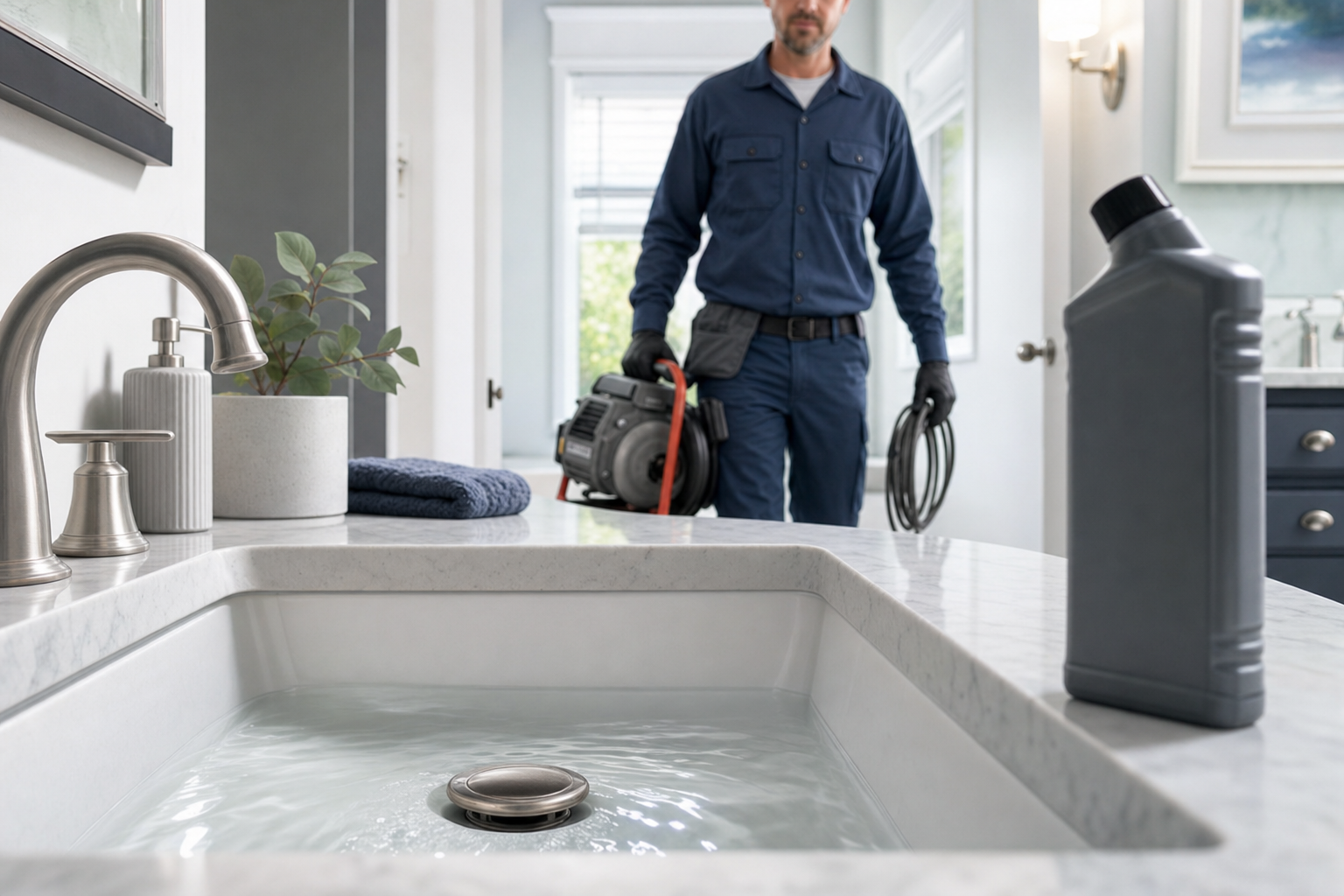
When to Stop Using Chemical Drain Cleaner and Call a Professional
If you have poured chemical drain cleaner down the same drain more than once in the past few months and the problem keeps coming back, the cleaner is not fixing your clog — it is temporarily masking it. Recurring slow drains, standing water, foul smells, or multiple fixtures backing up at once are signs that the blockage is deeper or more serious than a store-bought product can reach.
Chemical drain cleaners can work on a minor, one-time surface clog — a small clump of hair near the drain opening, for example. But when you find yourself reaching for the bottle again and again, something else is going on inside your pipes. This article will help you figure out what your drains are actually telling you, when chemicals stop being a reasonable option, and what to do next.
When Chemical Drain Cleaners Are Actually Fine
Before getting into the warning signs, it is worth being honest: chemical drain cleaners are not always the wrong choice. A single slow drain caused by soap buildup or a small hair clog near the surface of a bathroom sink can sometimes be cleared with one application. If you use a chemical cleaner once, the drain flows normally again, and it stays clear for months, the product did its job.
The problem starts when that one-time fix becomes a recurring habit. If any of the following situations sound familiar, the issue has moved beyond what chemicals can handle.
7 Signs Your Drain Problem Has Outgrown Chemical Cleaners
1. The Same Drain Keeps Clogging After You Treat It
This is the most common pattern homeowners describe, and it is the clearest signal that chemicals are not enough. Most chemical drain cleaners work by generating heat and dissolving organic material — but they only burn a narrow channel through the clog. The rest of the buildup stays in place against the pipe walls. Within days or weeks, that narrow channel closes back up, and the drain slows down again.
If you have treated the same kitchen sink or shower drain two or three times and the clog keeps returning, the obstruction is either too large, too deep, or too solid for a chemical reaction to fully clear it. A licensed drain cleaning professional uses mechanical tools that physically break apart and remove the entire blockage — not just a path through the middle of it.
2. More Than One Drain in Your Home Is Slow at the Same Time
This is an important distinction many homeowners miss. When only one fixture is draining slowly, the blockage is almost certainly contained within that fixture’s individual drain line. But when your kitchen sink, a bathroom sink, and a shower are all sluggish at the same time, the trouble has likely moved further downstream — into your main sewer line.
Your main sewer line is the single pipe responsible for carrying all wastewater away from your home to either the municipal sewer system or your septic tank. When that pipe develops a partial obstruction, every fixture tied into it begins to slow down. Applying chemical cleaner at one sink has no way of reaching a blockage located twenty, forty, or sixty feet further down the line. That kind of problem calls for professional sewer line clearing.
3. Water Backs Up Into a Different Fixture
This is one of the more alarming signs, and it often catches homeowners off guard. You flush a toilet and water bubbles up in the bathtub. You run the kitchen sink and notice standing water rising in the laundry drain. When water from one fixture shows up in another, those fixtures share a drain line — and something is blocking the shared section.
Chemical cleaners poured into one fixture have no reliable way to reach or clear a blockage in a shared drain line or a main sewer line. Cross-fixture backups are a strong signal that the blockage is systemic, not localized, and they often get worse quickly if left unaddressed.
4. Foul or Sewage-Like Odors Coming From Your Drains
A persistent bad smell from a drain — especially one that smells like sewage or rotten eggs — usually means organic waste is sitting and decaying somewhere in the pipe. Chemical cleaners may briefly cover the odor with their own strong chemical smell, but once that fades, the source of the stench is still there.
In some cases, the odor comes from a dried-out P-trap — the U-shaped section of pipe beneath a sink or shower that holds a small amount of water to block sewer gases. Running water for a minute can fix that. But if the smell persists even when the trap is full, there is likely a buildup of decomposing material deeper in the line that needs to be physically removed.
5. Gurgling or Bubbling Noises Coming From Drains or Toilets
A gurgling drain is a sign that air is being trapped and pushed back up through water sitting in the pipe. That occurs when a partial obstruction interferes with the normal movement of air through the drain system. You may notice it coming from a toilet that has not been recently used, or from a floor drain in the basement.
Gurgling is not just annoying — it is a diagnostic clue. It tells you that the obstruction is significant enough to disrupt how air and water move through your pipes. A chemical cleaner sitting in a partially blocked line is unlikely to restore that airflow. The blockage needs to be mechanically cleared.
6. Standing Water That Will Not Drain Even After Treatment
If you pour chemical drain cleaner into a sink or tub, wait the recommended time, and the water is still sitting there, the blockage is either complete or nearly complete. At that point, the chemical product is just sitting in a pool of standing water with nowhere to go. It cannot reach the clog effectively, and the caustic solution is now sitting against the inside of your pipes, generating heat — which can weaken older pipe materials over time.
A practical safety note: if you have poured a chemical drain cleaner into a fixture and the water has not drained, do not plunge the drain. Plunging can splash caustic chemical water back up and out of the fixture. Instead, let the water sit, ventilate the room, and call a drain cleaning professional. When you call, let them know which product you used — this helps the technician work safely.
7. You Are Buying Drain Cleaner Every Month
Sometimes the clearest sign is not a single dramatic symptom — it is a pattern. If you realize you have purchased drain cleaner three, four, or five times in recent months, step back and consider the math. Each bottle costs somewhere between $7 and $15, and none of them has solved the underlying problem. Meanwhile, the repeated chemical exposure may be gradually weakening your pipes, especially if your home has older cast iron or galvanized steel drain lines — which many homes across Central New Jersey do.
A professional drain cleaning visit can address what months of chemical treatments could not, and may help break the cycle of repeat purchases that only provide temporary relief.
Why Chemical Cleaners Cannot Fix Every Clog
Understanding how chemical drain cleaners actually work helps explain why they fail on deeper or recurring problems.
Most household drain cleaners contain either sodium hydroxide (lye) or sulfuric acid. These chemicals generate heat and dissolve organic material — hair, grease, soap residue — on contact. That works when the clog is small, soft, and close to the drain opening.
But chemical cleaners cannot do any of the following:
- Reach a blockage that is far down the line, such as in a main sewer line
- Break through solid obstructions like mineral scale, hardened grease buildup, or tree root intrusion
- Clear a clog that spans the full diameter of the pipe — they burn through the center but leave the edges intact
- Address a pipe that has partially collapsed, bellied, or shifted at a joint
With repeated use, these chemicals can also damage your pipes. Cast iron pipes, common in older New Jersey homes, can corrode faster with regular chemical exposure. Galvanized steel pipes are similarly vulnerable. Even PVC joints can soften if exposed to intense heat from chemical reactions over and over again. The product that is supposed to help your pipes can gradually make them more fragile.
Single-Fixture Clog vs. Main Sewer Line Problem
One of the most useful things you can do before calling anyone is figure out whether your issue is localized or system-wide. Here is a simple way to tell:
| What You Are Seeing | What It Likely Means |
|---|---|
| One sink or shower drains slowly; all other fixtures work fine | Localized clog in that fixture’s drain line — may respond to a plunger or one chemical treatment |
| Multiple drains in the home are slow or backing up | Likely a blockage in the main sewer line — needs professional sewer line clearing |
| Water backs up into a different fixture when you use one | Shared drain line or main sewer line blockage — call a professional |
| Toilet flushes slowly and gurgles, or won’t flush at all | Could be a localized toilet clog or a main line issue — if a plunger does not solve it, call a professional |
| Sewage smell from multiple drains or from the basement | Likely a deeper blockage causing waste to sit in the line — needs professional attention |
The main sewer line distinction matters because it changes both the urgency and the type of service needed. A backed-up main line can escalate from slow drains to sewage backing up into your home. If you are noticing problems in more than one fixture, do not wait to see if it resolves on its own.
A Simple Decision Rule
If you are trying to decide whether your drain problem still qualifies as a DIY situation or whether it is time to call someone, use this as a guide:
- One slow drain, first time it has happened: try a plunger. If that does not work, one application of a chemical cleaner may be reasonable.
- Same drain clogging for the second or third time: stop using chemicals. The clog is not being fully cleared, and repeated chemical use can damage your pipes. Call a drain cleaning professional.
- Two or more drains are slow or backing up at the same time: this points to a main sewer line issue. Call a professional for sewer line clearing.
- Water is backing up into another fixture, or you smell sewage: do not wait. Call now — this can get worse quickly.
What to Do If You Have Already Poured Chemicals and the Drain Is Still Clogged
If you are reading this with a sink full of standing water and a half-empty bottle of drain cleaner on the counter, here is what to do:
- Do not add more chemical cleaner. Doubling the dose does not double the effectiveness. It increases the concentration of caustic material sitting against your pipes.
- Do not plunge the drain. With chemical-treated water sitting in the fixture, plunging can splash it back up. That water can irritate skin and eyes.
- Ventilate the area. Open a window or turn on the bathroom fan if fumes are noticeable.
- Call a drain cleaning professional and tell them what product you used. This is important — it lets the technician take appropriate precautions when they work on the line.
What Professional Drain Cleaning Involves
If you have never called a drain cleaning company before, it can feel like an unknown. Here is what a typical visit looks like at a high level.
A licensed drain cleaning technician uses mechanical tools — most commonly a drain snake or motorized auger — to physically reach the blockage and break it apart or pull it out. Unlike chemicals, these tools do not rely on dissolving material from a distance. They make direct contact with the clog and work to remove it.
For main sewer line blockages, the technician feeds a heavier-duty cable through a cleanout access point to reach obstructions that are much further down the line — far beyond where any household product could reach.
The goal is a fully cleared pipe, not just a narrow chemical channel that may close up again in a few weeks.
When to Call Just Drains
If you are a homeowner in Central New Jersey, the Jersey Shore, or the surrounding areas — including Monmouth, Mercer, Union, Morris, or Ocean County — and your drain problem has moved past the point where a plunger or a bottle of cleaner can help, Just Drains is a licensed drain and sewer cleaning company built for exactly this kind of call.
Just Drains focuses specifically on drain cleaning and sewer line clearing — clogged sinks, clogged toilets, slow drains, clogged tubs and showers, backed-up sewer lines, and main line blockages. Drain cleaning starts at $63, and Just Drains aims to be at your home in as little as 60 minutes.
You do not need to diagnose the full problem yourself. If your drains are not working the way they should, call and describe what you are seeing. That is enough to get started.
Call Now: (732) 279-2427
Frequently Asked Questions
When should I stop using chemical drain cleaner and call a plumber?
If you have used a chemical drain cleaner more than once on the same drain and the clog keeps returning, stop and call a licensed drain cleaning professional. Repeated use signals a deeper blockage that chemicals cannot fully clear, and continued use can weaken your pipes over time.
Can chemical drain cleaners damage pipes?
Yes, particularly with repeated use. The heat generated by the chemical reaction can corrode cast iron and galvanized steel pipes and may soften PVC joints over time. Older homes with metal drain lines are especially vulnerable.
How can I tell if the problem is a single clogged drain or a main sewer line issue?
If only one fixture is draining slowly and everything else works normally, the clog is likely localized. If two or more fixtures are slow, water backs up into a different fixture, or you smell sewage from multiple drains, the problem is likely in the main sewer line and needs professional sewer line clearing.
Is professional drain cleaning worth the cost compared to buying more chemical cleaner?
In many cases involving recurring clogs, it can be. A bottle of chemical cleaner costs $7 to $15 per use and may need to be repeated monthly without addressing the underlying problem. Professional drain cleaning with Just Drains starts at $63 and is aimed at clearing the actual blockage rather than temporarily masking it.
What should I tell the drain cleaning technician when I call?
Let them know which fixtures are affected, how long the problem has been happening, whether the issue is getting worse, and whether you have used any chemical drain cleaning products recently. This helps the technician arrive prepared and work safely.