Main Sewer Line Backing Up? What Monmouth County Homeowners Should Do Right Now
If sewage is backing up through your basement floor drain, bathtub, or toilets, you likely have a main sewer line blockage — and you need to act quickly. Stop using all water in your home immediately, keep your family and pets away from any affected areas, and call a licensed drain and sewer cleaning professional to clear the line.
Just Drains provides emergency main line sewer clearing for homeowners across Monmouth County and the surrounding Central New Jersey area. If your main sewer line is backing up right now, call us at (732) 279-2427 to get help fast.
If you have a few minutes to read before calling, this guide walks you through exactly how to tell if your main line is the problem, what to do while you wait for help, what causes these backups in our area, and what the clearing process actually looks like when a professional arrives.
How to Tell If It Is Your Main Sewer Line and Not Just a Single Clogged Drain
Not every clog is a main line problem. A single slow sink or a toilet that needs plunging is usually a blockage in that fixture’s branch drain — the smaller pipe that connects it to the larger main sewer line. That kind of clog is frustrating, but it is contained to one spot.
A main sewer line blockage is different. Your main line is the single large pipe that carries all the wastewater from your entire home out to the municipal sewer or your septic system. When that pipe gets blocked, wastewater has nowhere to go — and it backs up through the lowest drains in your house.
Here is how to tell the difference:
| Single Drain Clog | Main Sewer Line Backup |
|---|---|
| Only one fixture is slow or backed up | Multiple fixtures are backing up at the same time |
| Other drains in the house work fine | Flushing a toilet causes water to come up in a tub or shower |
| A plunger or basic clearing may fix it | Plunging one fixture does not help — or makes another one worse |
| Usually affects one bathroom or one sink | Water or sewage appears at the lowest drain in the house, often the basement floor drain |
| No unusual sounds from other drains | You hear gurgling in multiple drains when you run water anywhere |
The clearest sign of a main line backup: when using water in one part of the house causes a reaction in a completely different fixture. If flushing upstairs sends water bubbling up through your basement drain or first-floor bathtub, the main line is almost certainly blocked.
At that point, a plunger is not going to help. You need a professional who can access and clear the main sewer line itself.
What to Do Immediately During a Main Line Sewer Backup
A main line backup can feel overwhelming, especially when there is sewage involved. Here is what to do right now, step by step:
- Stop using all water in the house. Do not flush toilets, run sinks, start the dishwasher, or use the washing machine. Every gallon of water you send down a drain adds to the backup because it has nowhere to go.
- Keep everyone away from affected areas. Sewage backup can contain harmful bacteria. Keep children and pets out of any room where water or sewage has come up through a drain. Avoid walking through standing wastewater if at all possible.
- Do not pour chemical drain cleaners down your drains. Store-bought drain cleaners are designed for minor clogs in branch lines. They will not clear a main sewer line blockage, and they can create complications for the professional who clears the line.
- If water is actively rising, shut off the main water supply valve. This prevents any automatic water use — such as an ice maker or a toilet fill valve — from adding to the backup. Your main shutoff valve is typically located near the water meter or where the water line enters your home.
- Document what you see. Take photos or short videos of the affected areas, including any standing water, damaged belongings, and which drains are backing up. This documentation can be helpful if you need to file an insurance claim later.
- Call a licensed drain and sewer cleaning professional. A main sewer line blockage requires professional equipment to clear. The sooner you call, the sooner the line can be opened and the backup can stop.
Just Drains specializes in exactly this kind of emergency. We provide sewer line clearing across Monmouth County, and we work to reach you as quickly as possible. Ask about our service-in-60-minutes offer when you call. Call (732) 279-2427 now if you are dealing with a backup.
What Causes Main Sewer Lines to Back Up in Monmouth County
Main line backups do not usually happen out of nowhere. Most of the time, something has been building up gradually until the line finally blocks completely. Here are the most common causes we see in the Monmouth County area:
Tree Root Intrusion
This is one of the most frequent causes of main line blockages in established neighborhoods throughout Central New Jersey. Tree roots naturally seek out moisture, and even small cracks or joints in an older sewer pipe can attract root growth. Over time, roots work their way into the pipe and create a mass that traps waste and eventually blocks the line entirely.
Grease and Debris Buildup
Grease, soap residue, food particles, and other debris accumulate inside sewer lines over months and years. Cooking grease is especially problematic — it goes down the kitchen sink as a liquid but cools and hardens inside the pipe, gradually narrowing the passage until the line cannot handle normal flow.
Aging Pipes
Many homes in parts of Monmouth County were built decades ago, and their original sewer lines may be made of clay, cast iron, or Orangeburg pipe. These materials can crack, collapse, or deteriorate over time, creating rough spots inside the pipe where blockages are more likely to form.
Heavy Rain and Storm Runoff
Monmouth County’s proximity to the Jersey Shore means homeowners in the area can experience heavy seasonal rainfall and storm surges. In some cases, excess groundwater or stormwater infiltration can put additional stress on a sewer line, especially one that already has partial buildup or root intrusion inside it.
Understanding the cause can help you prevent future backups, but when a blockage is active, the priority is clearing the line — which is what drain and sewer cleaning professionals are equipped to do.
Is This Your Responsibility or the Municipality’s?
This is a question many Monmouth County homeowners do not think about until a backup happens, and it matters because it affects who you should call.
The general rule: the sewer line from your house to the property line, often called the sewer lateral, is your responsibility as the homeowner. The main public sewer line that runs under the street is maintained by your local municipality or sewer authority.
If your main line backup is happening inside your home and affecting your fixtures, it is almost certainly a blockage in your private sewer lateral — and that is your responsibility to have cleared. A licensed drain and sewer cleaning company like Just Drains can handle this.
If you suspect the problem is in the public main, or if you see sewage surfacing in the street or affecting multiple homes on your block, contact your local municipal sewer authority as well. But in most single-home backup situations, the blockage is on the homeowner’s side of the line.
What Happens When a Sewer Cleaning Professional Arrives
If you have never had a main line cleared before, it helps to know what the process looks like. Here is a general walkthrough of what to expect:
- Locating the cleanout. Your home has a sewer cleanout — a capped access point, usually found in the basement, crawl space, or outside near the foundation. This is where the technician accesses your main sewer line. If you know where yours is, pointing it out can save time.
- Opening and assessing the line. The technician removes the cleanout cap and checks the condition of the line. If sewage is standing in the cleanout pipe, that confirms the blockage is downstream in the main line.
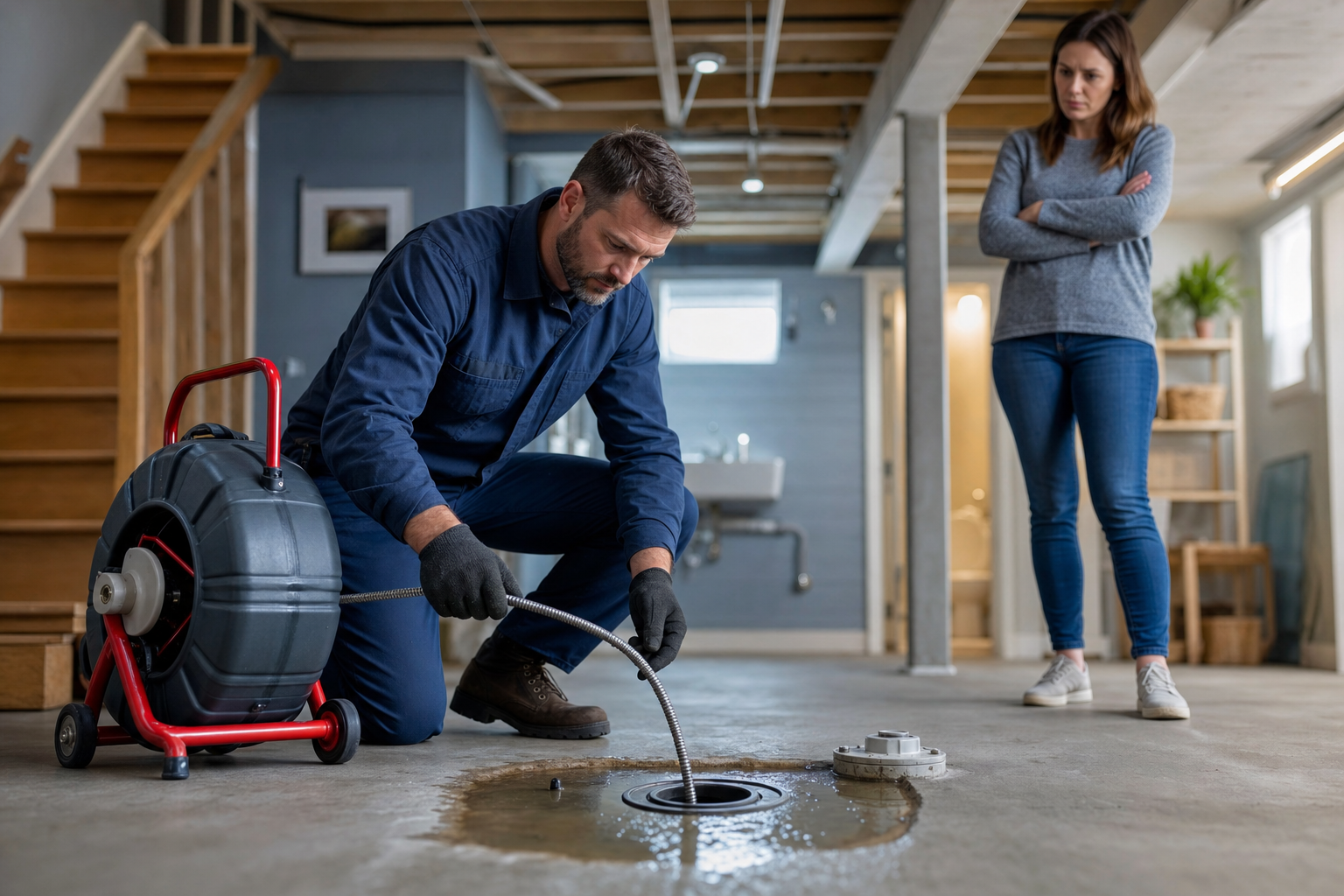
- Clearing the blockage. Using professional drain and sewer cleaning equipment, the technician works through the line to break up or push through the blockage — whether it is caused by roots, grease, debris, or a combination. This is mechanical cleaning, not a chemical treatment.
- Confirming flow is restored. Once the blockage is cleared, the technician runs water through the line to verify it is flowing freely again. You may be asked to flush a toilet or run a faucet to confirm that everything is draining properly from inside the house.
The process can be straightforward when the blockage is accessible and the line is in reasonable condition. In some cases, if the technician finds that the pipe itself is damaged, collapsed, or needs work beyond clearing, they will let you know so you can take the right next steps with an appropriate specialist.
Just Drains focuses specifically on drain cleaning and sewer line clearing. When you call us for a main line backup, our job is to clear the blockage and restore flow — and we work to get to you as quickly as possible.
Why Getting Help Quickly Matters
A main line backup is not the kind of problem that improves with time. Here is why acting quickly is important:
- Health concerns. Sewage contains bacteria and other pathogens that can pose health risks, especially in enclosed spaces like a basement. The longer wastewater sits in your home, the greater the potential for exposure. Avoid direct contact with backed-up water, and keep the affected area ventilated if possible.
- Property damage. Standing sewage can damage flooring, drywall, baseboards, stored belongings, and anything else it reaches. The damage can compound the longer the water sits. If the backup reaches finished living areas, cleanup can become significantly more involved.
- Escalation. A partial blockage can become a complete blockage. What starts as a slow drain in the basement can turn into sewage coming up through every low-lying fixture in the house if the line continues to fill.
- Insurance documentation. If you plan to file a homeowner’s insurance claim for sewer backup damage, acting promptly and documenting the situation helps. Many policies expect you to take reasonable steps to prevent further damage once you are aware of the problem.
Just Drains works to reach Monmouth County homeowners quickly. Ask about our service-in-60-minutes offer — we aim to arrive while the problem is still manageable, not hours or days later when the damage has spread.
When to Stop Trying DIY Fixes and Call a Professional
There is nothing wrong with trying a plunger on a single clogged toilet or a slow bathroom sink. But there are clear signals that you have moved past DIY territory and need professional drain and sewer cleaning help:
- Multiple drains in the house are slow, gurgling, or backed up at the same time
- Sewage or wastewater is coming up through a floor drain, tub, or shower
- A plunger is not working, or clearing one fixture causes backup in another
- You smell sewage in areas of the house where you normally would not
- A drain that was recently cleared has clogged again within days or weeks
- Water backs up when you run the washing machine or dishwasher
Any of these patterns can indicate a main line issue. At that point, the fastest and safest path is to call a licensed drain and sewer cleaning professional who can access and clear the main sewer line directly.
Just Drains handles exactly these situations for homeowners throughout Monmouth County and the surrounding Central New Jersey area. Drain cleaning starts at $63 — call (732) 279-2427 to get help now.
Frequently Asked Questions
How do I know if it is my main sewer line or just one clogged drain?
The main indicator is whether multiple fixtures are affected. If only one sink or one toilet is slow, it is likely a branch-line clog. If several fixtures are backing up at the same time — or if using one fixture causes a reaction in another — the blockage is almost certainly in the main sewer line. Water or sewage appearing at the lowest drain in the house, such as a basement floor drain, is another strong sign.
Is a sewer backup dangerous to my family?
Sewage can contain bacteria, viruses, and other pathogens that pose health risks, particularly with direct contact or prolonged exposure in enclosed spaces. Keep family members and pets away from affected areas, avoid touching or wading through standing wastewater, and ventilate the area if you can do so safely. Call a professional to have the line cleared as soon as possible.
How fast can Just Drains get to my home in Monmouth County?
Just Drains offers service in 60 minutes for homeowners across Monmouth County and the surrounding Central New Jersey area. Call (732) 279-2427 to let us know what is happening, and we will work to get a technician to you as quickly as possible.
What should I avoid doing during a sewer backup?
Stop using all water in the house — do not flush, run sinks, or start appliances that use water. Do not pour chemical drain cleaners into the drains, as they are not effective on main line blockages and can create complications for the professional who clears the line. Main sewer cleanouts should be handled by a licensed professional with the proper equipment — this is not a task for homeowners to attempt on their own.
What causes a main sewer line to back up?
The most common causes are tree root intrusion into the pipe, grease and debris buildup over time, aging or deteriorating pipe materials, and in some cases, heavy rain putting additional stress on the system. In established areas of Monmouth County, tree roots and aging pipes are especially common factors.
Will my homeowner’s insurance cover sewer backup damage?
It depends on your specific policy. Standard homeowner’s insurance does not always cover sewer backup damage — some policies require a separate sewer backup endorsement or rider. Document the damage with photos and videos, keep records of the service call, and contact your insurance provider as soon as possible to understand your coverage. Acting quickly and documenting everything works in your favor.
What is the difference between drain cleaning and sewer repair?
Drain cleaning and sewer line clearing involve removing blockages from the inside of the pipe so that wastewater can flow freely again. Sewer repair involves physically fixing or replacing damaged pipe — a different type of work requiring a different specialist. Just Drains specializes in drain cleaning and sewer line clearing. If a technician finds that your pipe needs structural repair, they will let you know so you can plan accordingly.
Clear the Line, Clear the Stress
A main sewer line backup is one of the most stressful things a homeowner can deal with — the mess, the smell, the uncertainty about what to do next. You do not have to figure it out alone.
Just Drains is a licensed drain and sewer cleaning company serving Monmouth County and the surrounding Central New Jersey area. We focus on one thing: getting your drains and sewer lines flowing again, fast. Drain cleaning starts at $63, and we offer service in 60 minutes so you are not left waiting while the problem grows.
If your main sewer line is backing up, call Just Drains now at (732) 279-2427. We will get to work clearing the line so your home can get back to normal.