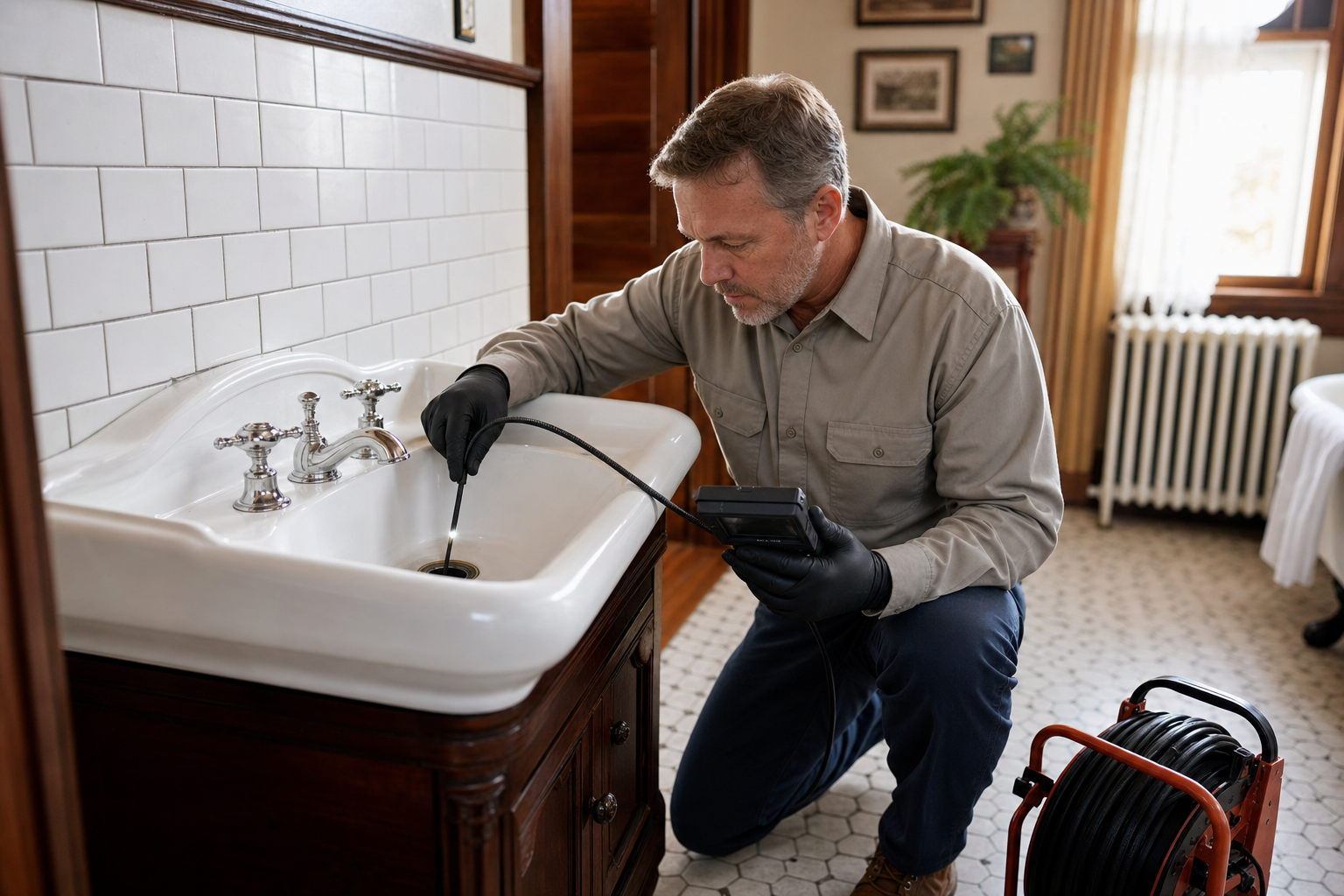
Drain Cleaning for Older Homes in Morris Plains: What Victorian-Era Plumbing Actually Needs
If you own an older home in Morris Plains — especially one built in the late 1800s or early 1900s — your drains do not function the same way they do in newer construction. The pipes are composed of different materials, they have endured more than a century of use, and the wrong cleaning method can cause more harm than the clog itself. Most standard drain cleaning advice is written for modern PVC systems, not for aging cast iron or clay pipes that have shifted, corroded, and been steadily encroached upon by tree roots over many decades.
This article explains why Victorian-era homes in Morris Plains present unique drain cleaning challenges, what pipe materials you are likely dealing with, which cleaning methods are appropriate and which are not, and how to recognize when a slow drain or a clog that keeps returning means it is time to contact a licensed drain and sewer cleaning professional. Just Drains works with homeowners throughout Morris County who face exactly these situations — and we know that older pipes require a careful, well-informed approach rather than simply a fast one.
Why Older Morris Plains Homes Have Different Drain Problems
Morris Plains has a housing stock that includes homes going back to the Victorian era and the early part of the twentieth century. These properties were built with plumbing materials and construction standards that differ substantially from anything installed over the past several decades. Knowing what is inside your walls and running beneath your yard is the essential starting point when a drain problem arises.
What Is Actually in Your Walls and Underground
Homes constructed before the mid-1900s in this part of Morris County typically have drain and sewer lines made from one or more of the following materials:
- Cast iron pipes — Sturdy when first installed, but susceptible to internal corrosion as the decades pass. The inner surfaces of aging cast iron pipes become rough and scaly as corrosion sets in, which catches grease, soap residue, and hair. This gradually reduces the pipe’s interior diameter and leads to clogs that return no matter how many times you clear them.
- Clay or terracotta sewer pipes — Widely used for underground sewer lines running between the house and the street. Clay pipes come in short sections fitted together at joints, and after a hundred or more years those joints can pull apart, shift, or fracture. Tree roots exploit even the smallest openings and establish themselves inside the pipe, producing persistent blockages far down the sewer line.
- Galvanized steel pipes — Occasionally present in older homes as drain or water supply lines. This material deteriorates from the interior outward, accumulating mineral deposits along the pipe walls that steadily choke off flow and produce ongoing slow-drain conditions.
A great many homes from this era contain a combination of all three — clay sewer pipe running underground, cast iron drain stacks within the walls, and individual sections that were repaired or upgraded with newer materials at various points over the years. That combination means a single home can have several different weak points, each of which calls for a different level of care when cleaning is performed.
How Age Changes the Way Pipes Clog
In a newer home with smooth PVC piping, most clogs follow a familiar pattern: hair in the shower drain, grease accumulation in the kitchen line, or something flushed down a toilet that did not belong there. The pipe walls are smooth, connections are well sealed, and the blockage is typically confined to one fixture.
In an older Morris Plains home, clogs form differently because of what has been taking place inside those pipes for decades:
- Scale buildup — Mineral deposits and corrosion byproducts coat the inner walls of cast iron and galvanized pipes, producing a rough texture that snags debris and steadily shrinks the usable pipe diameter with each passing year.
- Root intrusion — The large, established oak and maple trees characteristic of Victorian-era properties in Morris Plains send their roots in the direction of underground sewer lines, particularly clay pipes where the joints have aged. Roots work their way through even hairline openings and expand inside the pipe, trapping waste and generating blockages that return even after clearing.
- Pipe settling — Over the course of a century or more, the surrounding ground shifts. Underground sewer lines can develop low points — commonly referred to as bellied pipes — where solid waste settles and pools rather than continuing toward the main sewer. These depressions cause recurring clogs and sluggish drainage that cannot be resolved with a plunger.
- Corroded or separated joints — At the connections between pipe sections, age combined with ground movement can produce misalignment or gaps. Waste catches at these points and creates a location where clogs form again and again.
The outcome is that drain problems in older homes are rarely isolated, one-time occurrences. They tend to come back repeatedly, they frequently involve more than one fixture, and they often signal conditions that exist deeper in the sewer line rather than at the drain opening itself.
The Most Common Drain Issues in Victorian-Era Homes
If you live in an older home in Morris Plains, the following are the drain situations that arise most frequently — and what each one typically signals.
Recurring Kitchen and Bathroom Clogs
A sink that backs up or a tub that drains slowly and keeps returning to that state after you clear it usually indicates that the blockage is not at the drain opening itself. In older homes, the source of the problem is often farther down the line, where scale accumulation, corrosion, or a partially collapsed section is catching material. Plunging or reaching for a store-bought chemical product may relieve the immediate backup, but the underlying restriction causes the clog to reappear within days or weeks.
Multiple Slow Drains at Once
When several fixtures are all draining slowly at the same time — the kitchen sink, a bathroom sink, and the shower, for example — the issue almost certainly does not lie at any single drain. This pattern is a strong indicator of a blockage or restriction inside the main sewer line, the single large-diameter pipe that moves all wastewater from your home to the municipal system. In houses with aging clay sewer lines, this commonly points to root intrusion or a bellied section that has been accumulating waste over an extended period.
Basement Drain Backups and Sewage Smell
A basement floor drain that backs up — particularly one that pushes sewage odor or visible wastewater into the living space — is a clear signal that the main sewer line is not moving waste properly. This ranks among the most distressing situations a homeowner can encounter, combining mess, odor, and uncertainty about the underlying cause. In older homes, this condition is frequently tied to root intrusion, a collapsed or sagging section of clay pipe, or substantial scale accumulation inside the main line.
Gurgling Sounds After Flushing
Hearing gurgling from a sink or tub drain after flushing a toilet somewhere else in the house means that air is being pushed through the system because waste is not moving freely along the sewer line. In a Victorian-era home, this is often an early indicator that a main line restriction is developing. It does not necessarily mean the line is fully obstructed yet, but it does mean something is limiting flow and the situation is likely to deteriorate.
What Works for Old Pipes — and What Can Make Things Worse
The choice of drain cleaning method matters more in an older home than almost anywhere else. Using the wrong approach can convert a containable clog into a damaged pipe, and a damaged pipe in a century-old home is a far more serious problem than the original blockage.
Why Chemical Drain Cleaners Are Risky for Old Pipes
Caustic chemical drain cleaners — the type poured down the drain and left to work — are among the first remedies many homeowners try when drainage slows. In a newer home with PVC piping, these products occasionally clear a minor clog. In an older home with cast iron or clay pipes, they introduce specific hazards:
- Heat damage: Chemical drain products release heat during their reaction with the blockage. In cast iron pipes whose walls have already been thinned by years of internal corrosion, that heat can speed up deterioration and leave the pipe in worse condition than before.
- Incomplete clearing: Chemical products frequently break down only a portion of a blockage rather than eliminating it entirely, particularly in pipes with rough, heavily scaled interior surfaces. The drain may run slightly better for a short period and then clog again — and every application puts additional stress on already-compromised pipe walls.
- Joint damage in clay pipes: Chemical solutions can migrate through gaps in deteriorated clay pipe joints and alter the soil or bedding material around the pipe, potentially undermining the support structure over time.
For all of these reasons, chemical drain cleaners are not a sound choice for homes with older plumbing. The temporary improvement they may provide is not worth the added risk to pipes that are already in a fragile state.
Safer Alternatives for Between-Service Maintenance
Between scheduled professional drain cleanings, there are several things Morris Plains homeowners with older pipes can do to help maintain drainage without placing additional strain on the system:
- Enzyme-based drain maintenance products — These rely on naturally occurring bacteria to break down organic matter slowly over time. They produce no heat, they do not attack pipe walls, and they are broadly regarded as compatible with cast iron, clay, and galvanized piping. They are not capable of clearing an established blockage, but when used on a consistent basis they can slow the accumulation that eventually leads to clogs.
- Hot water flushing — Running hot — not boiling — water through the kitchen drain after cooking helps prevent grease from congealing inside the line. It is a straightforward practice that reduces one of the most common contributors to kitchen drain blockages.
- Drain screens — A simple mesh screen placed over shower and tub drains intercepts hair before it enters the pipe. In older homes where corrosion has left the interior pipe walls rough, hair that gets into the drain is significantly more likely to snag and accumulate than it would in a newer, smooth-walled system.
- Being mindful of what goes down the drain — Grease, coffee grounds, fibrous food scraps, and products marketed as “flushable” wipes create problems in any plumbing system, but they generate faster and more stubborn blockages in older pipes whose interiors have narrowed and roughened over time.
These practices can lengthen the interval between professional cleanings, but they are not a substitute for professional drain cleaning once a genuine blockage has formed.
When a Professional Drain Cleaning Is the Right Call
For owners of older homes, the point at which it makes sense to contact a professional is lower than it would be for a home with recently installed plumbing. The following table offers a practical reference:
| Situation | What It Likely Means | What to Do |
|---|---|---|
| One drain is slightly slow | Localized buildup near the fixture (hair, soap, grease) | Try a drain screen or enzyme maintenance product. If drainage does not improve within a day or two, contact a licensed drain cleaning professional. |
| One drain is fully clogged and a plunger does not clear it | Blockage deeper in the branch line, possibly compounded by scale or corrosion | Contact a licensed drain cleaning professional. Do not use chemical cleaners. |
| Multiple drains are slow at the same time | Main sewer line restriction — likely root intrusion, scale, or a bellied pipe | Arrange for professional sewer line clearing promptly. This condition will not resolve on its own. |
| Sewage smell or backup in the basement | Main sewer line blockage or significant restriction | Avoid contact with backed-up water. Contact a licensed drain and sewer cleaning company immediately. |
| Gurgling sounds from drains after flushing | A developing main line restriction limiting airflow | Arrange for professional assessment before a complete backup occurs. |
| A clog that returns after every attempt to clear it | An underlying pipe condition — corrosion, roots, a bellied section, or joint displacement | Professional drain cleaning to clear the line. If the problem persists after professional service, the pipe itself may warrant evaluation by a licensed plumber. |
In an older home, allowing a recurring or worsening drain situation to continue typically makes it harder and messier to resolve. Professional drain cleaning that physically removes the obstruction without depending on heat or harsh chemicals is a well-established and appropriate method for cast iron, clay, and galvanized piping when carried out by someone with genuine experience working with these materials.
What to Look for in a Drain Cleaning Company for an Older Home
Not every drain cleaning provider handles older homes with the same level of care. When selecting a company to call for a Victorian-era property in Morris Plains, these are the questions worth raising:
- Do they concentrate specifically on drain and sewer cleaning, or is it simply one entry among dozens of general plumbing services? A company whose primary focus is drain and sewer work is more likely to have direct experience with the pipe materials and conditions found in older homes.
- Are they licensed? A licensed company is held to state standards. That accountability matters for any plumbing-related work, and especially so when dealing with older systems where an error carries greater consequences.
- Can they walk you through their approach before work begins? A competent drain cleaning professional should be able to describe what they intend to do and the reasoning behind it, particularly when older pipe materials are involved.
- Are they upfront about pricing? You should have a clear cost figure before any work begins, not afterward. Vague estimates or on-the-spot pressure to approve additional services warrants caution.
- Do they cover your area and can they arrive promptly? When a sewer line is backed up or a toilet will not clear, response time matters. A local company that can reach you quickly is more practical than a larger operation sending technicians from a distant location.
None of these expectations are excessive. They represent the minimum a homeowner dealing with a stressful drain situation has every right to expect.
How Just Drains Handles Drain Cleaning in Morris Plains
Just Drains is a licensed drain and sewer cleaning company serving homeowners throughout Morris County, including Morris Plains. Our work centers exclusively on drain cleaning and sewer line clearing — it is the entirety of what we do.
For homeowners with older properties, that focused scope matters. When your house has cast iron drain stacks, clay sewer lines, or galvanized pipes that have been in continuous service for generations, you want a company whose technicians clear drains every single day — not one that last handled a drain between a water heater swap and a bathroom renovation.
We work with homeowners dealing with the issues most commonly encountered in older Morris Plains homes:
- Clogged sinks, toilets, tubs, and showers that will not clear with a plunger
- Slow drains that continue to worsen over time
- Recurring clogs that return after every attempt to address them
- Backed-up sewer lines and main line obstructions
- Emergency drain and sewer situations where the odor and mess require immediate attention
We understand that older pipes require a careful, informed approach. Clearing a drain in a Victorian-era Morris Plains home is not the same job as clearing one in a home built recently, and we approach each accordingly.
Drain cleaning starts at $63. We offer service in 60 minutes. No pressure, no extended sales conversation — just a licensed team that clears your drain or sewer line and restores normal conditions in your home.
If you are dealing with a drain or sewer problem right now, or if a recurring issue has you frustrated after repeated attempts to resolve it on your own, give us a call.
Call Now: (732) 279-2427
Frequently Asked Questions
Can drains in older Victorian homes be cleaned safely without harming the pipes?
Professional drain cleaning that physically removes obstructions without the use of heat or caustic chemicals is broadly recognized as a sound approach for cast iron, clay, and galvanized piping when performed by an experienced professional who is familiar with the materials and condition of the pipes involved. Just Drains focuses specifically on drain and sewer cleaning for homeowners throughout Morris County, including properties with older plumbing systems.
How do I find out what kind of pipes my older home has?
In many Victorian-era homes in the Morris Plains area, the drain stacks running inside the walls are cast iron — identifiable by their dark gray color and substantial weight — while the underground sewer line to the street is typically clay or terracotta, which appears reddish-brown and is installed in short fitted sections. Galvanized steel pipes, which are silver-gray with threaded joints, may also be present. Any exposed piping visible in a basement or utility space can often be identified by its color, texture, and connection style. A licensed drain and sewer cleaning professional can also help determine what you have during a service call.
Why do my drains keep clogging even after I clear them?
When blockages return repeatedly in an older home, it usually means the problem is not simply at the surface of the drain opening. Frequent underlying causes include internal corrosion and scale that has narrowed the pipe, root growth inside underground sewer lines, or a sunken pipe section where waste settles rather than flowing onward. These conditions remain in place after the immediate clog is removed and typically require professional drain cleaning to address properly.
Can chemical drain cleaners harm old pipes?
Yes. Caustic chemical products generate heat during their reaction with a blockage. In cast iron pipes whose walls have thinned from decades of internal corrosion, that heat can hasten further deterioration. In clay pipes, chemical solutions can seep through aged joints. These products also tend to only partially break down blockages in older pipes with rough, scaled interiors, which means the clog reappears quickly. Enzyme-based maintenance products are a safer option for routine upkeep, though they are not strong enough to clear an established blockage.
What is the difference between a single clogged drain and a main sewer line problem?
A single backed-up drain — one sluggish sink or one toilet that will not flush — generally indicates that the obstruction is in the branch drain line serving that particular fixture. When several fixtures all drain slowly at once, or when wastewater is pushing back up through a basement drain, the problem is almost certainly located in the main sewer line that carries all household waste to the municipal system. In older homes, main line blockages are typically the result of root intrusion, ground settling, or significant buildup, and they require professional sewer line clearing to resolve.
How much does drain cleaning cost for an older home?
At Just Drains, drain cleaning starts at $63. The final cost depends on the location and nature of the blockage, but you will have a clear figure before any work is performed. If you are uncertain whether your situation is a straightforward clog or something more involved, calling us is the quickest way to get clarity.
Take the Next Step
If you own an older home in Morris Plains and you are contending with a slow drain, a clogged sink or toilet that will not clear, a backup that keeps returning, or a sewer line that is not draining the way it should, you do not have to keep guessing or reaching for products and hoping for improvement.
Just Drains is a licensed drain and sewer cleaning company serving Morris County homeowners. We offer service in 60 minutes, and drain cleaning starts at $63. This is the work we concentrate on — clearing drains and sewer lines for homeowners who need dependable, straightforward help.
Call Now: (732) 279-2427