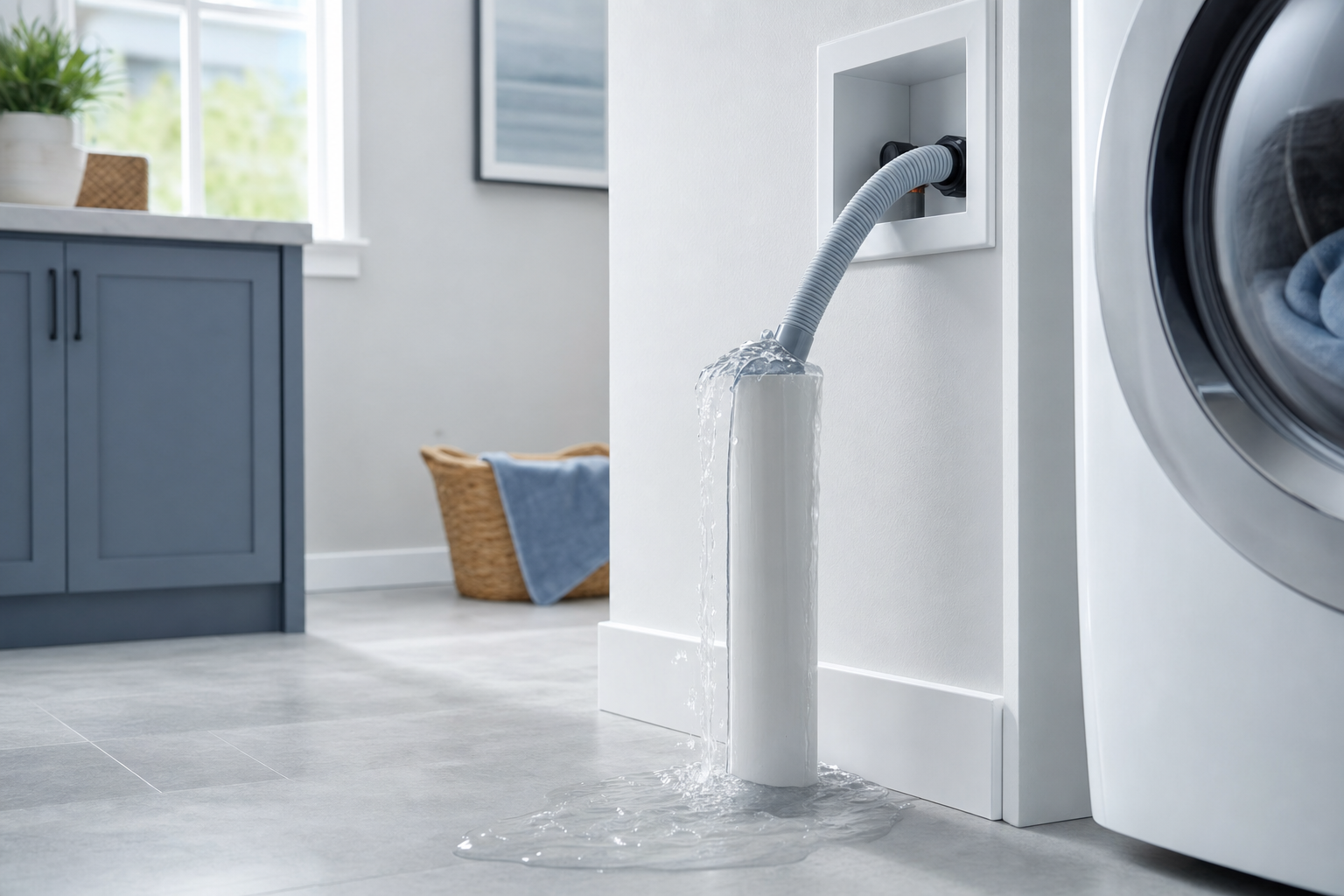
Why Your Laundry Standpipe Overflows Only When the Washer Drains
Your laundry standpipe overflows during the drain cycle because your washing machine pushes out a large volume of water faster than the drain system can accept it. A typical washer pumps an entire tub of water out in roughly two to three minutes — far more volume, far faster, than anything else connected to your household plumbing. If something in the drain line is slowing that flow even slightly, the water has nowhere to go but up and out of the standpipe onto your laundry room floor.
The rest of the time, no water is being forced into the pipe, so nothing overflows. That is why the problem shows up only during the drain cycle — it is the one moment when demand on that pipe is at its absolute highest. The overflow is not a washing machine malfunction. It is your drain system telling you it cannot keep up with the surge.
The real question is what is slowing the drain down. Some causes are things you can check yourself in a few minutes. Others point to a partial clog or a pipe condition that needs professional drain cleaning. This article walks through the most likely causes in order, gives you a way to read what your standpipe behavior actually means, and helps you decide whether this is something you can handle or whether it is time to call for help.
What a Standpipe Does and Why It Matters
A standpipe is the vertical pipe — usually about 34 inches tall and 2 inches in diameter — that your washing machine’s drain hose feeds into. It is open at the top so the hose can drop in without a sealed connection. Just below the standpipe is a P-trap — a curved pipe section that retains a small quantity of water, creating a seal that keeps sewer gases out of your living space. Below the P-trap, the drain line connects to a branch drain and eventually to your home’s main sewer line.
The standpipe works as a buffer. When the washer pumps water out, the water drops down the standpipe, passes through the P-trap, and flows into the drain line. A plumbing vent — a pipe that runs up through your roof — allows air to enter the system behind the water so it flows freely without creating suction or pressure problems.
When any part of this system is restricted — the standpipe itself, the P-trap, the branch drain, or the vent — the water backs up. And because the washer’s drain cycle pushes water harder and faster than a sink faucet or a shower, the standpipe is where the limitation shows up first.
The Most Likely Causes, in Order
Not every cause is equally common. The list below is ordered by what homeowners encounter most often, starting with the cause that explains the majority of standpipe overflows.
A Partial Clog in the Standpipe, P-Trap, or Drain Line
This is the most frequent cause. Over time, lint, soap residue, fabric softener buildup, and small debris accumulate inside the standpipe, settle in the P-trap, or coat the walls of the branch drain line. The buildup does not block the pipe completely — water from a sink or a slow trickle would still pass through. But when your washer pumps a full load of water into the pipe all at once, the narrowed opening cannot drain fast enough, and the water rises above the top of the standpipe.
The P-trap is especially vulnerable because it sits at the lowest point of the standpipe assembly. Lint and soap scum collect there over months and years, gradually reducing the pipe’s effective diameter. You may not notice any problem until the restriction reaches the point where only the washer’s high-volume surge triggers an overflow.
If this is the cause, the overflow typically gets worse over time. Loads that used to drain fine will start overflowing, and eventually even smaller loads may cause problems. This is a strong sign that the pipe needs to be professionally cleaned — a drain snake or mechanical cleaning clears the buildup and restores the full diameter of the pipe.
The Drain Hose Is Inserted Too Far Into the Standpipe
Your washing machine’s drain hose should sit only about 6 to 8 inches inside the standpipe. The gap between the hose and the inner wall of the standpipe creates an air gap — a space that allows air to flow alongside the water as it drains, preventing suction and allowing the water to move freely downward.
If the hose is pushed too far down — sometimes all the way to the P-trap — two things happen. First, the air gap disappears, and the water cannot drain efficiently because there is no air pathway. Second, the hose itself can partially block the pipe, creating a physical restriction right at the point where all the water is being pumped in.
This is one of the easiest things to check. Pull the washer away from the wall, look at how far the drain hose extends into the standpipe, and adjust it so only 6 to 8 inches are inside. If the hose tends to slide down or fall out, a hose clip or simple bracket can hold it at the right height. Run a full load and see if the overflow stops.
Excess Detergent or Suds Are Choking the Drain
This cause is underappreciated and more common than most homeowners realize, especially if you own a high-efficiency (HE) washer or recently switched detergent brands.
Excess suds do not just sit in the wash tub. They get pumped into the standpipe along with the drain water. Inside the pipe, foam compresses and expands, partially blocking the flow path and disrupting the air space the vent provides. The effect is a temporary plug — one that may not show up on every load, but tends to appear when you use more detergent, wash with hot water, or run a heavily soiled load that produces extra foam.
If your overflow seems intermittent — sometimes it happens, sometimes it does not — try running a load with half the detergent you normally use, or run an empty hot-water cycle with no detergent at all. If the overflow disappears, your detergent usage is likely part of the problem. HE washers require HE detergent in smaller quantities than traditional machines. Using regular detergent in an HE washer almost always produces excess suds.
The Drain Pipe May Be Undersized for Your Washer
Many older homes — including homes built in the mid-twentieth century across Central New Jersey and the Jersey Shore area — were originally plumbed with 1.5-inch drain pipes for the washing machine. At the time, that was adequate for the washers available.
Modern washers, especially large-capacity front-loaders, pump water out at significantly higher volumes than older machines. A 1.5-inch pipe may handle a standard load from a smaller washer but overflow consistently when a modern high-capacity machine drains a full tub. Current plumbing standards call for a 2-inch drain pipe for washing machine standpipes.
You may be able to get a sense of the pipe size by looking at the standpipe opening. A 2-inch pipe has an inner opening noticeably wider than the drain hose. A 1.5-inch pipe looks almost the same width as the hose. If you have an older home and a large modern washer, pipe size may be a factor — especially if you have already ruled out hose depth, detergent, and clogs.
If you suspect pipe sizing is the issue, that is a conversation to have with a licensed plumber, as resizing a drain pipe is a separate trade from drain cleaning. A drain cleaning visit can still help confirm whether a clog is contributing to the problem before you pursue other steps.
The Plumbing Vent Is Blocked or Inadequate
A plumbing vent allows air to enter the drain system so water can flow freely. Think of it like the small hole on the lid of a travel coffee mug — without it, liquid pours slowly and unevenly because there is no air replacing the liquid leaving the container.
When the vent serving your laundry drain is blocked — by a bird nest, leaves, ice in winter, or debris — negative pressure builds inside the pipe during the drain cycle. The water slows dramatically, the standpipe fills faster than it drains, and the result is an overflow. You may also hear gurgling sounds from the standpipe or nearby drains when the washer runs. Gurgling during the drain cycle is one of the strongest signs of a vent restriction.
Vent issues are harder to check on your own because the vent stack exits through the roof. If you suspect a blocked vent — especially if you hear gurgling — a licensed professional can diagnose and address the problem.
A Restriction in the Main or Branch Drain Line
If the clog is not in the standpipe itself but further downstream — in the branch drain that connects to the main sewer line, or in the main line itself — the standpipe overflow may be one symptom of a bigger drainage problem.
The key signal here is whether other fixtures in your home are affected at the same time. If you notice the toilet gurgling, the bathtub draining slowly, or water backing up in a basement floor drain while the washer runs, the restriction is likely beyond the laundry drain. The washer just happens to push the most water in the shortest time, so it exposes the deeper problem first.
A main line or branch drain restriction is exactly the kind of issue that professional sewer line clearing resolves. If multiple drains are backing up or gurgling, stop running the washer until the line has been cleared — continuing to run it while the line is restricted can spread the backup to other fixtures.
How to Read What Your Standpipe Is Telling You
You can learn a lot about the likely cause by watching the standpipe during a drain cycle. What you see — specifically, how quickly the water rises and what else happens around the house — points toward different problems.
| What You Observe | What It Usually Means |
|---|---|
| Water rises and overflows within seconds of the drain cycle starting | A severe restriction close to the standpipe or a significantly undersized drain pipe — the pipe has almost no capacity to handle the flow |
| Water drains normally at first, then gradually rises and overflows partway through the cycle | A partial clog downstream in the branch drain — the pipe can handle low flow but backs up once volume builds |
| Water surges up and down in the standpipe, with gurgling sounds | A vent blockage — air cannot enter the system, creating pressure fluctuations that interrupt drainage |
| Other drains in the house gurgle, slow down, or back up when the washer runs | A main line or branch line restriction — the problem is not limited to the laundry drain |
| Overflow happens only with certain loads, not every time | A partial clog that is close to the tipping point, excess suds on larger or hotter loads, or a combination of both |
You do not need any tools for this. Just start a drain cycle, stay in the laundry room, and watch what happens at the top of the standpipe for the first 60 to 90 seconds. What you see can help you understand whether this is a quick fix or something that needs professional attention.
What You Can Check Yourself Before Calling
Before picking up the phone, there are a few things worth checking. These are safe, quick, and require no special tools or plumbing experience.
- Check the drain hose depth. Pull the washer out enough to see where the hose enters the standpipe. If it is pushed more than 8 inches in, pull it up so only 6 to 8 inches sit inside the pipe. Secure it so it does not slide back down.
- Reduce or eliminate detergent for one test load. Run a normal-sized load with half your usual detergent — or run an empty hot cycle with no detergent. If the overflow stops, excess suds are contributing to the problem.
- Look at the drain hose behind the machine. Check for kinks, crushing, or sharp bends that could be restricting flow before the water even reaches the standpipe.
- Pour a bucket of water directly into the standpipe. Remove the drain hose and pour a full bucket of water steadily into the pipe. If the water backs up or drains very slowly, the restriction is inside the pipe — not related to your washer, hose, or detergent. This simple test helps confirm whether the drain line itself needs attention.
If the bucket test shows the pipe is slow or backed up, or if adjusting the hose and detergent does not stop the overflow, the problem is in the drain line and needs professional cleaning.
What Happens If You Keep Running the Washer
A standpipe overflow is worth addressing promptly. Each time the washer drains and water spills onto the floor, that water can spread under the machine and along baseboards. Over repeated cycles, the ongoing moisture may affect flooring and the surrounding area in ways that are not immediately visible.
If the overflow is caused by a partial clog, continued use can also push more lint and debris into the already-narrowed pipe, gradually making the restriction worse. What starts as an occasional overflow on large loads can progress to more frequent overflows over time.
If the quick checks above did not resolve the problem, the practical next step is getting the drain cleaned rather than continuing to run the washer through repeated overflows.
When It Is Time for Professional Drain Cleaning
If you have corrected the hose depth, reduced detergent, and the standpipe still overflows — or if the bucket test confirmed a slow or backed-up pipe — the most likely cause is a partial clog in the standpipe, P-trap, or branch drain line. This is exactly the kind of problem that professional drain cleaning resolves.
A drain snake fed into the standpipe clears the lint, soap buildup, and debris that have narrowed the pipe over time. It restores the full diameter of the drain so water from the washer can flow out at the rate it needs to. For most standpipe clogs, the job is straightforward and fast.
You should also call promptly if:
- Other fixtures in the house are gurgling, draining slowly, or backing up when the washer runs
- The overflow has been happening across multiple loads over several days
- You notice a sewage smell near the standpipe or laundry area
- The overflow is getting worse over time, even with smaller loads
These signs often point to a deeper restriction in the branch drain or sewer line — still a drain cleaning and sewer line clearing issue, but one that benefits from being addressed sooner rather than later.
At Just Drains, this is the kind of call we handle every day for homeowners across Central New Jersey and the Jersey Shore area, including Monmouth, Mercer, Union, Morris, and Ocean Counties. We are a licensed drain and sewer cleaning company — drain clogs and sewer line blockages are all we do, and we focus on getting to you fast. Our drain cleaning starts at $63, and we aim to have a technician to your home within 60 minutes.
If your laundry standpipe is overflowing and the quick checks did not solve it, give us a call. We will clear the line and get your laundry room back to normal.
Call Now: (732) 279-2427
Frequently Asked Questions
Is the overflow a washer problem or a drain problem?
In nearly all cases, a standpipe overflow during the drain cycle is a drain problem, not a washing machine malfunction. Your washer is doing what it is supposed to do — pumping water out. The drain system is not keeping up with the volume. The fix is almost always in the pipe, not the appliance.
Why does the standpipe overflow only sometimes, not every load?
Intermittent overflow usually means the clog is partial — the pipe is narrowed but not fully blocked. Smaller loads produce less water and may drain without overflowing, while larger loads or loads washed in hot water push more volume and more suds through the restriction. As the clog worsens over time, even smaller loads may start causing an overflow.
How far should the drain hose go into the standpipe?
The drain hose should extend 6 to 8 inches into the standpipe. This leaves enough of an air gap between the hose and the pipe wall to allow proper drainage. If the hose is pushed deeper — especially down near the P-trap — it can block airflow and restrict drainage, contributing to overflow.
What size pipe does a washing machine drain need?
Current standards call for a 2-inch diameter standpipe. Many older homes were built with 1.5-inch pipes, which may have been adequate for older washers but can struggle to handle the higher discharge rate of modern machines. If you have an older home and a newer high-capacity washer and have already ruled out clogs, pipe sizing may be worth discussing with a licensed plumber.
Should I use a chemical drain cleaner in the standpipe?
We do not recommend chemical drain cleaners for a standpipe clog. The buildup is typically lint, soap residue, and fabric softener — materials that chemical products are not designed to dissolve effectively. More importantly, chemical cleaners can damage pipes and create unsafe conditions, particularly if water is already backing up in the standpipe. Mechanical cleaning with a drain snake is the safer and more effective option for clearing this type of restriction.
How do I know if the problem is just the standpipe or the main sewer line?
Watch what happens with other fixtures while the washer drains. If only the standpipe overflows and everything else in the house works normally, the restriction is likely local — in or near the standpipe and its branch drain. If the toilet gurgles, the bathtub backs up, or a floor drain overflows at the same time, the restriction is further downstream, possibly in the main sewer line. Either way, professional drain cleaning or sewer line clearing can address the issue.
How often should the laundry drain be cleaned?
There is no universal schedule. Some homes go years without a problem. Homes with heavy laundry use, older pipes, or hard water may benefit from having the laundry drain cleaned every one to two years as a preventive measure. If you have had an overflow caused by buildup, it is reasonable to expect the buildup will return over time — especially in households that do a high volume of laundry.
If your standpipe is overflowing and you are ready to get it cleared, Just Drains can help. We provide fast, licensed drain cleaning and sewer line clearing for homeowners across Central New Jersey and the Jersey Shore.
Call Now: (732) 279-2427