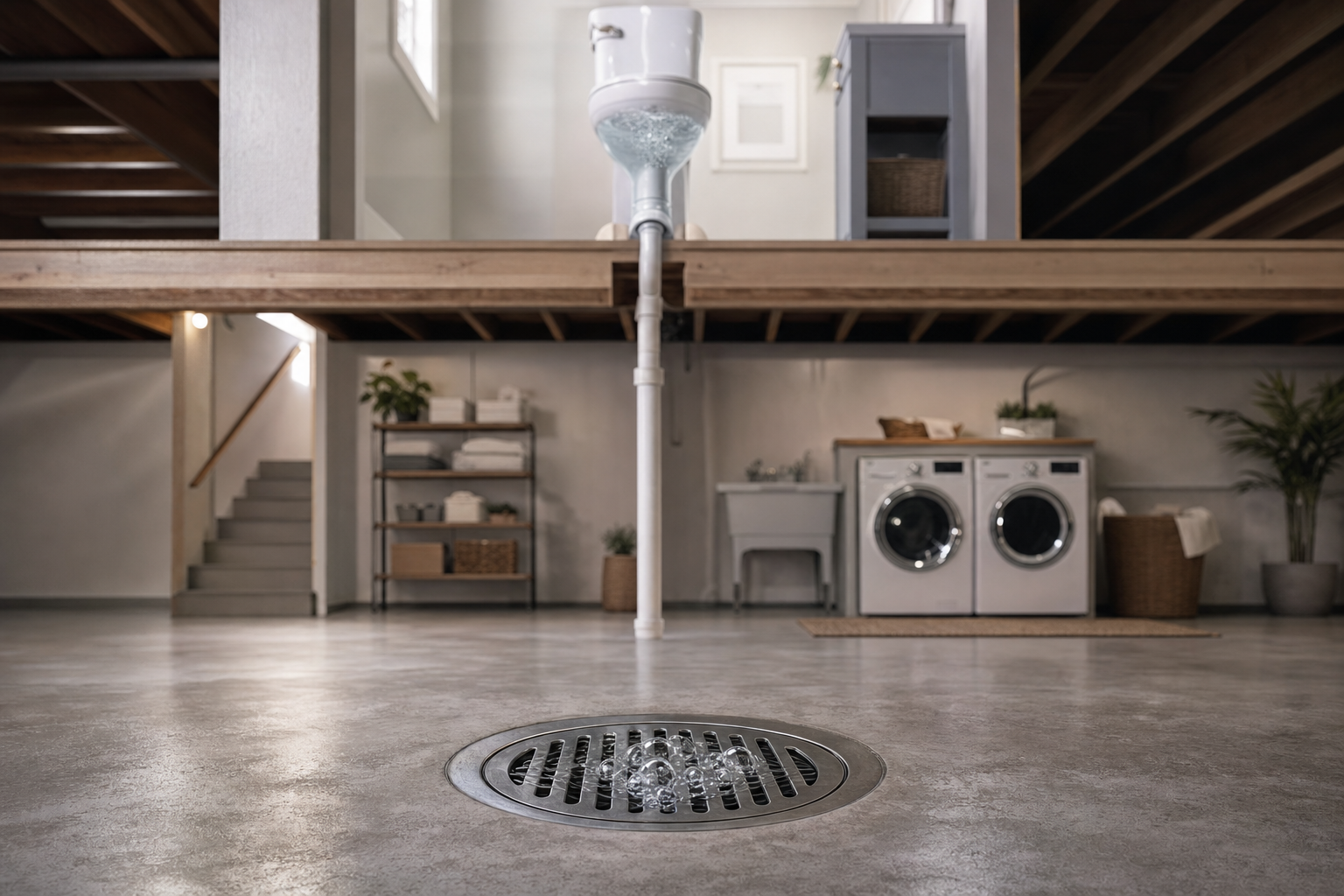
Why Your Basement Floor Drain Gurgles When You Flush the Upstairs Toilet
That gurgling sound from your basement floor drain when you flush an upstairs toilet is caused by an air pressure imbalance in your home’s shared drain pipes. When a toilet flushes, it pushes a large volume of water down the vertical drain pipe inside your walls. If something is restricting airflow or water flow in the system, that rushing water displaces air that has nowhere to go except back up through the lowest open drain in the house — which is almost always your basement floor drain. The gurgling is the sound of air being forced through the small pool of water sitting inside the drain’s trap.
This is not a random noise. It is your plumbing telling you that something is off with the drainage or venting in your home. In many cases, especially in older Central New Jersey homes with mature trees and aging sewer lines, this gurgling points to a partial blockage that will get worse over time if it is not addressed. Below, we will walk through exactly what causes it, how to figure out which cause applies to your situation, and when it is time to call a licensed drain and sewer cleaning professional.
What Is Actually Happening Inside Your Pipes
Your home’s drain system has two jobs: move wastewater out and keep air pressure balanced while it does so. All the drains throughout your house — sinks, toilets, tubs, showers, and floor drains — tie into a common pipe network that eventually reaches your main sewer line. Running alongside those drain pipes is a vent system, usually a vertical pipe (called the vent stack) that exits through your roof. The vent stack lets air flow in and out of the system freely so that water can move through the pipes without creating a vacuum.
When you flush an upstairs toilet, a large slug of water drops down the vertical drain pipe. Think of it like pulling the plug in a full bathtub — a lot of water moving fast through a pipe pushes air ahead of it and pulls air behind it. Under normal conditions, the vent stack supplies fresh air from above so the pressure stays balanced and every other drain in the house stays quiet.
But if the vent is blocked, or if there is a partial clog restricting the main sewer line, that displaced air cannot escape the way it is supposed to. Instead, it gets pushed toward the path of least resistance. In most homes, the basement floor drain sits at the lowest point in the entire system — making it the easiest exit. Air forces its way through the water sitting in the floor drain’s P-trap (the U-shaped bend that holds a small amount of water to block sewer gases), and you hear that familiar gurgling or bubbling sound.
Three Reasons This Happens
Not every gurgling basement floor drain means the same thing. There are three common causes, and they range from a quick check you can handle yourself to a problem that needs professional drain or sewer line clearing. Knowing which one applies to you makes all the difference.
A Partial Blockage in the Main Sewer Line
This is the most common cause — and the one that matters most. Your main sewer line is the large pipe that carries all wastewater from your home out to the municipal sewer or septic system. When that line develops a partial blockage, water from an upstairs toilet flush cannot flow out freely. The backup of water compresses the air in the system, and that air escapes through the basement floor drain because it is the lowest and most accessible opening.
Partial main line blockages build up gradually. Grease, soap residue, household debris, and sediment accumulate over time. Homes throughout New Jersey — particularly those with older clay or cast iron sewer pipes — are especially vulnerable to tree root intrusion. Mature trees extend roots toward sewer lines in search of moisture, and even minor intrusions can snag passing debris, narrowing the pipe enough to trigger the kind of pressure imbalance that produces gurgling.
What else you might notice: Other drains in the house may seem slightly slower than usual. You might hear gurgling from more than one drain. In some cases, there is a faint sewage smell near the basement floor drain, especially after heavy water use like running the washing machine or taking multiple showers back to back.
A Blocked or Restricted Vent Stack
The vent stack is the pipe that exits through your roof and allows air to flow into the drain system. When that opening becomes obstructed — whether from fallen leaves, a bird’s nest, ice that forms during a cold New Jersey winter, or stray construction debris — the drain system loses its air supply. When you flush a toilet, the water rushing down the drain creates a vacuum because no air can enter from above. That vacuum pulls air in from the next available opening, which is your basement floor drain.
The telling clue: A vent problem often allows water to drain at a normal speed, but you still hear gurgling from other fixtures. If your drains are not slow but the gurgling is consistent every time you flush, a vent restriction is worth considering.
Vent blockages can be seasonal. In the colder months across Monmouth, Ocean, and Morris Counties, ice can form around the vent opening on the roof and restrict airflow. In the fall, leaves and debris are common culprits. This is not something most homeowners should try to inspect on their own — climbing onto a roof to check a vent pipe carries real safety risks.
A Dry P-Trap in the Basement Floor Drain
Every drain in your home has a P-trap — a curved section of pipe that holds a small amount of standing water. That water acts as a seal, blocking sewer gases from entering your home. Basement floor drains are especially prone to drying out because they are not used regularly. If no water flows through the drain for weeks or months, the water in the trap evaporates.
A dry P-trap does not cause the gurgling by itself, but it makes the gurgling much louder and more noticeable. Without that water seal, displaced air passes through the drain with almost no resistance. It also means sewer gas — which smells like sulfur or rotten eggs — can drift into your basement.
The quick check: Slowly pour about two cups of water directly into the basement floor drain. If the trap was dry, this refills it. If the gurgling stops after you refill the trap and flush again, the dry trap was amplifying the sound. But if the gurgling continues even with a full trap, the problem is deeper in the system — likely in the main sewer line or the vent.
How to Figure Out Which Cause Applies to You
You do not need to be a plumber to narrow down what is going on. A few quick observations can help you understand the situation before you decide what to do next.
Step 1: Pour water into the basement floor drain. Two cups of water is enough. Wait a few minutes, then flush the upstairs toilet again. If the gurgling stops completely, the issue was likely a dry P-trap. Keep an eye on it — if the gurgling comes back in a few weeks, the trap is drying out again, but the system itself may be fine.
Step 2: Check whether other drains are slow. Run water in a bathroom sink, the kitchen sink, and the tub or shower. Do any of them drain noticeably slower than usual? If yes, you likely have a restriction in a shared drain line or the main sewer line, not just a vent issue.
Step 3: Flush the toilet and watch the floor drain closely. Is the gurgling the only thing happening, or do you also see water bubbling up or rising in the floor drain? Gurgling alone suggests a partial restriction or vent issue. Water actually rising in the floor drain is a stronger signal that the main sewer line is significantly blocked and wastewater has limited room to move.
Step 4: Test with other fixtures. Does the floor drain gurgle only when the toilet flushes, or does it also gurgle when you run the washing machine, the dishwasher, or a shower? If multiple fixtures trigger the gurgling, the issue is more likely in the main sewer line rather than in a branch line or a single vent.
| What You Observe | Most Likely Cause | Suggested Action |
|---|---|---|
| Gurgling stops after pouring water into the floor drain | Dry P-trap | Refill the trap periodically; monitor for return |
| Gurgling continues but drains are not slow; only happens with toilet flush | Restricted vent stack | Schedule professional drain inspection |
| Gurgling plus one or more slow drains in the house | Partial main sewer line blockage | Call a drain and sewer cleaning professional soon |
| Water rises in the floor drain, multiple fixtures affected, or sewage smell | Significant main sewer line blockage | Call a licensed drain and sewer cleaning company right away |
When to Monitor, When to Schedule, and When to Call Now
Not every gurgling floor drain is an emergency, but it is never something to ignore indefinitely. A partial blockage in a main sewer line does not clear itself. It tends to worsen as more material catches on the restriction — especially if tree roots are involved. Here is a practical way to think about urgency:
Monitor: The gurgling stopped after you refilled the P-trap with water. No other drains are slow. No odor. No water rising. You can keep an eye on it and refill the trap every few weeks. If it keeps drying out, that is normal for basement floor drains that do not see regular use.
Schedule service soon: The gurgling persists even after refilling the trap. You notice one other drain in the house is slightly slower than usual. There is no sewage backup, but the pattern is consistent. This is a good time to have a licensed drain and sewer cleaning professional clear the line before the problem escalates. At Just Drains, this is exactly the kind of call we handle for homeowners across Central New Jersey and the Jersey Shore — drain cleaning and sewer line clearing to restore proper flow before a partial blockage becomes a full one.
Call now: Multiple fixtures are affected. Water is rising in the basement floor drain. You notice a sewage smell in the basement. The toilet flushes slowly or bubbles after flushing. Any of these signals mean the main sewer line is significantly obstructed, and continued water use in the house could lead to sewage backing up through the basement floor drain. This is when you want fast, professional drain and sewer line clearing — not a wait-and-see approach.
If sewage has already backed up into your basement, do not attempt to clean it up yourself or wade through the water. Backed-up sewage contains bacteria and other harmful contaminants that pose a serious health risk. Keep people and pets away from the affected area and call a licensed professional immediately.
Why Chemical Drain Cleaners Are Not the Answer Here
When homeowners hear gurgling, the first instinct is often to pour a chemical drain cleaner down the floor drain. For this particular problem, that is unlikely to help and may cause additional issues. Chemical cleaners are designed for localized clogs close to the drain opening — hair in a shower drain, grease in a kitchen sink. They cannot reach a partial blockage deep in the main sewer line, and they cannot clear a blocked vent stack on the roof.
In older homes with cast iron or clay pipes — common across Monmouth, Mercer, and Ocean Counties — harsh chemical cleaners can also corrode aging pipe material over time, making the underlying problem worse. If the gurgling is caused by a main line restriction or a vent issue, a plunger will not resolve it either. These problems require professional clearing of the line with powered equipment.
What Professional Drain Cleaning Looks Like for This Problem
If you have worked through the diagnostic steps above and the gurgling persists — especially if other drains are slow or you see water movement in the floor drain — the next step is professional drain cleaning or sewer line clearing.
Here is what typically happens during a service visit for this type of issue:
- The technician locates the cleanout access point. Most homes have a main sewer cleanout — a capped pipe that gives direct access to the main sewer line. It is usually in the basement, crawl space, or outside the foundation.
- The line is cleared using a powered drain auger (sometimes called a snake). This is a flexible cable with a cutting head that feeds into the sewer line and breaks through the obstruction — whether it is a buildup of debris, grease, or root intrusion.
- Flow is confirmed. Once the blockage is cleared, the technician runs water through the system to verify that flow is restored and the gurgling has stopped.
For most gurgling floor drain situations caused by a partial main line clog, this is typically a single-visit service. The goal is to restore full drainage so your home can get back to normal.
At Just Drains, drain cleaning starts at $63. We are a licensed drain and sewer cleaning company serving homeowners across Central New Jersey, the Jersey Shore, and surrounding areas including Monmouth, Mercer, Union, Morris, and Ocean Counties. If the gurgling in your basement has you concerned, we can help clear the line and get things flowing again.
Call Now: (732) 279-2427
Frequently Asked Questions
Is a gurgling basement floor drain an emergency?
Not always, but it should not be ignored. If the only symptom is a gurgling sound and no water is rising in the drain, you have time to investigate using the diagnostic steps above. However, if you see water backing up through the floor drain, notice a sewage smell, or find that multiple drains in the house are slow or gurgling at the same time, that indicates a more significant blockage in the main sewer line. In that situation, calling a licensed drain and sewer cleaning professional promptly can help prevent a full sewage backup.
Can a gurgling floor drain lead to sewage backing up in my basement?
It can, yes. Gurgling from a floor drain frequently signals that a partial restriction has developed somewhere in the main sewer line. If that blockage worsens — which it tends to do over time — wastewater eventually has nowhere to go and backs up through the lowest drain in the system, which is typically the basement floor drain. Addressing the gurgling while it is still just a sound, before it becomes a backup, is far easier, faster, and less costly.
Why does the floor drain only gurgle when the toilet flushes and not when I run the sink?
A toilet flush sends a much larger volume of water into the drain system at once compared to running a sink or a faucet. That bigger rush of water displaces more air and creates more pressure change in the pipes. A partially blocked line or restricted vent might handle the smaller water volume from a sink without noticeable symptoms, but the sudden load from a toilet flush is enough to force air back through the basement floor drain. If you start hearing the gurgling when you run other fixtures too, that often means the blockage is getting worse.
Should I pour water down the basement floor drain?
Yes — this is a safe and useful first step. Pour about two cups of water slowly into the floor drain. This refills the P-trap, which is the curved section of pipe that holds water to block sewer gases. Basement floor drains dry out frequently because they do not get regular use. If refilling the trap stops the gurgling, the trap was dry and the sound was simply air passing through an empty drain more easily. If the gurgling continues after refilling the trap, the cause is deeper in the system.
Should I use a chemical drain cleaner to stop the gurgling?
No. Chemical drain cleaners are designed for small, localized clogs near the drain opening. They cannot reach a main sewer line blockage or clear a restricted vent stack, which are the two most common causes of this symptom. In older homes with cast iron or clay sewer pipes, chemical cleaners can also damage the pipe material. If the gurgling persists after you refill the P-trap, professional drain cleaning or sewer line clearing is the appropriate next step.
How much does it cost to fix a gurgling basement floor drain?
If the issue is a dry P-trap, the fix is free — just pour water into the drain. If the cause is a partial clog in the main sewer line, professional drain cleaning is the most common solution. At Just Drains, drain cleaning starts at $63, though the total cost of any service depends on the specifics of the job. In many cases, a single drain cleaning visit resolves the gurgling and restores normal flow.
What to Do Next
A gurgling basement floor drain is your home’s way of signaling that something in the drain or vent system needs attention. Start with the diagnostic steps in this article — refill the P-trap, check for slow drains elsewhere, and pay attention to whether the symptom is getting worse or staying the same.
If the gurgling persists, if other drains in the house are slow, or if you see any sign of water rising in the floor drain, it is time to call a licensed drain and sewer cleaning professional. A partial main line blockage does not improve on its own, and catching it early means a straightforward drain cleaning visit rather than dealing with a full sewage backup later.
Just Drains is a licensed drain and sewer cleaning company serving homeowners across Central New Jersey, the Jersey Shore, and surrounding areas. We specialize in exactly this kind of problem — clearing clogged drains and sewer lines so your home can get back to normal. Drain cleaning starts at $63, and our goal is to reach you fast.
Call Now: (732) 279-2427