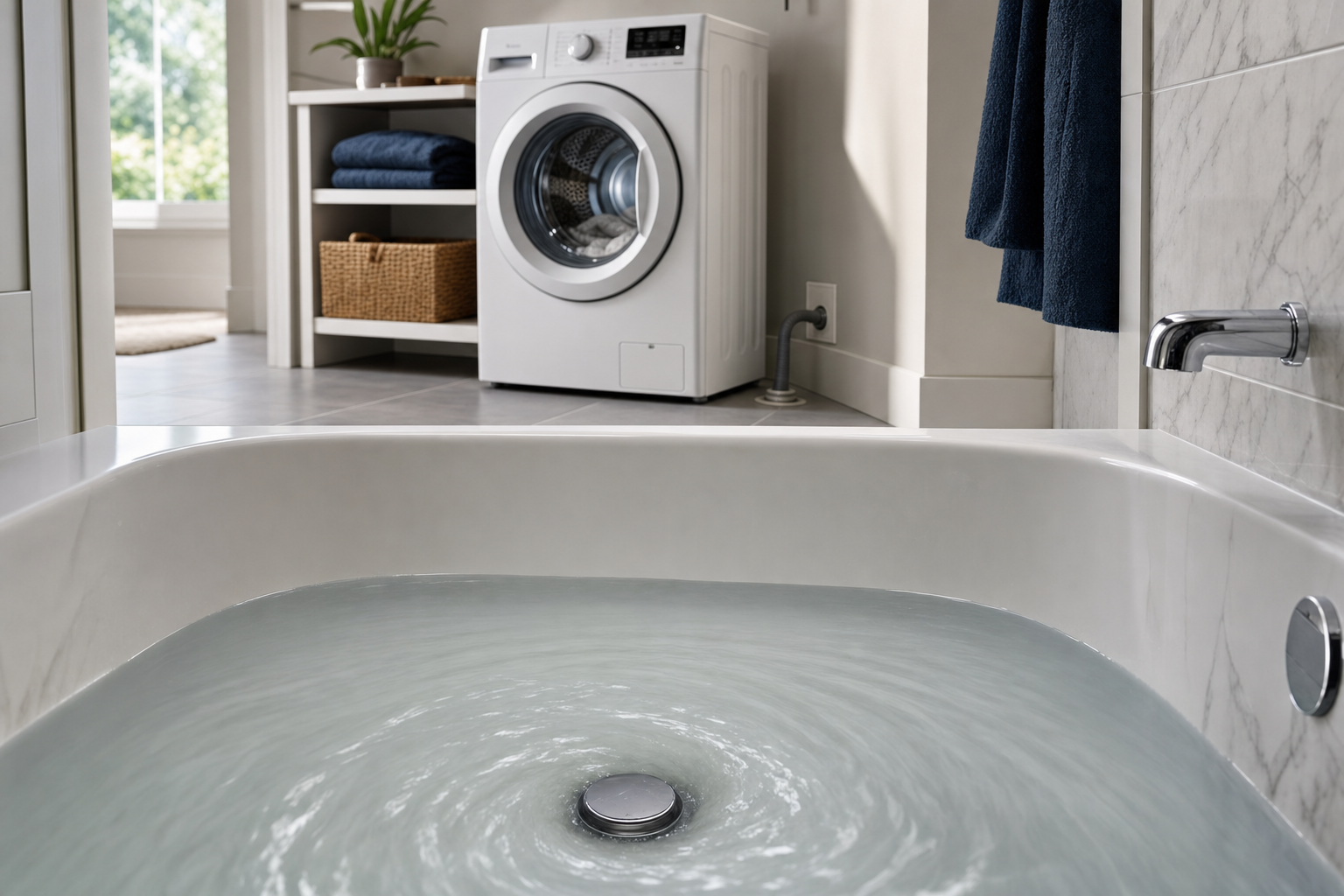
Why Water Backs Up Into Your Bathtub When the Washing Machine Drains
When water rises in your bathtub while the washing machine is running, it almost always points to a clog or partial blockage somewhere downstream in a drain line that both fixtures share. During its drain cycle, your washing machine forces out a large volume of water in a short amount of time. When that water encounters a blockage it cannot get past, it reverses and pushes up through the nearest open drain — and in most homes, that is the bathtub.
This is not a random occurrence or an odd plumbing quirk. It is a clear indicator that something is restricting flow within your drain system, and it is the kind of problem that tends to worsen without intervention. Below, we cover exactly why the bathtub shows this symptom first, what the most likely causes are, how to identify which applies to your home, and what steps to take.
Why the Bathtub Is Usually the First to Show the Problem
In most homes, the bathtub drain sits at a lower physical elevation than the toilet trap and bathroom sink drain. When something prevents water from moving normally through the drain system, that backed-up water finds the lowest available exit point — which is typically the tub.
The washing machine is what makes this problem apparent because of the way it expels water. A sink releases water in a slow, steady flow, but a washing machine unloads several gallons all at once in a rapid burst. That sudden volume overwhelms a partially blocked pipe in a way that slower fixtures never do. A drain line that keeps up just fine with your bathroom sink may completely fail when the washer empties its load all at once.
This is why everything else in the house may seem fine — right up until you do a load of laundry and find standing water climbing the walls of the tub.
The Most Common Causes
Not every bathtub backup during a wash cycle has the same root cause. Below are the most likely explanations, ordered from most to least common.
A Clog in the Main Sewer Line
The main sewer line is the primary pipe responsible for carrying all wastewater out of your home and into the municipal sewer system or a septic tank. When this pipe develops a partial or complete blockage, wastewater from any fixture — including the washing machine — has no outlet. It reverses course and rises through whichever drain sits lowest, which is generally the bathtub.
Main sewer line blockages tend to develop gradually through an accumulation of grease, soap residue, hair, and organic matter inside the pipe. In many older homes throughout Central New Jersey and the Jersey Shore, tree roots can also work their way into aging sewer lines and form persistent obstructions.
When the main sewer line is the source of the problem, additional symptoms usually appear alongside the bathtub backup: toilets that are slow to flush, gurgling coming from multiple drains, or a sewage odor near floor drains.
A Blockage in the Shared Branch Line
In many home layouts, the washing machine and bathroom connect to the same branch drain line — a secondary pipe that feeds into the main sewer line. When debris builds up in this shared section, the washer’s discharge water has nowhere to go but back up through the bathtub, since both fixtures share the same upstream connection.
Branch line blockages are frequently caused by washing machine lint mixing with soap scum, hair, and other material that settles in the pipe over time. Lint is an especially common contributor because many homeowners are unaware of how much passes through the washing machine drain and into the household plumbing.
When the obstruction is in a shared branch line rather than the main sewer line, the backup is typically limited to the bathtub and possibly the bathroom sink — other fixtures throughout the home usually continue draining without issue.
A Blocked Plumbing Vent
Every home’s plumbing system includes a vent stack — a vertical pipe that extends through the roof and introduces air into the drain lines. That airflow is what allows water to drain freely. Without it, a vacuum-like effect builds up in the pipes, slowing drainage and potentially causing water to back up.
When the vent stack becomes obstructed — by leaves, debris, animal nests, or ice — your drains are starved of the airflow they need. The high-volume output of the washing machine adds pressure to an already struggling system, and without adequate venting, that pressure forces water back through the bathtub drain.
A blocked vent typically produces gurgling sounds from drains throughout the house, not just the tub. You may also notice the water level in your toilet bowl sinking on its own.
Undersized or Aging Drain Pipes
Many older homes were constructed with drain pipes sized to accommodate the appliances and water usage of earlier decades. Today’s washing machines — particularly high-efficiency models — can discharge water at rates faster than those older or narrower pipes were ever intended to manage. If your home still has its original cast iron or smaller-diameter drain lines, those pipes may simply lack the capacity to keep pace with a modern washer’s output, especially when any degree of interior buildup is already present.
This cause is less common than a straightforward clog, but it is worth keeping in mind if you live in an older home and the issue started after installing a newer washing machine.
How to Identify Which Problem You Have
Before deciding on a course of action, take a moment to observe what is happening elsewhere in your home. The combination of symptoms you notice can help pinpoint the source of the problem.
| What You Are Seeing | What It Likely Means |
|---|---|
| Only the bathtub backs up when the washer runs; all other fixtures drain normally | A clog in the shared branch line between the washer and the bathroom |
| The bathtub backs up AND the toilet gurgles, flushes slowly, or bubbles | A blockage in the main sewer line — the problem is deeper in the system |
| Multiple fixtures throughout the house drain slowly, and you hear gurgling from several drains | A main sewer line clog or a blocked plumbing vent — possibly both |
| The tub backs up and you notice a sewage smell from floor drains or the tub itself | A main sewer line blockage that needs prompt professional attention |
| The problem started only after replacing the washing machine with a newer model | The new machine may discharge water faster than older pipes can handle, often combined with partial buildup in the line |
This observation step is not a replacement for a professional diagnosis, but it gives you helpful context — and it makes it easier to describe the situation clearly when you reach out for drain cleaning assistance.
What to Do Right Away
If you are watching water climb up into your bathtub while the washing machine is running, take these steps immediately.
- Stop the washing machine. Pause or cancel the cycle so no additional water is being pushed into a drain line that cannot handle it. Running the washer through a blocked line raises the risk of overflow and potential water damage.
- Avoid using other fixtures. While the tub is still draining and you are still assessing the situation, hold off on running sinks, flushing toilets, or using showers. Any additional water adds further strain to a system that is already struggling.
- Allow the tub to drain on its own. If the water gradually recedes after you stop the washer, a partial clog is likely. If it sits without moving, the blockage may be more complete.
- Check other drains in the house. Walk through the home and take note of any drains that seem slow, are producing gurgling sounds, or are backing up. This information helps establish whether the problem is in a branch line or further down in the main sewer line.
- Skip the chemical drain cleaner. For this type of backup, the obstruction is almost certainly located too far downstream for any store-bought chemical product to reach it. These products are formulated for small, nearby clogs at individual fixture drains — not for blockages sitting deep inside a shared line or the main sewer. Repeated applications can also degrade pipe walls, particularly the older cast iron drain lines found throughout many Central New Jersey homes.
When DIY Methods Fall Short
A plunger can occasionally dislodge a clog sitting right at the bathtub drain, but when water is backing up because of the washing machine, the obstruction is almost always located much further down the line — in the shared branch pipe or the main sewer line. Neither a plunger nor a standard hand snake from the hardware store can reach that far into the system.
The following are clear signs that professional drain cleaning is needed:
- The bathtub backs up every time you run the washing machine, not just on one occasion
- More than one fixture in the home is draining slowly or making gurgling sounds
- A sewage odor is detectable coming from any drain
- Water has risen into the tub on multiple occasions within a short timeframe
- You have already used a plunger or hand snake and the problem has returned
- The backed-up water appears dark, discolored, or has a foul smell
When any of these conditions apply, the blockage is beyond what most homeowners can safely or effectively address themselves. A licensed drain and sewer cleaning professional has the tools to locate and fully clear the actual obstruction.
What a Professional Drain Cleaning Visit Involves
If you have not used a drain cleaning service before, it helps to understand what the process looks like. For a bathtub backup connected to the washing machine, the service typically means clearing the obstruction from the shared branch line or the main sewer line using a professional-grade drain snake (also referred to as an auger) — a flexible cable that extends deep into the pipe to break apart and extract the clog.
This is a targeted drain cleaning service, not a major plumbing undertaking. In most cases, it does not involve opening walls, digging outside, or replacing pipe sections. The objective is simply to restore normal water flow so everything drains the way it should.
At Just Drains, drain cleaning starts at $63, and we work to have a licensed technician at your home and on the job quickly — with service in 60 minutes for homeowners throughout Central New Jersey, the Jersey Shore, and surrounding areas including Monmouth, Mercer, Union, Morris, and Ocean Counties. Drain cleaning and sewer line clearing are what we do every day, so this is exactly the type of situation we are equipped to handle.
If your bathtub is backing up when the washing machine drains, call now: (732) 279-2427 to talk through what is happening and get the help you need.
Why Waiting Makes the Problem Worse
A partial clog that triggers occasional backups during laundry will not resolve on its own. Whatever material is narrowing the pipe — lint, grease, soap scum, hair, and other debris — keeps building with every cycle that runs. What begins as an infrequent nuisance during the wash cycle can develop into a full blockage that sends sewage into the tub, damages the surrounding area, or renders the bathroom unusable.
Dealing with it early, while the symptom is still limited to tub backups during laundry, is far less disruptive and less costly than waiting until the main sewer line is completely blocked and multiple fixtures throughout the home are affected.
Frequently Asked Questions
Why does my bathtub gurgle when the washing machine drains?
Gurgling indicates that air is being displaced inside the drain pipe because water cannot flow freely past a partial obstruction. When the washing machine pushes a high volume of water into a partially clogged line, the trapped air gets forced back up through the bathtub drain, producing that gurgling sound. It is often an early indicator that a full backup is developing.
Is water backing up in my bathtub dangerous?
It depends on the source of the water. If it is gray water from the washing machine — soapy runoff and lint — it is unpleasant but not immediately hazardous. However, if the blockage is in the main sewer line, the water backing up into the tub could contain sewage. Avoid any direct contact with backed-up water that smells foul or appears dark, and contact a drain cleaning professional without delay.
Can I use Drano or another chemical drain cleaner to fix this?
Chemical drain cleaners are not the right solution for this type of problem. They work on small clogs located directly at a fixture drain — not on blockages sitting deep inside a shared branch line or the main sewer. The product cannot travel far enough through standing water and pipe curves to reach the actual obstruction. Using these cleaners repeatedly can also degrade pipe interiors over time, especially in older cast iron drain lines.
Will a plunger clear this kind of backup?
A plunger is unlikely to resolve the issue when the clog is located in a shared line or the main sewer. Using a plunger on the bathtub generates pressure only at that one fixture — it has no effect on a blockage that is several feet further along in the drain system. If a few attempts with a plunger do not produce results, the obstruction is almost certainly beyond its reach.
How can I tell if the clog is in my main sewer line?
The most telling sign is whether multiple fixtures are involved. If the bathtub backs up during laundry and you are also seeing slow-flushing toilets, gurgling from other drains, water seeping from a floor drain, or a sewage odor anywhere in the home, the blockage is likely in the main sewer line rather than a single branch. If only the bathtub is affected and everything else functions normally, the clog is more likely in the branch line shared by the bathroom and laundry area.
Can this problem lead to water damage if I leave it alone?
Yes. An unresolved partial clog will keep worsening as material continues to collect inside the pipe. Periodic backups that are manageable at first can eventually become full overflows that spill onto the bathroom floor, compromise flooring and subfloor materials, and create conditions favorable to mold growth. Taking action when the problem first appears is far simpler and less expensive than addressing the consequences of a fully blocked sewer line.
Is it safe to keep running the washing machine while this is happening?
No. Every time the washer drains into a blocked line, you are sending more water into a system that has no way to move it through — raising the likelihood of overflow onto the bathroom floor. Stop using the washing machine until the drain line has been properly cleared. Once the blockage is removed and normal drainage is restored, you can resume doing laundry without issue.
What to Do Next
If water is rising in your bathtub when the washing machine runs, the first priority is to stop adding water to the system and check whether other fixtures in the home are affected. That tells you whether the issue is isolated to a shared branch line or whether it involves the main sewer line.
For most homeowners, this is not a situation that a plunger, a chemical product, or a store-bought drain snake can resolve. The blockage sits deeper in the system than those tools are capable of reaching, and each load of laundry you run makes the buildup worse.
Just Drains provides licensed drain cleaning and sewer line clearing for homeowners throughout Central New Jersey and the Jersey Shore, including Monmouth, Mercer, Union, Morris, and Ocean Counties. Drain cleaning starts at $63, and we work to get a technician to your home quickly — with service in 60 minutes.
Call now: (732) 279-2427 to get your drains flowing again.