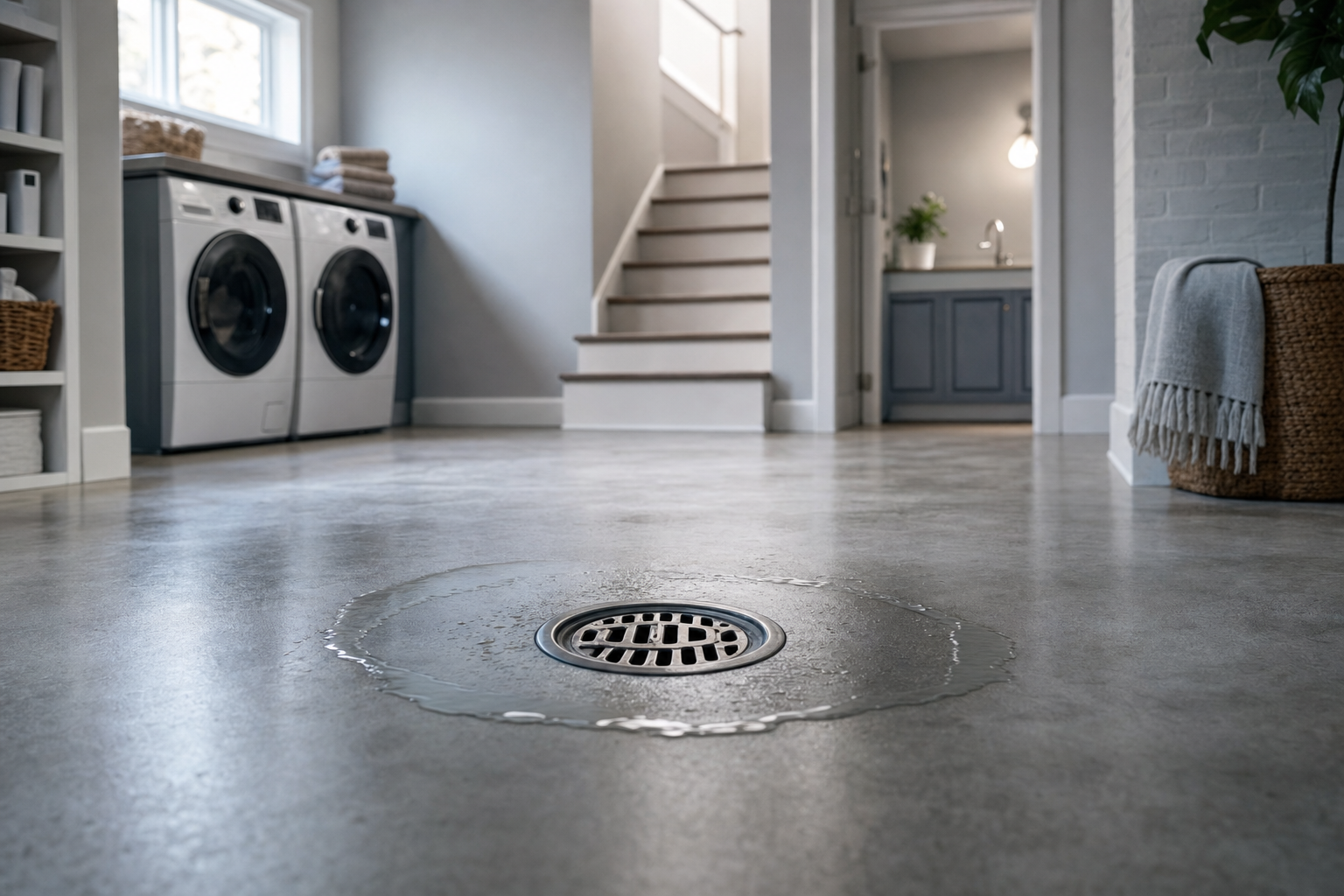
Why Sewage Backs Up Into the Lowest Drain in Your House First
When your main sewer line is blocked, wastewater has nowhere to flow. It builds up inside your pipes, and the first place it escapes is the lowest drain in your home — usually a basement floor drain, a ground-floor shower, or a laundry room drain. That drain is not broken. It is showing you that something downstream, in the main sewer line, is preventing wastewater from leaving your house.
If you are seeing water or sewage rising through a low drain right now, the most important thing to understand is this: the problem is not at that drain. The problem is further down the line, and what you are seeing is your plumbing system’s earliest signal that the main line needs to be cleared.
How Your Home’s Drain System Is Connected
Every drain in your house — every sink, toilet, shower, tub, and floor drain — connects to a smaller pipe called a branch drain line. Those branch lines all feed into one larger pipe called the main sewer line (sometimes called the sewer lateral). That single main line carries all of your home’s wastewater out to the municipal sewer system or, in some parts of Central New Jersey, to a septic tank.
Think of it like a tree. Each drain is a small branch. The branches connect to larger limbs. Every limb feeds into the trunk. The main sewer line is the trunk. If the trunk is blocked, nothing from any branch can get through.
Why the Lowest Drain Fails First
When a blockage forms in the main sewer line, wastewater from your fixtures has nowhere to go. Instead of flowing out, it starts to fill the pipe backward — rising from the blockage point back toward your house.
Here is the part most explanations leave out: it is not just gravity at work. As wastewater fills the blocked pipe, it creates a rising column of water inside your plumbing. The pressure at the bottom of that column is higher than the pressure at the top. The lowest drain in your house sits at the bottom of that column, which means it takes the least amount of backed-up water to push sewage out through that opening.
A drain on your second floor would need the water column to rise much higher before it overflowed. Your basement floor drain or ground-floor shower drain requires far less rise. That is why it spills over first.
In simple terms: backed-up water fills the pipe system from the bottom up, and the lowest opening is the first one it can reach.
What Counts as the “Lowest Drain” in Your Home
The lowest drain depends on how your house is built. In many homes across Monmouth, Ocean, and Morris Counties, the lowest drain is one of these:
- Basement floor drain — the most common lowest point in homes with basements
- Ground-floor shower or bathtub drain — especially in slab-on-grade homes without basements, which are common in parts of the Jersey Shore area
- Laundry room drain — often located at or near ground level
- Utility sink drain — typically in a basement or garage
If your home does not have a basement, the lowest drain is usually a shower, tub, or floor drain on the ground floor. Homeowners in slab-on-grade homes sometimes do not realize they have a “lowest drain” because there is no basement — but the principle still applies. Whatever drain sits closest to the elevation of the main sewer line will show signs of backup first.
How to Tell If It Is a Main Line Problem or a Single Clogged Drain
Not every slow drain means your main sewer line is blocked. Sometimes a single fixture is clogged in its own branch line. Knowing the difference helps you decide what to do next.
| Sign | Likely a Single-Drain Clog | Likely a Main Line Blockage |
|---|---|---|
| Which drains are affected? | Only one fixture is slow or backed up | Multiple fixtures on different floors are slow or backing up |
| Does using one fixture affect another? | No — flushing a toilet does not cause water to appear elsewhere | Yes — flushing a toilet causes gurgling or water rising in a shower or floor drain |
| Where is the backup happening? | At the fixture itself (sink, tub, or toilet) | At the lowest drain in the house, even when you use a fixture on a different floor |
| Do you hear gurgling from other drains? | No | Yes — gurgling from drains you are not using is a strong main line signal |
| Is there a sewage smell from drains you have not used? | Unlikely | Common — odor from floor drains or basement drains |
A useful timing clue: If the backup at your lowest drain happens specifically when you run the washing machine, take a shower, or flush a toilet, that strongly suggests the blockage is in your home’s own main sewer line. The water you are sending down has nowhere to go, so it comes back up at the lowest point. If the backup seems to happen even when no one in your house is using water, the issue could involve the municipal sewer system rather than your own line.
What to Do Right Now If Sewage Is Coming Up Through a Drain
If you are seeing sewage or dirty water rising through your lowest drain, here is what to do immediately:
- Stop using all water in the house. Do not flush toilets, run the dishwasher, start a load of laundry, or take a shower. Every bit of water you send down adds to the backup.
- Keep family members and pets away from the affected area. Backed-up sewage contains bacteria and should not be touched, walked through, or cleaned up without proper precautions.
- Do not pour chemical drain cleaner down the drain. Chemical cleaners are designed for small clogs near the fixture opening. They will not reach a blockage deep in the main sewer line, and sitting chemicals in standing sewage water can create fumes or splash hazards.
- Do not try to plunge a floor drain for a main line backup. A plunger works on localized clogs near the drain opening. It cannot clear a blockage that is twenty, forty, or sixty feet down the main line.
- Call a licensed drain and sewer cleaning professional. A main line blockage requires professional equipment to clear. This is not a situation that resolves on its own or responds to household tools.
If you are in Central New Jersey — including Monmouth, Mercer, Union, Morris, or Ocean County — and sewage is backing up through your lowest drain, Just Drains can help. We are a licensed drain and sewer cleaning company that handles exactly these situations: backed-up sewer lines, mainline blockages, and clogged drains that a plunger cannot fix. Drain cleaning starts at $63, and we aim to arrive within 60 minutes of your call. Call now: (732) 279-2427.
Common Causes of Main Line Blockages
If your lowest drain is backing up, something is blocking the main sewer line. These are the most common reasons, especially in older homes across Central New Jersey:
- Tree root intrusion. Tree roots are attracted to the moisture around sewer pipes. They can grow into small cracks or pipe joints and gradually fill the inside of the line. In suburban neighborhoods with mature trees, root intrusion is one of the most frequent causes of main line blockages.
- Grease buildup. Cooking grease poured down the kitchen sink does not stay liquid. It cools and hardens inside the pipe, narrowing the passage over months and years until wastewater cannot pass through.
- Non-flushable items. Baby wipes, so-called “flushable” wipes, feminine hygiene products, paper towels, and cotton swabs do not break down in water. They catch on imperfections inside the pipe and create blockages that grow with every flush.
- Aging or damaged pipes. Many homes in Monmouth, Ocean, and Morris Counties were built with clay or cast iron sewer pipes. Over decades, these materials can crack, collapse, or develop rough interior surfaces that catch debris and slow flow. A pipe that has been losing capacity for years may finally block completely.
- Heavy rain overwhelming the system. During severe storms, groundwater or stormwater can enter the sewer system through cracks in the pipe or through shared storm-and-sewer infrastructure. When the system is overwhelmed, water has nowhere to go — and it can push backward into homes through the lowest drain.
What Happens If You Keep Using Water During a Backup
This is worth understanding clearly, because many homeowners do not realize how quickly the situation gets worse.
When the main line is blocked, every toilet flush, every shower, and every washing machine cycle adds more water to a system that cannot move it. That water has to go somewhere. It rises in the pipes and pushes more sewage out through your lowest drain.
What started as a small puddle around a floor drain can become inches of standing sewage on a basement floor within a few loads of laundry. The mess grows, the smell gets worse, and the cleanup becomes more difficult and more costly.
The single most effective thing you can do before a professional arrives is to stop adding water to the system. Turn off the washing machine if it is running. Do not flush. Do not run any faucets. Let the system stay still until the blockage can be cleared.
Why This Will Not Go Away on Its Own
A main line blockage is a physical obstruction inside the pipe. Roots do not retract. Grease does not dissolve. Wipes do not disintegrate. Waiting does not help — it only means the next time someone uses water, the backup starts again.
Some homeowners notice that the water eventually recedes from the lowest drain and assume the problem fixed itself. What usually happened is that the water slowly seeped past the partial blockage. The blockage is still there, still growing, and the next heavy-use moment — a full load of laundry, a few back-to-back showers, holiday guests — will trigger the backup again.
If you have seen sewage come up through your lowest drain even once, the main line likely needs professional clearing.
Frequently Asked Questions
Is a backup in my basement floor drain always a main sewer line problem?
Not always, but it usually is. A basement floor drain is almost always the lowest drain in the system. If water or sewage is coming up through it — especially when you use fixtures on other floors — that is a strong sign of a main line blockage, not a problem with the floor drain itself. If the floor drain is the only fixture that is slow and no other drains are affected, the issue could be localized. But once you see sewage rising through it, a main line problem is the most likely explanation.
Can I fix a main line backup myself with a plunger or drain cleaner?
No. A plunger can clear small clogs near the drain opening, and liquid drain cleaners are designed for minor buildup in the first few feet of pipe. A main line blockage sits deep in the sewer line — often many feet from any fixture. It requires professional drain cleaning equipment to reach and clear. Using chemical cleaners on a backed-up line can also create a hazard, since the chemicals sit in standing water that may splash back up through the drain.
Can heavy rain cause sewage to back up into my house?
Yes. During heavy storms, municipal sewer systems can become overwhelmed, especially in areas with older infrastructure. When the system cannot handle the volume, water can flow backward through the main line and into your home through the lowest drain. If your backups tend to happen only during heavy rain and not during normal daily use, the issue may involve the municipal system rather than a blockage in your own line. However, heavy rain can also worsen an existing partial blockage in your sewer lateral.
How quickly should I call a professional if sewage is coming up through a drain?
As soon as you notice it. Sewage backup is not a situation that improves with time. Every flush and every drain cycle makes it worse. Stop using water in the house and call a licensed drain and sewer cleaning company. The sooner the line is cleared, the less mess you will deal with and the sooner your home gets back to normal.
What is the lowest drain in a house without a basement?
In a slab-on-grade home — which is common in some parts of the Jersey Shore area and surrounding communities — the lowest drain is typically a ground-floor shower drain, bathtub drain, or laundry room drain. Some slab homes also have a floor drain in the garage or utility area. If you are unsure which drain is lowest, it is the one closest in elevation to where the main sewer line exits the house.
Is the problem in my sewer line or the city’s main?
As a homeowner, you are typically responsible for the sewer lateral — the pipe that runs from your house to the connection point at the municipal sewer main. The city or township is responsible for the main sewer line in the street. If only your home is affected and the backup happens when you use water, the blockage is most likely in your lateral. If neighbors on your street are experiencing backups at the same time, the issue could be in the municipal main. A licensed drain and sewer cleaning professional can help determine where the blockage is.
When It Is Time to Call for Help
If sewage is coming up through your lowest drain, if multiple drains in your house are backing up at the same time, or if you have had repeated clogs that a plunger cannot fix, the problem is almost certainly in the main sewer line. That is not a DIY situation — it is exactly what professional sewer line clearing is designed to solve.
Just Drains is a licensed drain and sewer cleaning company serving homeowners across Central New Jersey, the Jersey Shore, and surrounding areas — including Monmouth, Mercer, Union, Morris, and Ocean Counties. We handle clogged drains, backed-up sewer lines, and mainline blockages. Drain cleaning starts at $63, and we work to reach you within 60 minutes.
If your lowest drain is telling you something is wrong, do not wait for it to get worse. Call Just Drains now: (732) 279-2427.