Emergency Drain Snaking Prices in Morris County, NJ: What You’ll Actually Pay
Emergency drain snaking costs vary depending on which drain is clogged, how severe the blockage is, and whether you’re calling outside normal business hours. On top of the base snaking price, many companies charge a separate emergency dispatch or trip fee for after-hours, weekend, or holiday calls — always ask about this before a technician is sent out.
Those factors cover most residential situations — from a backed-up kitchen sink to a main sewer line blockage. The rest of this article breaks down exactly what pushes your cost toward the low end or the high end of that range, how to tell whether your situation is a true emergency, and what to ask before you agree to any service call. If you already know you need help now, Just Drains offers drain cleaning starting at $63 and serves Morris County and surrounding areas. Call Now: (732) 279-2427.
Emergency Drain Snaking Prices by Drain Type
Not every clogged drain costs the same to clear. The single biggest factor in your price is which drain is backed up, because that determines how deep the technician needs to go and what equipment the job requires.
In general, costs tend to increase with the complexity and depth of the drain involved. Secondary drains — sinks, tubs, and toilets — are typically less expensive to clear than a main sewer line, which requires heavier equipment and more time. Emergency or after-hours calls typically cost more than standard daytime service for the same reason: off-hours dispatch adds operational cost.
Important note: Any price ranges you may see online reflect general market patterns reported by homeowners across the region and vary significantly by company, job complexity, and timing. They are not Just Drains’ quoted prices for your specific situation. Just Drains’ drain cleaning starts at $63 for standard service calls. When you call, ask upfront what the quoted price covers so there are no surprises.
What Affects Your Emergency Drain Snaking Cost
Price ranges exist because not every clog is the same. Here are the four factors that matter most.
Which Drain Is Clogged: Secondary Drain vs. Main Sewer Line
A secondary drain (also called a branch line) serves a single fixture — your kitchen sink, a shower, or one toilet. Clogs at this level tend to sit closer to the surface, making them quicker to resolve and less expensive to address overall.
A main sewer line is the central pipe responsible for moving all wastewater from your home toward the municipal system or septic tank. Blockages in this line affect several fixtures simultaneously, demand heavier equipment, and require more time on the job — which is why clearing a main line typically runs higher than addressing a single fixture drain.
How to tell the difference from what you’re seeing at home:
- If only one sink, tub, or toilet is slow or backed up, it’s likely a secondary drain clog.
- If multiple fixtures are backing up at the same time — especially if you notice water coming up through a basement floor drain or a first-floor tub when you flush a toilet — that usually points to a main sewer line blockage.
Time of Day, Weekends, and Holidays
Emergency calls outside regular business hours cost more because a technician has to be dispatched on short notice during off-peak times. Many companies add a surcharge above standard daytime rates or charge a flat emergency dispatch fee. Some companies credit the dispatch fee against the job total if you proceed with the work, while others charge it separately. Ask about emergency pricing before a technician is sent out — it’s one of the most important questions to get answered upfront.
Cleanout Access
A cleanout is an exterior access point — usually a capped pipe near your foundation or in your yard — that gives a technician direct access to your sewer line. If your home has an accessible cleanout, the job is faster and simpler. If the technician has to access the line through a toilet, roof vent, or hard-to-reach area, the job takes longer and may cost more.
Many older homes in Morris County were built without exterior cleanouts, or the cleanout may be buried or overgrown. If you know where yours is, mention it when you call. If you don’t know, the technician will determine the best access point when they arrive.
Severity of the Blockage
A simple grease buildup or hair clog in a secondary drain is usually cleared in one pass with a standard drain snake. A compacted blockage deep in the main line — caused by years of buildup, root intrusion, or foreign objects — may take longer and require more effort. In some cases, standard snaking alone may not fully resolve a deep or stubborn main line blockage, and additional methods could be needed. A licensed drain and sewer cleaning professional can assess the situation and let you know what they’re seeing.
Standard vs. Emergency Pricing: What’s the Real Difference?
The main difference comes down to timing and availability. During regular business hours, a drain cleaning company has technicians on scheduled routes, equipment loaded, and dispatch running normally. After hours, someone has to reroute, and that costs more to operate.
Here’s a practical way to think about it:
- Standard daytime call: You schedule a visit, the technician arrives during business hours, and you pay the regular service rate. Promotional offers and lower starting prices — like Just Drains’ $63 drain cleaning — typically apply here.
- Emergency or after-hours call: You need help right now — it’s late at night, it’s a weekend, or it’s a holiday. The base cost of the snaking work may be similar, but you’ll often pay an additional emergency dispatch fee or a higher per-job rate on top of that.
This doesn’t mean emergency service is a ripoff. The surcharge reflects real operational costs. But it does mean you should understand before you call whether your situation truly requires immediate attention or whether it can safely wait until the next business day.
Is Your Clog Actually an Emergency? How to Tell
Not every backed-up drain needs a midnight service call. Here’s a straightforward way to assess your situation.
Signs It’s a True Emergency
- Sewage or dirty water is actively backing up into your home — through a floor drain, tub, or toilet
- Water is rising and you cannot stop it
- Multiple drains in the house are backing up at the same time
- There’s a strong sewage smell and visible waste coming up through drains
- The backup is affecting your only bathroom or creating a situation where the home isn’t safely usable
Signs It Can Probably Wait Until Morning
- One sink or tub is draining slowly, but water is still going down
- A single toilet is clogged, but other toilets in the house work fine
- There’s minor gurgling from one drain with no active backup
- You can avoid using the affected fixture until a technician arrives during business hours
If your situation falls in the “can wait” category and you hold off until regular hours, you’ll likely avoid the emergency dispatch fee and may qualify for standard pricing or promotional rates like Just Drains’ $63 drain cleaning starting price.
If it’s a true emergency — especially if sewage is backing up into your living space — avoid direct contact with the water, stop using water in the house if possible, and call for help. Just Drains handles emergency drain cleaning and sewer line clearing across Morris County and surrounding areas. Call Now: (732) 279-2427.
What to Ask Before You Hire an Emergency Drain Snaker
When you’re stressed and dealing with a backed-up drain, it’s tempting to say yes to the first company that answers the phone. Take 60 seconds to ask these questions before a technician is dispatched. It can save you real money and frustration.
- Is there a separate trip fee or dispatch fee? Some companies charge a flat dispatch fee on top of the service cost. Others include it in the total price. Know which model you’re dealing with.
- Does the trip fee apply toward the cost of the work? Some companies credit the dispatch fee against the job total if you proceed. Others do not. Ask directly.
- Is the price flat-rate or hourly? Flat-rate means you know the total before work starts. Hourly means the final cost depends on how long the job takes. For emergency drain snaking, flat-rate pricing is generally easier to budget for.
- What’s included if the snake doesn’t clear the clog? Sometimes a clog is too severe for standard snaking. Ask what happens next — will you be charged for the attempt, and what are the options if additional work is needed?
- Can you give me a written or verbal estimate before starting? A reputable company should be willing to quote a price or range before the technician begins work.
- Do you have any current promotions or discounts? Some companies offer reduced rates even for emergency calls. It’s always worth asking.
A trustworthy drain cleaning company won’t be bothered by these questions. If anything, they’ll appreciate that you’re informed. If a company avoids giving straight answers on pricing, that’s a signal to keep looking.
What Happens During an Emergency Drain Snaking Visit
If you’ve never had a drain snaked before, here’s what to expect so the process doesn’t feel unfamiliar.
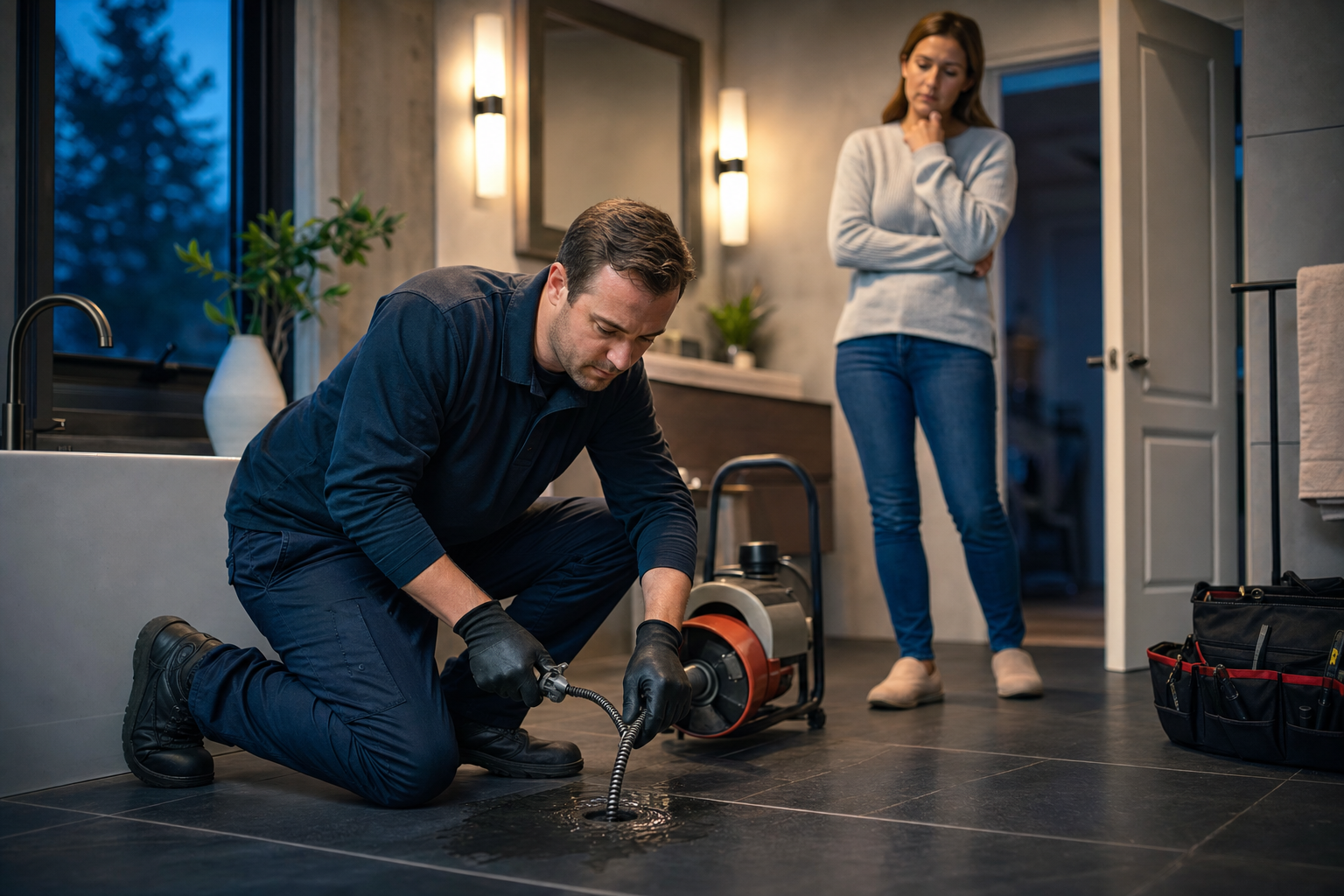
A drain snake (also called a drain auger) is a flexible metal cable with a cutting or hook tip on the end. The technician feeds it into the drain opening, works it through the pipe until it reaches the clog, and either breaks up the blockage or pulls it out. It’s a mechanical process — no harsh chemicals involved.
Typical steps during the visit:
- Assessment: The technician will look at the affected drain, ask you a few questions about the symptoms, and determine the best access point — usually the fixture drain itself, an exterior cleanout, or another access point.
- Snaking: The snake is fed into the pipe. For a secondary drain (sink, tub, toilet), this typically takes 15 to 30 minutes. For a main sewer line, it may take longer depending on the depth and severity of the clog.
- Testing: After the clog is cleared, the technician will run water through the line to confirm it’s draining properly.
- Brief walkthrough: A good technician will let you know what they found, whether they expect the issue to recur, and any observations about your drain system that you should be aware of.
Most emergency drain snaking visits are completed within about an hour from arrival to cleanup, though this can vary based on job complexity.
What to Do While You Wait for the Technician
If you’ve called for emergency drain service and a technician is on the way, here are a few things you can do in the meantime:
- Stop using water in the house. Don’t run sinks, flush toilets, or use the dishwasher or washing machine. Adding more water to a backed-up system makes the situation worse.
- Avoid direct contact with backed-up water. If sewage has come up through a drain, keep family members and pets away from the area. Do not attempt to clean it up without proper protective equipment.
- Note where your exterior cleanout is located, if you know it. It’s usually a capped white or black pipe near your foundation. Do not attempt to open it yourself — pressure behind a blocked line can cause sewage to release when the cap is removed. Let the technician handle it.
- Clear a path. If the affected drain is in a basement, utility room, or under a sink, move anything blocking access so the technician can get to work immediately.
- Have your questions ready. Use the checklist above. Asking about pricing, scope, and next steps before work begins puts you in control.
How to Avoid Overpaying for Emergency Drain Snaking
Emergency situations create pressure to act fast, and some homeowners feel like they can’t negotiate or ask questions in the moment. You can. Here are a few practical ways to protect yourself:
- Ask for the total cost upfront. A flat-rate quote before work begins is the clearest way to avoid surprises.
- Understand what the advertised price covers. A low starting price may apply to standard daytime drain cleaning, not a complex emergency main line call. Ask whether the promotion applies to your specific situation.
- Don’t agree to work you weren’t expecting. If a technician arrives to snake your drain and then recommends a more extensive service you weren’t planning on, ask for the estimate in writing and take time to decide — unless the situation is actively worsening.
- Choose a company that specializes in drains. Companies that focus specifically on drain cleaning and sewer line clearing often have more efficient workflows and clearer pricing for exactly this type of work.
Frequently Asked Questions
How much does emergency drain snaking cost in Morris County?
Costs vary depending on whether it’s a single fixture drain or a main sewer line, the severity of the blockage, and whether the call is after hours. Many companies also charge a separate emergency dispatch fee on top of the base service cost. Just Drains’ drain cleaning starts at $63 for standard service. When you call, ask for a quote specific to your situation before any work begins.
Do drain cleaning companies charge extra for after-hours emergency calls?
Most do, yes. Emergency or after-hours service often adds a surcharge above standard rates, or a flat emergency trip fee. The exact amount varies by company. Always ask about emergency pricing before a technician is dispatched.
What’s the difference between snaking a sink drain and snaking a main sewer line?
A sink drain is a smaller branch line that serves one fixture. It’s shorter, more accessible, and typically faster to clear. A main sewer line is the large primary pipe that moves all wastewater away from your home to the municipal system or septic tank. Because it runs deeper and requires more specialized access, clearing it generally takes more time and costs more than snaking a single fixture.
Do I need to pay a trip fee on top of the snaking price?
It depends on the company. Some charge a separate trip or dispatch fee, some include it in the service price, and some credit the trip fee toward the total if you go ahead with the work. Ask before the technician leaves for your home.
How long does emergency drain snaking take?
For a secondary drain like a sink or tub, many jobs are finished in 15 to 30 minutes once the technician starts. Main sewer line snaking may take longer depending on the depth and complexity of the blockage. Including arrival and assessment, many emergency visits are completed within about an hour total, though this varies.
What if snaking doesn’t clear the clog?
In some cases, a blockage is too compacted or too deep for a standard drain snake to resolve fully. When that happens, the technician will let you know what they found and discuss next steps. Additional methods or further assessment may be needed. A reputable company will be transparent about what worked, what didn’t, and what your options are — before any additional charges.
Can I try to fix the clog myself before calling?
For a simple sink or tub clog, a basic plunger is a reasonable first step. If plunging several times doesn’t move things along — or if you’re noticing backup across several fixtures, a sewage odor, or water rising out of a floor drain — it’s time to reach out to a licensed drain and sewer cleaning company. Avoid pouring chemical drain cleaners into a fully or partially blocked drain — they can sit in the pipe, damage older plumbing, and create a safety hazard for the technician who arrives to clear the line.
When You Need Fast Drain or Sewer Cleaning Help in Morris County
Dealing with a drain emergency is stressful. You shouldn’t have to spend an hour searching for pricing information or wondering if the company you’re calling actually knows how to handle your problem.
Just Drains is a licensed drain cleaning and sewer line clearing company serving Morris County and the surrounding Central New Jersey and North Jersey areas. We specialize in exactly this kind of work — clogged sinks, backed-up toilets, slow drains, sewer line blockages, and main line clogs that a plunger can’t fix.
Our drain cleaning starts at $63, and we focus on getting to you fast. When you call, we’ll give you straight answers about what the job involves and what it costs.
Call Now: (732) 279-2427